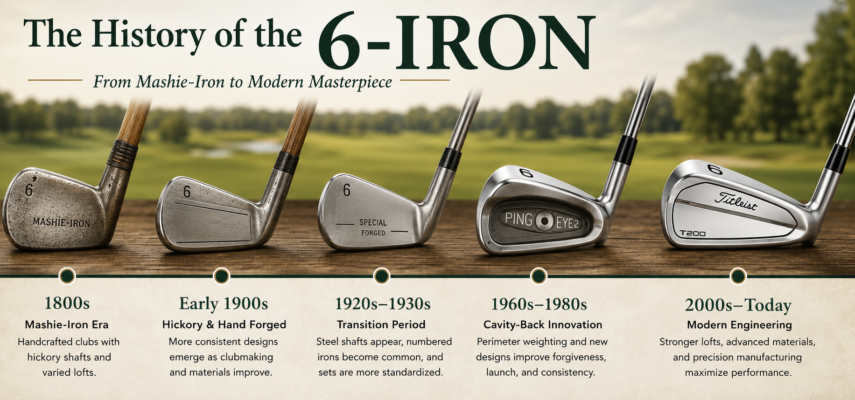
The 6-iron occupies an interesting place in the golf bag. It is not a power club in the traditional sense, nor is it designed primarily for delicate scoring shots. Instead, it sits near the center of the iron set, combining useful distance with enough loft to produce height, stopping power, and control.
For generations of golfers, that balance made the 6-iron one of the most versatile clubs available. It could be used from the fairway, from moderate rough, on long par-3s, for controlled recovery shots, and even for low-running approaches around the green.
Yet the 6-iron did not begin as a clearly defined club. Like the other numbered irons, it emerged gradually from an older world in which golf clubs had individual names, were handmade, and often varied substantially from one craftsman to another.
Its history is therefore not merely the story of a single club. It reflects golf’s broader transition from an improvised game played with specialized tools into a standardized sport supported by mass-produced equipment, engineered club sets, and modern materials.
Before the 6-Iron Had a Number
In golf’s early centuries, players did not carry matched sets labeled from 2-iron through pitching wedge. Clubs were usually known by names that described their shapes, construction, or intended purposes.
Among the best-known early iron clubs were the cleek, mid-iron, mashie, mashie-iron, spade mashie, mashie-niblick, and niblick. The precise meaning of these names was never completely fixed. A mashie made by one clubmaker might have a different loft, length, or head shape from one made elsewhere.
The club most commonly associated with the role of the modern 6-iron was the mashie-iron.
Historical equivalencies are imperfect because early clubs lacked standardized specifications, but the mashie-iron generally filled the space between the longer mid-irons and the more lofted mashies. The Golf Historical Society of Canada, for example, lists the mashie-iron as the closest hickory-era counterpart to the modern 6-iron.
That position made it a useful approach club. It offered more loft and control than the longer irons while producing considerably more distance than the short, steep-faced clubs used near the green.
The mashie-iron was not necessarily carried by every player. Golfers assembled bags according to preference, budget, course conditions, and the skill of the clubmaker. Two players might use entirely different clubs to play approximately the same shot.
The identity of the eventual 6-iron was therefore defined less by a particular design than by a recurring need: golfers wanted an iron capable of producing a moderately long, reasonably high, controllable shot.
The Rise of the Hickory-Shafted Iron
During the 19th and early 20th centuries, hickory became the preferred material for golf-club shafts. It was valued for its combination of strength, flexibility, and responsiveness, although no two hickory shafts behaved exactly alike.
Iron heads were forged individually, often by skilled blacksmiths and clubmakers. They tended to be small, thin, and unforgiving by modern standards. The sweet spot was narrow, and an off-center strike could result in a severe loss of distance.
A mashie-iron required considerable skill. The golfer had to control not only the face and path of the club but also the flex and twisting characteristics of the wooden shaft. Because lofts and lengths differed between makers, players learned the particular behavior of each club rather than relying on a universally recognized number.
The balls of the era also influenced iron design. Early feather-filled balls and later gutta-percha balls performed differently from modern multilayer golf balls. Clubmakers adjusted head shapes, grooves, lofts, and sole designs as ball construction changed.
By the early 20th century, advances in manufacturing were making clubs more consistent. Companies such as Spalding, MacGregor, Wilson, and others began producing equipment on a larger scale. Instead of purchasing isolated clubs from local makers, golfers increasingly bought coordinated sets.
That development created the conditions necessary for the modern 6-iron to emerge.
From Club Names to Club Numbers
The shift from named irons to numbered irons occurred gradually during the early decades of the 20th century.
Numbering offered a simple commercial advantage. A golfer could understand that a 5-iron sat between a 4-iron and a 6-iron, even if the clubs came from a manufacturer whose products the golfer had never used before. Retailers could stock sets more easily, manufacturers could organize product lines, and players could replace individual clubs with less confusion.
The old Scottish names did not disappear immediately. For a time, manufacturers used numbers and traditional names together. Eventually, however, the numbered system became dominant.
The mashie-iron’s general function was absorbed into the middle of the numbered set, where it became identified as the 6-iron.
Numbering did not produce complete uniformity. One company’s 6-iron could still differ from another’s in loft, shaft length, weight, and design. Nevertheless, golfers increasingly understood the 6-iron as a middle iron intended for controlled approach shots rather than as a unique handmade instrument.
This was an important change. The club was no longer defined primarily by tradition or craftsmanship. It was defined by its place within a sequence.
Steel Shafts Transform the 6-Iron
The adoption of steel shafts was one of the most important developments in the history of the golf club.
Inventors had experimented with metal shafts for years, and Arthur F. Knight patented a tubular steel golf shaft in 1910. The governing bodies initially resisted the technology, viewing steel as a departure from the accepted form of the club. The USGA later permitted steel-shafted clubs in the 1920s, while The R&A followed near the end of that decade.
Steel produced more consistent flex, weight, and performance than hickory. It was also more durable and easier to manufacture in standardized quantities.
For the 6-iron, the change was especially significant. Because the club was expected to combine distance with accuracy, consistent shaft behavior was enormously valuable. Golfers could swing more aggressively without worrying that one shaft might react very differently from another.
Steel also accelerated the development of matched iron sets. Manufacturers could establish predictable progressions in length, loft, and weight from one club to the next.
The 6-iron became a true midpoint club. It was engineered to travel farther than the 7-iron but launch higher and prove easier to control than the 5-iron. The spacing between clubs became more deliberate, helping golfers select clubs according to expected distance rather than intuition alone.
By the middle of the 20th century, the steel-shafted, numbered 6-iron had become a familiar part of the standard golf set.
The Classic Blade Era
For much of the 20th century, irons were built in what golfers now call a blade or muscle-back style.
These clubs featured compact forged heads, narrow soles, thin toplines, and relatively little weight around the perimeter. They offered skilled players excellent feedback and the ability to shape shots, but they punished poor contact.
The traditional blade 6-iron demanded precision. A center strike could produce a penetrating, controlled flight. A strike toward the toe, heel, or lower portion of the face could feel harsh and lose substantial distance.
For elite players, this sensitivity was not necessarily a disadvantage. The 6-iron became an important shot-making club because it provided enough loft to curve the ball intentionally while still generating meaningful distance.
Players could hit a high fade into a firm green, a low draw beneath the wind, a punch shot under tree branches, or a running recovery from firm turf.
This versatility helped give the 6-iron a reputation as a useful test of ball striking. It was long enough to expose swing flaws but short enough that a skilled player was expected to control it.
For many amateur golfers, however, the traditional 6-iron represented the point at which the iron set began to become difficult.
Perimeter Weighting Makes the 6-Iron More Forgiving
The development of perimeter-weighted and cavity-back irons transformed the role of the 6-iron for ordinary golfers.
Instead of concentrating most of the clubhead’s mass directly behind the center of the face, designers moved weight toward the heel, toe, and edges. This increased resistance to twisting on off-center strikes.
The result was greater forgiveness. A poorly struck shot still lost distance, but usually not as dramatically as it would with a traditional blade.
Cavity-back designs became increasingly influential during the second half of the 20th century, especially after manufacturers such as PING demonstrated that irons could be engineered as much for stability and ease of use as for appearance and feel.
The 6-iron was one of the chief beneficiaries.
Because many golfers began to struggle as they moved from short irons into the middle and long irons, added forgiveness helped preserve the 6-iron’s place in the bag. Wider soles improved turf interaction. Lower centers of gravity helped launch the ball. Larger faces made the club appear less intimidating at address.
By the 1980s and 1990s, game-improvement irons had made the 6-iron accessible to a much broader population of players.
It was no longer only a precision instrument for accomplished golfers. It became a practical advancement club for the average amateur.
The 6-Iron and the Loft Revolution
Although the number stamped on the sole has remained the same, the physical specifications of the 6-iron have changed considerably.
Traditional 6-irons often carried lofts in the low-to-mid 30-degree range. Modern players’ irons may remain relatively close to those specifications, but many game-improvement and distance-oriented sets use significantly stronger lofts.
In some modern sets, a 6-iron may have less than 27 degrees of loft. That is similar to what earlier generations might have associated with a 4-iron or 5-iron.
This trend is often described as “loft jacking,” although the engineering involved is more complex than simply reducing loft.
Modern iron heads frequently use low centers of gravity, thin flexible faces, internal weighting, hollow construction, and advanced materials. These features can help a strongly lofted club launch high enough to remain playable.
Manufacturers argue that the number on the club represents its intended position within a coordinated set, not a fixed loft that must remain constant across generations. Critics counter that stronger lofts allow companies to advertise greater distance while obscuring meaningful comparisons.
Both perspectives contain some truth.
A modern 6-iron can be longer, more forgiving, and easier to launch than an older club with the same loft. At the same time, golfers comparing distances must recognize that two clubs labeled “6” may have dramatically different specifications.
The modern 6-iron is therefore not one universal design. It is a category that may include a traditional forged iron, a large cavity-back club, a hollow-bodied distance iron, or a hybrid-like super-game-improvement model.
Graphite, Multi-Material Heads, and Modern Engineering
Steel remains common in iron shafts, but graphite has become increasingly important.
Early graphite shafts were often associated with lighter weight and additional clubhead speed. Modern graphite designs can now be produced in a wide variety of weights, flex profiles, and stability levels, making them suitable for seniors, beginners, high-speed players, and professionals.
Graphite may also reduce the vibration transmitted through the hands, which can benefit golfers with joint discomfort.
Clubheads have become equally sophisticated. A modern 6-iron may contain tungsten weights, polymer inserts, multiple grades of steel, forged faces, cast bodies, or internal structures designed to manage sound and vibration.
Computer modeling allows engineers to reposition the center of gravity, control face flex, increase moment of inertia, and influence launch characteristics with far greater precision than early clubmakers could have imagined.
Despite this complexity, the underlying purpose of the club remains recognizable. The 6-iron is still intended to provide a blend of usable distance and directional control.
Is the 6-Iron Becoming Obsolete?
The rise of hybrids has placed pressure on the longer end of the traditional iron set.
Many golfers have already replaced their 3-, 4-, and 5-irons with hybrids, high-lofted fairway woods, or utility clubs. For slower-swinging players, even the 6-iron may now be difficult to launch consistently.
As a result, some modern sets begin at the 6-iron or 7-iron. Other golfers replace the 6-iron with a 6-hybrid, which generally offers a larger head, lower center of gravity, and more help launching the ball from imperfect lies.
That does not mean the 6-iron is disappearing.
For players who generate sufficient speed, the club remains highly useful. It typically offers a more compact shape, flatter trajectory, and greater ability to control spin and curvature than a comparable hybrid.
The choice often depends on the golfer rather than the number on the club.
A skilled or faster-swinging player may see the 6-iron as a reliable approach club. A slower-swinging player may experience better results with a hybrid. Modern equipment fitting increasingly recognizes that the traditional sequence of irons does not suit everyone.
The 6-iron’s future may therefore involve greater specialization. It will remain an iron for players who value control, while others will use alternative designs to achieve the same distance.
The Club in the Middle
The 6-iron has rarely been the most celebrated club in golf.
Drivers attract attention because of their power. Wedges are associated with creativity and scoring. Putters determine the final outcome of every completed hole.
The 6-iron is quieter. Its importance comes from its balance.
It emerged from the mashie-iron tradition, gained a numerical identity as golf equipment became standardized, benefited from the transition from hickory to steel, and became easier to use through perimeter weighting and modern materials.
Along the way, it served as one of golf’s great all-purpose clubs.
It was long enough to challenge the player, lofted enough to attack a green, and versatile enough to escape trouble. It marked the transition between the demanding long irons and the more controllable scoring clubs.
That position has changed as lofts have strengthened and hybrids have spread, but the essential idea behind the 6-iron has survived.
For more than a century, golfers have needed a club that sits between power and precision. Whatever its loft, construction, or shaft material, the 6-iron has continued to fill that role.
It is the club in the middle—and its history is the story of how golf learned to make the difficult approach shot more predictable.