The putter is the quietest club in the golf bag.
It does not produce the speed of a driver, the towering flight of a long iron, or the dramatic spin of a wedge. Its motion is comparatively small, its loft is minimal, and its purpose appears straightforward: roll the ball across the green and into the hole.
Yet no golf club has inspired more experimentation, superstition, attachment, or anxiety.
Golfers routinely replace drivers in search of additional distance, but they form relationships with putters. A favored model may remain in a player’s bag for decades. Others are abandoned after a single bad round. Professionals have won major championships with putters that became almost as famous as the players themselves.
The putter’s history is therefore more than a story of changing clubhead shapes. It is the story of golf’s search for precision—and of the psychological battle that begins when every other shot has already been played.
Before There Was a Putter
Golf’s earliest clubs were not organized into the standardized categories familiar today. Players carried wooden-headed clubs for longer shots and iron-headed clubs for situations requiring greater accuracy or a different trajectory.
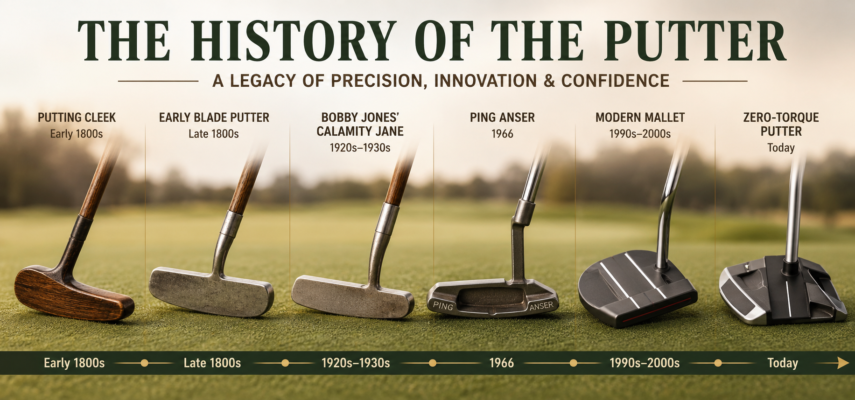
The club used near the hole was generally known as a putting cleek.
A cleek was an early iron club with a narrow blade, somewhat resembling a modern long iron. Putting cleeks were usually smaller, straighter-faced versions designed to strike the ball along the ground. Because early golf courses did not have the smooth, carefully maintained greens of the modern game, putting was often less about producing a perfect roll than navigating rough, inconsistent turf.
Some early golfers also putted with wooden-headed clubs. In the earliest eras of the game, putters commonly had wooden heads, while metal examples remained relatively uncommon until the middle of the 19th century.
These clubs were handmade and highly individual. There was no universally accepted head shape, shaft position, length, or weight. The best design was simply the one that allowed a particular golfer to move the ball reliably toward the hole.
That individualism would remain central to putter design for centuries.
The Rise of the Dedicated Putting Club
As golf expanded during the 19th century, equipment became more specialized. Clubmakers began producing clubs intended specifically for putting rather than modified versions of general-purpose cleeks.
These early putters usually had compact iron heads and relatively simple blade shapes. Hickory was the dominant shaft material, and the heads were often forged by hand. Compared with modern putters, they offered little help with alignment or off-center strikes.
They also had more loft than many contemporary designs.
Greens were slower, bumpier, and less uniform. A golfer sometimes needed to lift the ball slightly at impact so it could begin moving over imperfections in the turf. Putting was therefore closer to a gentle striking action than the smooth rolling motion expected on today’s finely maintained surfaces.
As greenkeeping improved, putter design changed with it. The ball no longer needed to be launched as aggressively. Faces became more upright, loft decreased, and designers began concentrating on balance, directional control, and feel.
By the end of the 19th century, the putter was clearly established as its own category of golf club.
The Schenectady Putter Challenges Tradition
One of the first major putter controversies emerged at the beginning of the 20th century.
In 1902, Arthur F. Knight, an engineer associated with General Electric, developed an aluminum putter at Mohawk Golf Club in Schenectady, New York. Unlike the conventional heel-shafted blades of the period, Knight’s design featured a mallet-like head and a shaft positioned closer to its center.
The club eventually became known as the Schenectady putter.
Walter Travis, one of the leading amateur golfers of his generation, began using the design and reportedly described it as the best putter he had ever played. He used a Schenectady to win the 1903 U.S. Amateur and the 1904 British Amateur, becoming the first American to capture the latter championship.
Its success provoked debate. Traditionalists disliked the unconventional appearance and believed center-shafted, mallet-headed clubs departed too far from the accepted form of a golf club.
In 1910, The Royal and Ancient Golf Club issued a ruling that prohibited certain center-shafted, mallet-headed designs, including the Schenectady. The United States Golf Association did not completely follow the R&A’s interpretation, creating an unusual difference between British and American equipment rules. The R&A restriction on center-shafted putters was eventually removed in 1951.
The episode established a pattern that continues in golf equipment debates today. Whenever a putter appears unusually effective—or simply unusually different—questions arise about whether the design represents legitimate innovation or an unfair technological shortcut.
Bobby Jones and Calamity Jane
During the 1920s and early 1930s, perhaps the most celebrated putter in golf belonged to Bobby Jones.
Jones called it Calamity Jane.
The club was a relatively simple blade putter, reportedly modeled after a design made by Scottish clubmaker George Low. Its head was small, its shaft was hickory, and it lacked the elaborate alignment systems or perimeter weighting of later putters.
What made it famous was Jones.
Jones used versions of Calamity Jane during the period in which he became the dominant amateur golfer of his era. In 1930, he completed his celebrated Grand Slam by winning the U.S. Open, British Open, U.S. Amateur, and British Amateur in the same year.
The relationship between Jones and his putter helped establish the idea that a great player’s putter could become an object of legend. The club was no longer merely equipment. It was a companion, a source of confidence, and part of the golfer’s public identity.
That idea would later surround putters used by players such as Jack Nicklaus, Ben Crenshaw, Seve Ballesteros, and Tiger Woods.
Steel Shafts and More Consistent Manufacturing
The transition from hickory to steel shafts during the early 20th century transformed every part of the golf bag, including the putter.
Steel shafts were more uniform than hickory. They reduced the variation from one club to another and allowed manufacturers to produce putters with more predictable weight, flex, and balance.
At the same time, improvements in casting and machining made it possible to reproduce successful head designs in larger quantities. Putters increasingly became branded products rather than one-off creations made by individual craftsmen.
Blade putters remained dominant. Many featured narrow heads, heel-mounted shafts, and modest amounts of offset. Designs varied, but the basic silhouette remained recognizable: a compact metal blade intended to provide the golfer with direct feedback at impact.
Among the most enduring forms was the heel-shafted blade later represented by models such as the Wilson 8802. Putters of this type rewarded precise contact and suited players who preferred to feel the head opening and closing during an arcing stroke.
They were elegant, simple—and relatively unforgiving.
Karsten Solheim and the PING Revolution
The most important breakthrough in modern putter design arrived through an engineer rather than a traditional clubmaker.
Karsten Solheim began experimenting with putters in the late 1950s. Frustrated by his own putting, he applied engineering principles to the problem. One of his early creations produced a distinctive metallic sound when it struck the ball, inspiring the name PING.
Solheim’s defining contribution was the use of heel-toe weighting.
Instead of concentrating most of the clubhead’s mass near the center, he distributed more weight toward the heel and toe. This increased the head’s resistance to twisting when the ball was struck away from the sweet spot. In modern terminology, it raised the putter’s moment of inertia.
The result was greater forgiveness.
Solheim introduced the PING Anser in 1966. The design combined heel-toe weighting with a cavity-back construction, an offset hosel, a clean topline, and proportions that made the club easy to aim. Solheim reportedly developed the name after deciding he needed an “answer” to the putters then dominating professional golf; the word was shortened to “Anser” so it would fit on the back of the club.
The Anser’s patent application was filed in May 1966, and the design patent was issued in March 1967.
Its influence is difficult to overstate. Countless putters produced since the 1960s have used the same basic architecture. The familiar rectangular blade with a rear cavity, heel-toe weighting, plumber’s-neck hosel, and moderate offset is often described simply as an “Anser-style” putter.
Solheim had created more than a successful product. He had established the dominant template for the modern blade.
Mallets Return
Although blade putters remained popular, mallet designs never disappeared.
A mallet putter typically has a larger head extending farther behind the face. The additional size gives designers more freedom to redistribute weight, increase stability, and incorporate visible alignment features.
Early mallets could appear awkward compared with traditional blades. Over time, however, improvements in materials allowed manufacturers to create larger heads without making them excessively heavy.
Aluminum, stainless steel, polymers, tungsten, and other materials could be combined to place weight precisely where designers wanted it. Mass could be pushed toward the perimeter and rear of the head, making the putter more resistant to rotation during an off-center strike.
The distinction between blade and mallet gradually became less absolute. Mid-mallets combined compact proportions with increased stability, while wide-body blades attempted to preserve a traditional appearance while offering some of a mallet’s forgiveness.
The putter was becoming an exercise in weight distribution rather than merely head shape.
Face Inserts and the Search for Feel
For much of golf history, a putter’s face and body were made from the same material. The ball struck steel, bronze, aluminum, or another metal surface directly.
Late in the 20th century, manufacturers increasingly began adding separate face inserts.
These inserts could be made from polymers, elastomers, aluminum, or other materials. Their purpose varied. Some softened the sensation of impact. Others changed the sound produced by contact, affected initial ball speed, or introduced grooves intended to encourage a more consistent roll.
The rise of softer-covered golf balls also influenced putter development. Designers had to consider how the putter face interacted with different ball constructions, speeds, and acoustic properties.
“Feel” became one of the industry’s most important—and subjective—selling points.
To one golfer, a soft face felt responsive and controlled. To another, it felt muted. Some preferred the crisp feedback of milled steel. Others performed better with the quieter sensation of an insert.
Unlike distance clubs, where launch-monitor data can clearly demonstrate changes in speed or trajectory, putter preference remains deeply personal. Sound, appearance, balance, and confidence can be as important as measurable performance.
Precision Milling and the Premium Putter
Another important movement was the rise of precision-milled putters.
Rather than being cast into a mold, a milled putter can be cut from a solid block of metal using computer-controlled machinery. Milling allows extremely tight tolerances and creates distinctive patterns on the face.
Designers such as Scotty Cameron helped transform the milled putter into a premium product during the 1990s. These clubs combined engineering with craftsmanship, polished finishes, limited production runs, and strong associations with professional golf.
Tiger Woods’ longtime Scotty Cameron Newport 2 became one of the most famous examples. Woods first put the putter into tournament play in 1999 and used it for 14 of his 15 major-championship victories.
The club’s basic shape was clearly descended from the PING Anser. Yet its association with Woods elevated it beyond design lineage. Like Calamity Jane before it, the putter became inseparable from the player.
Premium putters also created a collector culture. Special editions, tour prototypes, rare finishes, and historically important models began commanding prices far beyond their original retail cost.
Anchoring, Long Putters, and Rule Changes
Putter design has also been shaped by changes in technique.
Some golfers began using longer putters that could be stabilized against the body. Belly putters were commonly anchored near the abdomen, while broomstick putters could be held against the chest.
Supporters argued that these methods helped reduce unwanted wrist movement and made the stroke more repeatable. Critics believed anchoring removed too much of the challenge traditionally associated with putting.
Golf’s governing bodies eventually prohibited the act of anchoring the club directly against the body. The rule, which took effect in 2016, did not ban long putters themselves. Players could still use them, provided the club and gripping hand were not intentionally anchored to create a fixed pivot point.
The distinction demonstrated the difficulty of regulating putting equipment. A putter can vary dramatically in length, shaft position, head shape, grip size, and balance while still remaining legal.
The question is often not what the club looks like, but how it is used.
The High-MOI and Zero-Torque Era
Modern putter development increasingly focuses on controlling rotation.
High-MOI mallets place substantial weight around the perimeter of the head. Their purpose is to preserve ball speed and face direction when contact occurs away from the center.
More recently, low-torque and zero-torque putters have attracted attention. These designs attempt to align the shaft more closely with the head’s center of gravity so the putter has less tendency to twist open or closed during the stroke.
The underlying objective is familiar. Designers are still trying to solve the same problem that inspired Arthur Knight’s Schenectady and Karsten Solheim’s Anser: how to make the clubface return to the ball more consistently.
Professional golf has increasingly embraced larger, more stable designs. Mallets and other high-MOI configurations have become common even among players who spent much of their careers using traditional blades.
Nevertheless, the blade has not vanished. Its compact appearance, feedback, and historical associations continue to appeal to golfers who value simplicity and control.
Why the Putter Is Different
Every other club is primarily designed to send the ball through the air. The putter is designed to start the ball along the ground.
That difference gives it a unique relationship with the golfer.
A driver can produce an obviously measurable improvement in clubhead speed or carry distance. A putter’s advantages are often subtler. A different alignment line may improve aim. A heavier head may smooth tempo. A larger grip may quiet the hands. A new balance point may make the face feel easier to control.
But none of those improvements matters unless the golfer believes in the club.
Putting operates at the intersection of physics and confidence. The stroke is short enough that conscious thought can interfere with it. The target is visible, the result is immediate, and even a technically excellent stroke can fail because of an imperfect read or an unexpected deviation in the surface.
That is why golfers change putters so frequently—and why they sometimes return to an old favorite years after abandoning it.
The Putter’s Enduring Legacy
The putter has evolved from crude wooden heads and narrow putting cleeks into one of the most technologically diverse pieces of equipment in golf.
Its history includes hand-forged blades, aluminum mallets, hickory shafts, steel shafts, face inserts, precision milling, heel-toe weighting, adjustable components, high-MOI heads, and torque-resistant designs.
Yet its essential purpose has never changed.
The putter must deliver the face squarely, start the ball on the intended line, and produce the correct speed. Everything else—shape, material, balance, sound, grip, alignment system, and price—is an attempt to help the golfer accomplish those three tasks more consistently.
The putter may be the simplest club in the bag, but it is also the most personal. It reflects not only how a golfer moves, but how a golfer sees, feels, and thinks.
A driver may determine how spectacularly a hole begins.
The putter determines how it ends.