










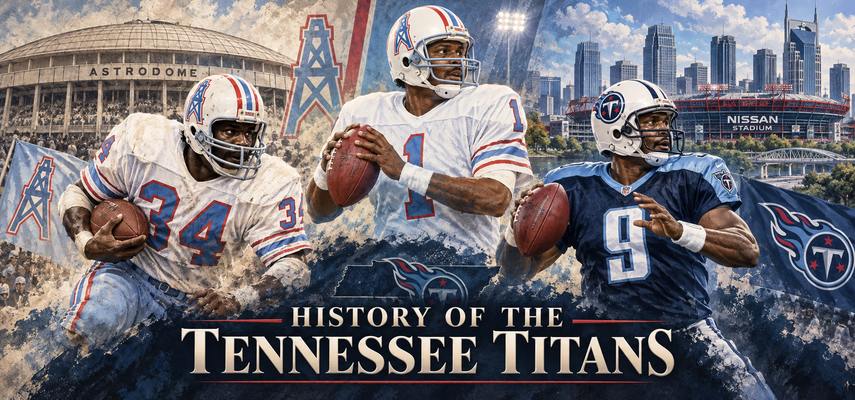

The Tennessee Titans’ history begins with the Houston Oilers and continues through relocation, a new name and a dramatic near miss in the Super Bowl. Early AFL championships, Earl Campbell’s powerful running and Warren Moon’s passing established distinct Houston eras. Steve McNair, Eddie George and later Derrick Henry helped shape the Tennessee chapter. Those teams share one continuous franchise record, even as their cities and identities changed. This account follows the Oilers and Titans through the completed 2025 season, keeping their AFL titles separate from later AFC honors and distinguishing finished results from the ongoing 2026 campaign.
Franchise at a glance
| Field | Details |
|---|---|
| Founded | August 14, 1959; AFL franchise awarded |
| First season | 1960, American Football League |
| Original city and name | Houston, Texas — Houston Oilers |
| Current city and name | Tennessee Titans; Nashville, Tennessee |
| Previous cities and names | Houston Oilers, 1960–1996; Tennessee Oilers, 1997–1998; Titans from 1999 |
| League and conference/division | NFL — American Football Conference South; AFL before the 1970 merger |
| Home venue | Nissan Stadium; current outdoor venue opened in 1999 |
| League championships | 2 AFL championships: 1960, 1961; 0 Super Bowl victories |
| Other recognized championships | 1 AFC championship: 1999; AFL titles are separate league honors |
| Historical coverage | 2025 NFL season, including postseason completed in February 2026; later developments through October 16, 2026 |
Origins and early years
Bud Adams helped establish the American Football League and secured its Houston franchise in 1959. The Oilers began play in 1960, giving the new league a team in one of the country’s growing cities. Their earliest seasons combined experienced professional players with talented newcomers, and their success helped give the AFL credibility while it competed with the NFL for players, supporters and television attention.
Quarterback George Blanda became a central figure, with Billy Cannon and Charlie Hennigan among the offense’s prominent players. Lou Rymkus coached the first championship team. The organization’s early identity developed in Houston, first at Jeppesen Stadium and later at Rice Stadium before the move indoors to the Astrodome. That beginning remains part of the Titans’ official history. The Houston Texans, who began in 2002 after the Oilers had left, are a different franchise. The later Tennessee Oilers and Titans names therefore mark stages of this same organization rather than newly created teams with separate championship or statistical records.
Defining eras
1960–1962: The Oilers win the AFL’s first championships
Houston immediately became one of the AFL’s strongest clubs. Blanda’s passing and kicking, Cannon’s versatility and Hennigan’s receiving helped the Oilers compete with an expansive offensive style. In the inaugural championship game, Houston defeated the Los Angeles Chargers 24–16. The victory gave Adams’ organization the new league’s first title and established an early identity well before its later move to Tennessee.
The Oilers repeated in 1961, beating the Chargers, who had moved to San Diego, 10–3. Wally Lemm coached the team after replacing Rymkus during that season. Houston returned to the championship game in 1962 but lost to the Dallas Texans in double overtime. That opponent later became the Kansas City Chiefs and should not be confused with the modern Houston Texans. The three consecutive finals made the Oilers an important part of the AFL’s opening years. Their two victories remain official league championships, separate from the Super Bowl competition that developed later.
1963–1980: The Astrodome and Luv Ya Blue
The Oilers could not sustain their initial dominance through the rest of the AFL period. Changes in coaching and personnel produced uneven results, and the franchise joined the NFL’s AFC when the merger took effect in 1970. The Astrodome gave Houston a distinctive indoor home, while the organization searched for another competitive identity. That identity became closely associated with Bum Phillips and a powerful running game.
Earl Campbell arrived in 1978 and immediately supplied an exceptional combination of strength and acceleration. Phillips’ teams generated intense local enthusiasm, remembered through the Luv Ya Blue expression and the close connection between the coach, players and supporters. Houston reached the AFC Championship Game after both the 1978 and 1979 seasons, losing to Pittsburgh each time. Those runs did not produce another league title, but they became enduring parts of the franchise’s cultural history. The emotional attachment to that group remained strong even after the roster and coaching leadership changed.
1981–1993: Moon and a prolific passing era
Warren Moon joined Houston in 1984 after establishing himself in Canadian football. His passing eventually became the center of a high-scoring offense, supported by an accomplished line that included Bruce Matthews. The organization moved toward the run-and-shoot system and a deep receiving group, producing a striking contrast with the Campbell-era emphasis on power running. Regular playoff appearances restored the Oilers’ standing as a contender.
The postseason results did not match the offense’s promise. The most painful defeat came after the 1992 season, when Buffalo recovered from a 35–3 deficit to win 41–38 in overtime. Houston returned with another strong regular season in 1993 but again fell short in the playoffs. Moon’s departure closed the central chapter of this passing era. The years illustrated how sustained regular-season production could coexist with unresolved championship ambitions, leaving supporters with both admiration for the talent involved and frustration at opportunities that had seemed within reach.
1994–1999: Relocation and a new Tennessee identity
Jeff Fisher took over during the 1994 season and gradually rebuilt the team around a physical approach. Steve McNair and Eddie George became foundational offensive players as the organization’s future in Houston became uncertain. The franchise moved to Tennessee in 1997, retaining the Oilers name for two seasons. It played first in Memphis and then at Vanderbilt in Nashville while its new stadium was being completed.
The Titans name arrived in 1999 along with the new Nashville home. That season produced the Music City Miracle playoff victory over Buffalo, followed by wins at Indianapolis and Jacksonville. Tennessee’s 33–14 AFC Championship Game victory over the Jaguars secured the franchise’s first Super Bowl appearance. The Titans then lost 23–16 to the St. Louis Rams in Super Bowl XXXIV, with Kevin Dyson stopped short of the goal line on the final play. The run gave the Tennessee chapter an immediate defining story: a new local identity joined to the older franchise’s continuing championship pursuit.
2000–2017: Competitive peaks and changing offensive stars
Fisher’s teams remained competitive after the Super Bowl appearance. McNair’s leadership and George’s running continued to define the offense, while a physical defense supported further playoff opportunities. McNair shared the AP NFL MVP award with Peyton Manning for the 2003 season. Later changes brought Kerry Collins at quarterback and an exceptional rushing period from Chris Johnson, whose 2009 season exceeded 2,000 yards.
The organization struggled to maintain continuity as the original Tennessee core departed. Fisher’s tenure ended after the 2010 season, and subsequent coaches worked through uneven rosters and quarterback transitions. Marcus Mariota arrived in 2015 and helped produce a memorable playoff moment following the 2017 season. Tennessee recovered from a large deficit at Kansas City to win 22–21 before New England ended its run. The victory revived postseason expectations, but the team still needed another coaching direction to turn its physical strengths into a more durable contender.
2018–2025: Henry’s peak and another rebuilding cycle
Mike Vrabel became head coach in 2018 and built a contender around defense, situational toughness and Derrick Henry’s extraordinary running. Ryan Tannehill’s emergence at quarterback helped unlock the offense in 2019. Tennessee won playoff games at New England and Baltimore before losing the AFC Championship Game at Kansas City. The run returned the Titans to the conference’s final stage without producing another conference title.
Henry exceeded 2,000 rushing yards in 2020 and earned AP Offensive Player of the Year honors. The Titans secured the AFC’s top playoff seed the following season, but Cincinnati ended their postseason immediately. Decline and personnel changes followed. Vrabel departed after 2023, Henry moved to Baltimore and Brian Callahan’s coaching period did not restore sustained success. Tennessee selected quarterback Cam Ward first overall in 2025 but finished 3–14. Another coaching transition followed, leaving the team to pursue a new competitive foundation after several very different eras of offensive star power.
Recent history
Tennessee finished the 2025 regular season 3–14 and missed the playoffs. Callahan’s tenure ended during that campaign, with Mike McCoy handling the interim role. Ward’s rookie season belonged to a rebuilding team rather than an established contender. In January 2026, the Titans hired Robert Saleh as head coach, beginning a new coaching partnership with general manager Mike Borgonzi.
As of October 16, 2026, the new season remained in progress. The current outdoor Nissan Stadium was still the home venue. A separate enclosed stadium project, also carrying the Nissan name, was planned for a 2027 opening; it should not be described as an already occupied home. The completed franchise honors remained two AFL championships and the 1999 AFC title, with no Super Bowl victory. Those records include the Houston Oilers years and the two Tennessee Oilers seasons, preserving the organization’s continuous history across its relocation and renaming.
Greatest players and influential figures
Earl Campbell
Campbell’s power and acceleration gave Houston’s late-1970s teams their defining offensive force. His running helped carry the Oilers to consecutive AFC Championship Games and made him central to the Luv Ya Blue period. His No. 34 remains an important tribute within the franchise’s continuing Oilers–Titans history.
Warren Moon
Moon transformed Houston’s offense after an accomplished Canadian football career. His passing supported repeated playoff appearances and a markedly different identity from the Campbell teams. His Hall of Fame career crossed leagues and teams, but his Oilers years supplied the central NFL chapter of that wider professional achievement.
Bruce Matthews
Matthews supplied exceptional durability and versatility across the offensive line. His service connected the Moon-era Oilers with the franchise’s move to Tennessee and its Super Bowl team. He could contribute at several positions without losing his high standard, making him a foundational player across changing offensive systems.
Steve McNair
McNair’s toughness, mobility and leadership helped establish the Titans’ Tennessee identity. He quarterbacked the team’s Super Bowl XXXIV run and shared the AP NFL MVP award for the 2003 season. His partnership with George gave the offense a recognizable personality during the franchise’s strongest early Nashville years.
Eddie George
George provided a dependable, physical running presence as the franchise moved from Houston to Tennessee. His ability to carry a demanding workload complemented McNair and Fisher’s overall approach. The organization retired his No. 27, recognizing a player whose service helped connect relocation with immediate local credibility.
Derrick Henry
Henry’s combination of size and open-field speed made him one of the franchise’s most distinctive runners. His performances helped drive the 2019 playoff run, and his 2020 season exceeded 2,000 yards. His subsequent Baltimore career is separate from the rushing achievements and postseason moments he produced for Tennessee.
Jeff Fisher
Fisher guided the football operation through relocation and coached the Titans to their only Super Bowl appearance. His long tenure supplied continuity while cities, venues and the team name changed. The physical style associated with his teams helped establish a lasting Tennessee identity beyond the immediate excitement of a new stadium.
Bud Adams
Adams helped found the AFL and launched the Houston Oilers, whose early championships strengthened the new league. His ownership also encompassed the difficult move to Tennessee and the Titans rebranding. His legacy includes both establishing the franchise and making decisions that changed its relationship with two different communities.
Championships and postseason milestones
The Oilers won the AFL championship in 1960 and 1961. Tennessee later won the AFC in 1999 but lost the Super Bowl. These are distinct competitions: the early league titles are not AFC championships, and the later conference title is not a Super Bowl victory. All rows use the season year.
On smaller screens, scroll horizontally to see all columns.
| Season/year | Competition | Opponent | Result | Defining figure(s) |
|---|---|---|---|---|
| 1960 | AFL Championship | Los Angeles Chargers | Won 24–16 | George Blanda; Billy Cannon; Lou Rymkus |
| 1961 | AFL Championship | San Diego Chargers | Won 10–3 | George Blanda; Wally Lemm |
| 1999 | AFC Championship | Jacksonville Jaguars | Won 33–14 | Steve McNair; Eddie George; Jeff Fisher |
| 1999 | Super Bowl XXXIV | St. Louis Rams | Lost 16–23 | Steve McNair; Kevin Dyson; Jeff Fisher |
Rivalries, venues and team identity
Rivalries
Pittsburgh defined the most important postseason obstacle for the Luv Ya Blue teams. The modern AFC South schedule creates regular rivalries with Indianapolis, Jacksonville and Houston. The Texans matchup carries the additional memory of the Oilers’ former home, while the Jaguars rivalry includes Tennessee’s decisive role in ending Jacksonville’s outstanding 1999 season.
Home venues and traditions
The franchise played at Jeppesen Stadium, Rice Stadium and the Astrodome before moving to Tennessee. Memphis and Vanderbilt served as temporary homes before Nashville’s current stadium opened in 1999. Oilers blue and the derrick remain historical symbols, while the Titans name, flame imagery and Nashville traditions express the later chapter.
Retired numbers and team honors
Retired numbers preserve both cities’ history, including Moon’s No. 1, McNair’s No. 9, George’s No. 27 and Campbell’s No. 34. Matthews’ No. 74 also recognizes his service across the relocation. These honors belong to one continuous franchise, rather than dividing the Houston and Tennessee players into unrelated statistical organizations.
Legacy
The Titans’ story cannot be told fully without the Oilers. Two AFL titles, Houston’s great running and passing eras, relocation and Nashville’s Super Bowl near miss all belong to the same organization. Its strongest teams have often relied on unusually influential individual players while searching for the final combination needed to win again. The Tennessee identity is now firmly established, but the historical record remains broader than one city or name. Future success will add to that record rather than replace the complicated journey that created it.
Where to eat in Nashville
Planning a visit? Explore our best restaurants in Nashville guide.












