










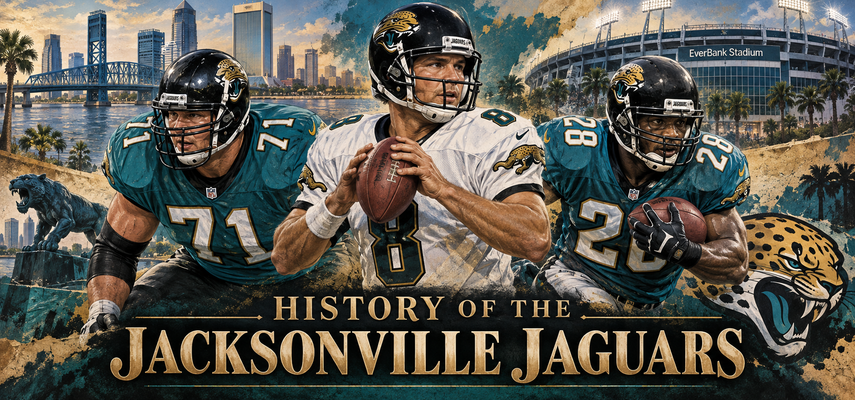

The Jacksonville Jaguars reached the edge of the Super Bowl remarkably quickly, then spent much of their history trying to recover that early momentum. Tom Coughlin’s expansion teams established a demanding identity around players such as Tony Boselli, Mark Brunell and Fred Taylor. Later contenders brought different defensive stars and another generation of quarterbacks, but sustained success proved difficult to maintain. Jacksonville’s story also reflects the determination of a smaller NFL market to retain its place in the league. This account follows the franchise through the completed 2025 season, with subsequent developments distinguished from the ongoing 2026 campaign.
Franchise at a glance
| Field | Details |
|---|---|
| Founded | November 30, 1993; NFL expansion franchise awarded |
| First season | 1995, National Football League |
| Original city and name | Jacksonville, Florida — Jacksonville Jaguars |
| Current city and name | Jacksonville Jaguars; Jacksonville, Florida |
| Previous cities and names | None; temporary venues do not establish a new franchise |
| League and conference/division | NFL — American Football Conference South |
| Home venue | EverBank Stadium; opened in 1995, undergoing renovation |
| League championships | 0 Super Bowl victories |
| Other recognized championships | 0 AFC championships; conference-final appearances in 1996, 1999 and 2017 |
| Historical coverage | 2025 NFL season, including postseason completed in February 2026; later developments through October 16, 2026 |
Origins and early years
Jacksonville’s successful expansion bid followed years of local work to demonstrate that the city could support an NFL franchise. Wayne Weaver’s ownership group secured the team in November 1993, joining Carolina in the league’s next expansion class. The Jaguars began regular-season play in 1995. Their new stadium rose on the site associated with the Gator Bowl, giving the organization an established football location while creating a home suited to its professional ambitions.
Tom Coughlin became the first head coach and directed the construction of the football operation. The first draft selection, offensive tackle Tony Boselli, supplied a durable building block. A trade brought quarterback Mark Brunell from Green Bay, while receivers including Jimmy Smith and Keenan McCardell helped develop the passing game. The opening season brought the expected difficulties of assembling a roster, but the franchise did not remain an expansion outsider for long. Its immediate rise would become a demanding reference point for every later rebuilding effort, making early success both an achievement and a lasting source of expectation.
Defining eras
1995–1996: Expansion becomes immediate contention
The first Jaguars team won four regular-season games, establishing a starting point without suggesting that a conference championship appearance was imminent. Coughlin demanded discipline and careful preparation as the roster developed around Brunell, Boselli and an improving receiving group. Jacksonville’s challenge was to make a newly assembled team dependable enough to compete through an entire schedule. The progress in its second season was therefore unusually rapid rather than the predictable outcome of an established contender.
The 1996 Jaguars reached the playoffs and then won road games at Buffalo and Denver, both by 30–27 scores. The Denver victory in particular changed how the young franchise was regarded nationally. New England stopped the run in the AFC Championship Game, winning 20–6. Jacksonville had reached the conference final in only its second season. The breakthrough gave the city an immediate place in postseason football and set a standard against which future teams would be judged, even though a Super Bowl appearance remained just beyond reach.
1997–1999: The first core reaches its peak
Jacksonville built on its early success with repeated playoff appearances. Fred Taylor’s arrival added an exceptional runner to an offense already supported by Brunell, Smith and a strong line. Boselli’s play at left tackle helped give the group a reliable foundation. The Jaguars became a regular contender rather than an isolated expansion surprise, and their improvement culminated in a 14–2 regular season in 1999.
That team overwhelmed Miami 62–7 in the divisional playoffs, one of the most emphatic postseason performances of the era. Tennessee then won the AFC Championship Game 33–14 in Jacksonville. All three Jaguars defeats that season came against the Titans, creating a particularly sharp end to an otherwise outstanding campaign. The loss left the franchise without a conference title despite possessing the AFC’s strongest regular-season record. It also marked the peak of the original roster’s championship opportunity. The years ahead would test whether the organization could renew its core without losing the standard it had established so quickly.
2000–2011: Rebuilding and another road playoff victory
Salary pressures, injuries and changes in personnel weakened the first contender. Boselli’s injuries shortened an exceptional career, while the organization eventually moved beyond Coughlin’s tenure. Jack Del Rio became head coach in 2003 and placed renewed emphasis on defense and physical play. Jacksonville remained capable of strong seasons, but it no longer sustained the uninterrupted playoff presence of its first successful period.
Taylor and Maurice Jones-Drew gave the running game contrasting strengths, and David Garrard became the leading quarterback. The 2007 team won a 31–29 playoff game at Pittsburgh before losing at New England. That victory showed that Jacksonville could build another credible postseason team after its original core changed. Maintaining the progress proved harder. Quarterback transitions and uneven results followed, eventually ending Del Rio’s tenure. By the close of 2011, the Jaguars faced another reset in leadership and expectations, with the organization’s early achievements increasingly distant from its week-to-week performance on the field.
2012–2017: New ownership and a defensive revival
Shad Khan’s purchase of the team became effective in 2012, beginning a different ownership chapter. Coaching changes and rebuilding seasons initially brought little sustained improvement. The franchise also developed a recurring presence in London, extending its commercial reach without changing its Jacksonville identity. Draft choices and free-agent additions gradually created a more talented roster, particularly on defense, even while results remained inconsistent.
The pieces came together in 2017 under head coach Doug Marrone, with Coughlin back in an executive football role. Calais Campbell, Jalen Ramsey and a deep defensive group made Jacksonville difficult to attack. Blake Bortles led an offense that complemented the defense well enough to win the division. Playoff victories over Buffalo and Pittsburgh brought the Jaguars to another AFC Championship Game. They led New England late before losing 24–20. The run restored national attention but again stopped one step short of the Super Bowl, creating another difficult challenge of sustaining success after a near breakthrough.
2018–2022: Another collapse and a new quarterback
The 2017 contender did not produce a lasting period of success. Injuries, personnel departures and organizational disagreements contributed to a sharp decline. Jacksonville finished the 2020 season 1–15, giving it the first overall selection in the next draft. The Jaguars chose Trevor Lawrence in 2021, hoping to establish the long-term quarterback foundation that had been missing through repeated rebuilds. Urban Meyer’s brief coaching tenure instead ended during that difficult rookie season.
Doug Pederson took over in 2022 and helped restore a more stable football environment. Lawrence improved, and Jacksonville won the AFC South. In the wild-card round, the Jaguars recovered from a 27–0 deficit to defeat the Chargers 31–30. Kansas City ended the run in the divisional playoffs. The comeback became a major moment in the team’s modern history, pairing an established coach with a young quarterback who could support another competitive cycle. It also illustrated how quickly Jacksonville’s fortunes could change when leadership and offensive development aligned.
2023–2025: Lost momentum and Coen’s rapid recovery
The following seasons did not establish the continuity Jacksonville wanted. A promising 2023 start gave way to a finish outside the playoffs, and further disappointment eventually ended Pederson’s tenure. Lawrence remained central to the organization’s plans, but the team needed another offensive direction and a more reliable structure around him. The changes again raised the question that had followed earlier Jaguars contenders: whether a breakthrough could become a durable standard.
Liam Coen became head coach for 2025 and immediately helped restore division-winning football. Jacksonville finished 13–4, securing the AFC South and a home playoff game. Buffalo won that wild-card matchup 27–24, ending an encouraging season without a deeper run. The improvement mattered because it demonstrated that a talented roster could recover quickly under new leadership. Yet the defeat also kept the franchise’s larger record unchanged. Through the completed 2025 campaign, Jacksonville still had three AFC Championship Game appearances but no conference title or Super Bowl appearance.
Recent history
The Jaguars completed the 2025 regular season 13–4 and won the AFC South. Their postseason ended with a 27–24 home loss to Buffalo in the wild-card round on January 11, 2026. Coen remained head coach for the following season, with Lawrence continuing as the central quarterback figure. The strong regular-season recovery is therefore recorded separately from the shorter postseason outcome.
As of October 16, 2026, the new campaign was underway and EverBank Stadium remained the current home with reduced capacity during renovation. The approved plan called for home games at Orlando’s Camping World Stadium in 2027 before returning to the renovated Jacksonville venue in 2028. That arrangement is temporary, not a permanent franchise relocation. The 2026 season’s final record and postseason outcome are not assigned here. Jacksonville’s completed championship record remained without an AFC title or Super Bowl victory, despite its several memorable conference-final runs.
Greatest players and influential figures
Tony Boselli
Boselli was Jacksonville’s first draft selection and gave the original contender an exceptional left tackle. His strength and technique helped protect Brunell and support the running game before injuries shortened his career. He became the franchise’s first Pro Football Hall of Fame player and had his No. 71 retired.
Fred Taylor
Taylor’s speed, vision and ability to turn ordinary openings into long gains made him a defining Jacksonville runner. He contributed to the 1999 contender and later playoff teams, connecting different stages of the franchise. His recognition in the Pride of the Jaguars reflects that sustained importance to the offense.
Jimmy Smith
Smith became a leading receiver after earlier career setbacks elsewhere. His route running and consistency gave Brunell a dependable target during Jacksonville’s rapid rise. He remained productive through changing teams and quarterbacks, becoming one of the clearest offensive connections between the expansion years and the franchise’s later development.
Mark Brunell
Brunell’s mobility and passing helped make the expansion Jaguars unexpectedly competitive. He led the offense during the early playoff runs and both conference-final appearances of the 1990s. His importance lies in giving a new franchise credible quarterback leadership while its roster, expectations and local identity were still taking shape.
Maurice Jones-Drew
Jones-Drew paired compact power with receiving and return ability, giving Jacksonville a versatile offensive threat. He first complemented Taylor and later carried a larger rushing responsibility. His productive seasons helped sustain the team’s offensive identity during a period when quarterback changes and uneven results made continuity difficult.
Calais Campbell
Campbell’s arrival strengthened the defense that carried Jacksonville to the 2017 AFC Championship Game. His size, versatility and leadership helped organize an aggressive front capable of changing games. Although much of his distinguished career occurred elsewhere, his Jaguars years supplied a major contribution to the franchise’s modern defensive identity.
Tom Coughlin
Coughlin built the original football operation and coached the Jaguars to rapid postseason relevance. His teams reached two AFC Championship Games in their first five seasons. A later executive return connected him to the 2017 contender, although his initial coaching period remains the foundation of his Jacksonville legacy.
Wayne Weaver
Weaver led the ownership group that secured the expansion franchise and oversaw its first era. His role linked the city’s campaign for an NFL team with the practical work of launching the organization. The early playoff success gave that civic effort an unusually quick return on the field.
Championships and postseason milestones
Jacksonville has not won an AFC championship or Super Bowl through the completed 2025 season. These selected milestones identify significant playoff victories and the three conference-final defeats. They are not presented as championship wins. The year attached to each game is its NFL season, including postseason games played the next January.
On smaller screens, scroll horizontally to see all columns.
| Season/year | Competition | Opponent | Result | Defining figure(s) |
|---|---|---|---|---|
| 1996 | AFC divisional playoff | Denver Broncos | Won 30–27 | Mark Brunell; Tom Coughlin |
| 1996 | AFC Championship Game | New England Patriots | Lost 6–20 | Mark Brunell; Tony Boselli |
| 1999 | AFC Championship Game | Tennessee Titans | Lost 14–33 | Mark Brunell; Fred Taylor |
| 2007 | AFC wild card | Pittsburgh Steelers | Won 31–29 | David Garrard; Maurice Jones-Drew |
| 2017 | AFC Championship Game | New England Patriots | Lost 20–24 | Calais Campbell; Doug Marrone |
| 2022 | AFC wild card | Los Angeles Chargers | Won 31–30 | Trevor Lawrence; Doug Pederson |
Rivalries, venues and team identity
Rivalries
Tennessee became a particularly meaningful opponent after the 1999 season, when the Titans handed Jacksonville all three of its defeats. Indianapolis and Houston supply the other AFC South rivalries. Repeated postseason meetings with New England also connect several otherwise separate Jaguars eras through the frustration of conference-final losses.
Home venues and traditions
Jacksonville’s stadium has carried several commercial names since opening in 1995. Teal uniforms, the jaguar imagery and the supporters’ Duval call supply a distinctive local identity. London games extend the team’s reach, while the renovation and temporary Orlando plan are intended to preserve its long-term Jacksonville home.
Retired numbers and team honors
Boselli’s No. 71 is formally retired. The Pride of the Jaguars separately recognizes contributors including Taylor, Brunell, Smith, Coughlin and Wayne and Delores Weaver. Membership in that group is not automatically a jersey retirement. Keeping those distinctions clear allows the team’s local honors to stand alongside Boselli’s separate Canton recognition.
Legacy
Jacksonville’s history is unusually rich in rapid rises followed by difficult attempts to sustain them. The original expansion contender established an ambitious standard, the 2017 defense revived it and later quarterback-led teams pursued another route. Each period added memorable players and postseason moments without completing the Super Bowl journey. The franchise also remains closely tied to its city’s determination to belong in the NFL. Its next lasting achievement will depend on turning renewed promise into continuity, building on the best of those earlier teams while avoiding another abrupt reset.
Where to eat in Jacksonville
Planning a visit? Explore our best restaurants in Jacksonville guide.











