
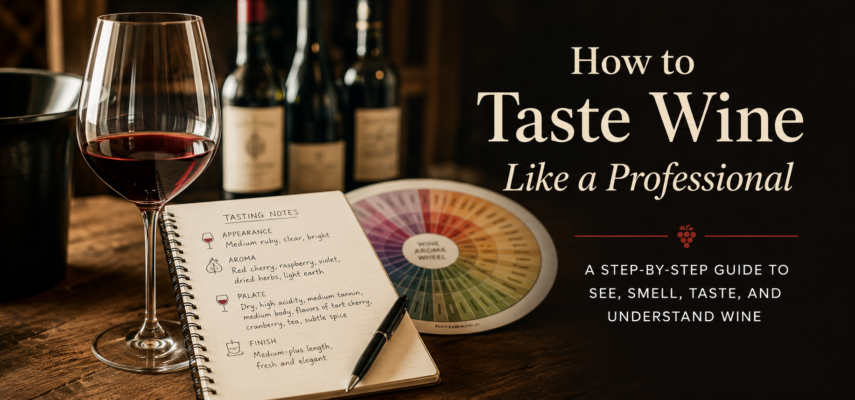
Most people drink wine. Professionals taste it.
That distinction matters.
Drinking wine is casual, emotional, and personal. You like it or you do not. Tasting wine is more deliberate. It is the process of slowing down, paying attention, and breaking a glass of wine into parts: appearance, aroma, flavor, structure, balance, and finish.
The good news is that tasting wine professionally does not require a rare palate, expensive bottles, or encyclopedic knowledge of Burgundy villages. It requires a repeatable system.
Wine professionals use structured methods because wine can be overwhelming. A single glass may smell like fruit, flowers, herbs, earth, oak, butter, smoke, spice, or something you cannot quite name. Without a framework, those impressions disappear quickly. With a framework, you begin to recognize patterns.
Professional tasting methods, including the WSET Systematic Approach to Tasting and the Court of Master Sommeliers’ deductive tasting format, both start with a similar idea: observe the wine carefully, then evaluate what it looks like, smells like, tastes like, and how all of those pieces fit together.
Tasting Wine Is a Skill, Not a Party Trick
The first thing to understand is that professionals are not simply “better” at tasting because they were born with superior senses. They are better because they taste with intention.
They compare wines. They take notes. They use consistent language. They train their memory. They learn to separate personal preference from quality.
That last point is important.
A wine can be well made even if it is not your style. You may dislike a highly acidic white wine, but that does not mean it is bad. You may love a rich, oaky red wine, but that does not automatically make it great. Professional tasting asks a different question:
Not just, “Do I like this?”
But also, “What is this wine trying to be, and how well does it succeed?”
That mindset changes everything.
Step 1: Look at the Wine
Before you smell or sip, look.
Hold the glass against a white background if possible. Tilt it slightly and observe the wine from the center to the rim. This tells you more than most beginners realize.
Start with clarity. Is the wine clear, hazy, or cloudy? Most still wines should be clear. Some natural wines may be intentionally hazy, but in general, unusual cloudiness can suggest a flaw or instability.
Next, look at color. White wines can range from pale lemon to deep gold. Rosé can move from pale salmon to deeper pink. Red wines can range from purple to ruby, garnet, or tawny.
Color can hint at age and grape variety. A young Sauvignon Blanc may look pale lemon. A mature Chardonnay may appear deeper gold. A young Cabernet Sauvignon may look deep ruby or purple. An older red wine may shift toward garnet or brick at the rim.
Then consider intensity. Is the wine pale, medium, or deep in color? A deeply colored red may suggest a thicker-skinned grape like Syrah, Malbec, or Cabernet Sauvignon. A paler red may suggest Pinot Noir, Nebbiolo, or Gamay.
You are not trying to solve the entire wine by sight alone. You are gathering clues.
Step 2: Smell Before You Swirl
Most beginners swirl immediately. Professionals often smell first.
The first smell gives you a baseline. Without swirling, the wine may show lighter, more delicate aromas. Then swirl the glass gently. Swirling increases the wine’s contact with oxygen and helps release volatile aroma compounds, making the wine easier to smell.
Now smell again.
Do not bury your nose in the glass and inhale aggressively. Use short, focused sniffs. Move the glass slightly. Some aromas show more clearly at the top of the glass; others are easier to detect deeper inside.
At first, do not worry about naming every aroma perfectly. Start broad.
Ask yourself:
Is the wine fruity? Floral? Herbal? Spicy? Earthy? Oaky? Funky? Fresh? Ripe? Savory?
Then get more specific.
If it is fruity, what kind of fruit?
For white wines, common fruit notes include lemon, lime, grapefruit, green apple, pear, peach, apricot, melon, pineapple, or tropical fruit.
For red wines, common fruit notes include cranberry, raspberry, strawberry, cherry, plum, blackberry, blueberry, blackcurrant, or fig.
Then look for non-fruit aromas.
Floral notes might include rose, violet, orange blossom, or honeysuckle. Herbal notes might include grass, mint, eucalyptus, thyme, or bell pepper. Earthy notes might include mushroom, forest floor, wet leaves, leather, or tobacco.
Oak can add aromas like vanilla, toast, cedar, baking spice, smoke, coconut, clove, or chocolate. Winemaking and aging can also create notes such as butter, cream, bread dough, nuts, dried fruit, or honey.
WSET organizes wine aromas into categories such as primary, secondary, and tertiary characteristics. Primary aromas come mainly from the grape and fermentation. Secondary aromas come from winemaking choices, such as oak use or malolactic conversion. Tertiary aromas develop with bottle age, such as dried fruit, leather, tobacco, honey, nuts, or forest floor.
This structure is useful because it prevents tasting notes from becoming random poetry. Instead of saying “this smells interesting,” you can ask: is the aroma coming from the grape, the winemaking, or age?
Step 3: Taste for Structure, Not Just Flavor
Now take a sip.
Do not judge the wine instantly. Let it move across your mouth. Professionals are not only looking for flavor. They are evaluating structure.
Structure is the physical architecture of the wine. It includes sweetness, acidity, tannin, alcohol, body, flavor intensity, and finish.
Sweetness
A wine may be dry, off-dry, medium-sweet, or sweet.
Many beginners mistake fruitiness for sweetness. A wine can smell like ripe peach or blackberry and still be completely dry. Sweetness refers to actual sugar, not fruity flavor.
One clue is where you feel it. Sweetness often registers on the tip of the tongue and gives a soft, rounded impression. Dry wines may still taste fruity, but they do not leave a sugary sensation.
Acidity
Acidity gives wine freshness, brightness, and lift.
High-acid wines make your mouth water. Think of biting into a lemon or green apple. Wines like Sauvignon Blanc, Riesling, Champagne, Chianti, and many Pinot Noirs often have noticeable acidity.
Low-acid wines feel softer, rounder, and sometimes heavier.
Acidity is one of the key reasons wine works so well with food. It cuts through richness, refreshes the palate, and keeps the wine from feeling flat.
Tannin
Tannin is mostly found in red wines, though some white and orange wines can have it too.
Tannin creates a drying, grippy, sometimes bitter sensation. You feel it on your gums, tongue, and cheeks. Strong black tea is a useful comparison.
Cabernet Sauvignon, Nebbiolo, Syrah, and young Bordeaux often have noticeable tannin. Pinot Noir and Gamay usually have less.
Tannin is not the same as dryness. A wine can be dry because it has little sugar. A wine can feel drying because it has tannin.
Alcohol
Alcohol contributes warmth, weight, and body.
A lower-alcohol wine may feel lighter and more refreshing. A higher-alcohol wine may feel fuller, richer, and warmer in the throat or chest. Too much alcohol can make a wine feel hot or unbalanced.
You do not need to guess the exact alcohol percentage. Just ask: does the alcohol feel low, medium, or high? Does it support the wine, or does it stick out?
Body
Body is the weight of the wine in your mouth.
A light-bodied wine feels closer to skim milk. A full-bodied wine feels closer to whole milk or cream. Body is influenced by alcohol, sugar, tannin, grape variety, and winemaking.
Pinot Grigio, Muscadet, and Beaujolais are often lighter-bodied. Chardonnay, Viognier, Cabernet Sauvignon, Malbec, and many warm-climate reds are often fuller-bodied.
Flavor Intensity
Flavor intensity asks how strongly the wine expresses itself.
Some wines are subtle and quiet. Others are bold and obvious. Neither is automatically better. A delicate wine can be excellent. A powerful wine can be clumsy.
The question is whether the intensity feels appropriate and complete.
Finish
The finish is what remains after you swallow or spit.
Does the flavor disappear quickly? Does it linger for several seconds? Does the finish feel pleasant, complex, bitter, hot, watery, or harmonious?
Professionals pay close attention to finish because it often separates ordinary wines from serious ones. A long, evolving finish can be a sign of quality. A short, hollow finish may suggest a simpler wine.
Step 4: Decide Whether the Wine Is Balanced
Balance is one of the most important concepts in wine tasting.
A balanced wine does not mean every element is equal. It means every element feels like it belongs.
A high-acid Riesling can be balanced if it has enough fruit, concentration, or sweetness to match the acidity. A tannic Cabernet Sauvignon can be balanced if it has enough fruit depth, body, and structure to support the tannin. A full-bodied Chardonnay can be balanced if oak, alcohol, acidity, and fruit work together rather than competing.
When a wine is out of balance, one feature dominates.
Too much alcohol feels hot. Too much oak tastes like wood rather than wine. Too much tannin feels harsh. Too little acidity feels flat. Too much sweetness without acidity feels syrupy.
A professional taster is always asking: does anything stick out in the wrong way?
Step 5: Separate Preference From Quality
This is where many casual wine drinkers get stuck.
You might say, “I do not like this wine.”
That is valid. But professional tasting asks you to go one step further.
Is it poorly made, or just not your style?
For example, you may dislike earthy, high-acid red wines. But a traditional red Burgundy may be excellent precisely because of its elegance, acidity, and earthy complexity.
You may dislike sweet wines. But a great Sauternes, Tokaji, or German Riesling can be world-class because sweetness is balanced by acidity, concentration, and complexity.
You may dislike tannic wines. But a young Barolo or Napa Cabernet may be built for aging, not immediate softness.
Preference is personal. Quality is analytical.
The more you taste, the better you get at respecting both.
What Professionals Look For in Quality
Wine quality usually comes down to a few core questions.
First, is the wine balanced?
Second, does it have concentration? In other words, does it have depth of flavor, or does it feel thin?
Third, does it have complexity? Are there multiple layers of aroma and flavor, or is it one-dimensional?
Fourth, does it have length? Does the finish last?
Fifth, does it express its grape, place, or style clearly?
A simple wine can still be enjoyable. Not every bottle needs to be profound. But serious wines usually offer more than fruit and alcohol. They have shape, persistence, and a sense of completeness.
How to Write a Useful Tasting Note
A good tasting note does not need to sound dramatic.
In fact, the best notes are usually clear and structured.
Use this format:
Appearance: color and intensity
Nose: aroma intensity and main aromas
Palate: sweetness, acidity, tannin, alcohol, body, flavors, finish
Conclusion: quality, style, and personal impression
For example:
“Medium ruby color. Medium-plus aromas of red cherry, raspberry, rose, dried herbs, and light earth. Dry palate with high acidity, medium tannin, medium alcohol, and medium body. Flavors of tart cherry, cranberry, tea, and subtle spice. Medium-plus finish. Elegant, fresh, and well balanced.”
That note is not trying to impress anyone. It is trying to capture the wine accurately.
The more notes you write, the faster your palate improves.
Common Beginner Mistakes
The first mistake is tasting too quickly. Many wines change in the glass. The first sip is not always the full story. Give the wine a few minutes and return to it.
The second mistake is only looking for flavors. Flavor matters, but structure matters more. Acidity, tannin, alcohol, body, and finish tell you what kind of wine you are dealing with.
The third mistake is confusing expensive with good. Price can reflect scarcity, reputation, region, labor, oak, marketing, or demand. It does not guarantee that you will enjoy the wine.
The fourth mistake is using vague words. “Smooth” is not wrong, but it is limited. What makes it smooth? Low tannin? Low acidity? Soft fruit? Higher alcohol? A creamy texture?
The fifth mistake is forcing descriptors. If you smell cherry, say cherry. If you do not smell “crushed violets on a wet stone patio,” do not write it.
Professional tasting is not about exaggeration. It is about precision.
How to Train Your Palate
The best way to improve is to taste comparatively.
Try two wines side by side. Compare Sauvignon Blanc and Chardonnay. Pinot Noir and Cabernet Sauvignon. Old World and New World styles. Oaked and unoaked Chardonnay. Young red wine and aged red wine.
Side-by-side tasting makes differences obvious.
You can also smell ingredients outside of wine. Smell lemons, limes, apples, peaches, blackberries, herbs, pepper, vanilla, tobacco, tea, mushrooms, honey, and spices. Aroma memory is built through repetition.
UC Davis’s wine sensory education emphasizes the study of appearance, aroma, flavor, and descriptive language as central parts of developing tasting ability.
Another useful exercise is blind tasting, even casually. Cover the bottle and guess the grape, region, climate, or style. You will be wrong often. That is the point. Blind tasting teaches humility and pattern recognition.
Ask why you guessed wrong. Was the acidity higher than expected? Was the fruit riper? Did oak mislead you? Was the wine older than you thought?
Every mistake becomes data.
Should You Spit Wine?
If you are tasting several wines, yes.
Professionals spit because alcohol dulls perception. The goal is not to drink every pour. The goal is to evaluate accurately.
At a dinner, you may not spit. At a tasting, especially one with many wines, spitting is normal. It keeps your palate sharper and your judgment clearer.
Temperature and Glassware Matter
Wine does not need perfect conditions, but small details help.
Serve white wines cool, not ice-cold. If a white wine is too cold, aromas become muted. Serve red wines slightly cool rather than warm. Many reds taste fresher and more balanced with a slight chill.
Use a clear glass with enough room to swirl. You do not need a separate glass for every variety, but shape matters. A standard tulip-shaped wine glass is enough for most tasting situations.
Avoid heavy perfumes, scented candles, strong food smells, and toothpaste right before tasting. Wine tasting relies heavily on smell, and outside aromas can interfere.
The Professional Tasting Mindset
The best tasters are curious, not pretentious.
They do not pretend to know everything. They ask better questions.
What does this wine look like?
What aromas are present?
Is the fruit fresh, ripe, dried, or cooked?
Is there oak?
How high is the acidity?
How strong are the tannins?
Is the alcohol balanced?
How long is the finish?
Is this wine simple, good, very good, or outstanding?
Would I want another glass?
That final question still matters.
Wine is not only an academic exercise. The purpose of tasting like a professional is not to remove pleasure from wine. It is to increase pleasure by increasing attention.
When you know how to taste, wine becomes more interesting. You notice why Sauvignon Blanc feels electric, why Pinot Noir can be delicate and haunting, why Cabernet Sauvignon feels powerful, why Riesling can balance sweetness and acidity, why Champagne tastes like more than bubbles.
You stop drinking labels and start understanding what is in the glass.
Final Pour
To taste wine like a professional, follow the same process every time.
Look.
Smell.
Taste.
Evaluate structure.
Judge balance.
Write it down.
Compare it with other wines.
Repeat.
Over time, your palate becomes sharper. Your vocabulary becomes clearer. Your confidence grows. You begin to understand not only what you like, but why you like it.
That is the real value of professional tasting.
It does not make wine less enjoyable.
It makes every glass more alive.


