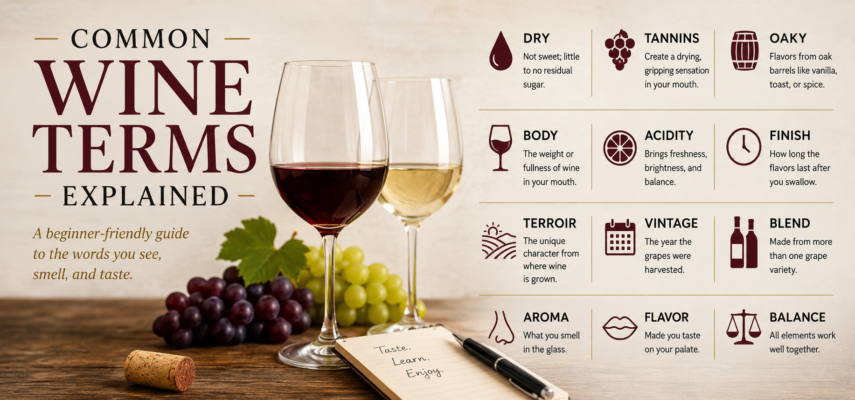
Wine has its own language.
That language can be useful, but it can also make wine feel more complicated than it needs to be. Words like dry, tannic, oaky, full-bodied, and terroir appear on wine labels, restaurant menus, tasting notes, and shelf tags. For beginners, those terms can sound intimidating.
The good news is that most wine vocabulary is simply a way of describing what you see, smell, taste, and feel when drinking wine.
You do not need to memorize hundreds of technical definitions to enjoy wine. But learning a few common terms can help you understand what you like, explain your preferences more clearly, and make better choices when buying a bottle or ordering from a wine list.
This guide explains the wine terms you are most likely to encounter.
Dry
A dry wine is a wine that does not taste sweet.
This is one of the most commonly misunderstood wine terms. In everyday language, “dry” might sound like the opposite of refreshing or juicy. In wine, it simply means that most or all of the grape sugar has been converted into alcohol during fermentation.
A dry wine can still taste fruity. For example, a dry Pinot Noir may have flavors of cherry or raspberry, and a dry Sauvignon Blanc may taste like citrus or tropical fruit. Fruity does not automatically mean sweet.
Most red wines are dry. Many white wines are dry as well, including Chardonnay, Sauvignon Blanc, Pinot Grigio, Albariño, and many Rieslings.
Sweet
A sweet wine contains noticeable sugar.
Sweetness can range from lightly sweet to dessert-level sweet. Some wines have just a touch of sweetness to balance acidity, while others are intentionally rich and sugary.
Examples of sweet or off-dry wines include Moscato, some Rieslings, certain Gewürztraminers, Port, Sauternes, and many dessert wines.
A useful beginner tip: if a wine tastes like fresh fruit, that does not always mean it is sweet. True sweetness is the sugary sensation you feel on your tongue, similar to honey, syrup, or ripe juice.
Off-Dry
Off-dry means slightly sweet.
An off-dry wine is not fully sweet, but it has enough residual sugar to be noticeable. These wines can be excellent with spicy food because a little sweetness helps soften heat.
Riesling is one of the most common examples. Some Rieslings are bone dry, while others are off-dry or sweet. This is why one person may say they love Riesling and another may say they hate it — they may have tasted completely different styles.
Body
Body describes the weight or fullness of a wine in your mouth.
A light-bodied wine feels thinner and more delicate. A full-bodied wine feels richer, heavier, and more mouth-coating. A medium-bodied wine sits somewhere in between.
A helpful comparison is milk:
Light-bodied wine feels more like skim milk.
Medium-bodied wine feels more like whole milk.
Full-bodied wine feels more like cream.
Examples of light-bodied wines include Pinot Noir, Gamay, Pinot Grigio, and Vinho Verde. Medium-bodied wines include Merlot, Chianti, and many Spanish reds. Full-bodied wines include Cabernet Sauvignon, Syrah, Malbec, Zinfandel, and many oaked Chardonnays.
Acidity
Acidity is the fresh, crisp, mouthwatering quality in wine.
It is what makes a wine feel bright, lively, or refreshing. Wines with high acidity often make your mouth water after you swallow. This is the same sensation you get from lemons, green apples, or vinegar, though wine acidity is usually much more balanced.
High-acid wines are often excellent with food because they cut through richness and refresh the palate. Sauvignon Blanc, Riesling, Champagne, Chablis, Sancerre, Barbera, and Chianti are known for noticeable acidity.
Low-acid wines can feel softer, rounder, or heavier. If a wine tastes flat or dull, it may lack acidity.
Tannins
Tannins are compounds that create a drying, gripping sensation in your mouth.
They are most noticeable in red wine because they come from grape skins, seeds, stems, and sometimes oak barrels. Since red wines ferment with grape skins, they usually have more tannin than white wines.
Tannins are not a flavor exactly. They are more of a texture. If you drink strong black tea and feel your mouth dry out, that sensation is similar to tannin.
Cabernet Sauvignon, Nebbiolo, Syrah, Malbec, and Bordeaux blends often have firm tannins. Pinot Noir, Gamay, and many lighter reds usually have softer tannins.
Tannins can make wine feel structured and serious. They also help some wines age well.
Finish
Finish describes how long the flavors of a wine remain after you swallow.
A short finish disappears quickly. A long finish lingers. In many higher-quality wines, the finish may continue for several seconds or longer, leaving behind fruit, spice, earth, minerality, oak, or other impressions.
A long finish is often considered a sign of quality, but it is not the only one. Balance, complexity, freshness, and overall enjoyment matter too.
Balance
Balance means that the major parts of a wine work well together.
A balanced wine does not feel like one element is overpowering everything else. The fruit, acidity, tannin, alcohol, sweetness, and oak all feel integrated.
For example, a wine with high alcohol but not enough fruit may taste hot or harsh. A wine with high acidity but not enough body may taste sharp. A wine with too much oak may taste like vanilla, toast, or wood instead of wine.
Balance is one of the most important concepts in wine because it affects whether a wine feels pleasant and complete.
Structure
Structure refers to the framework of a wine.
The main structural elements are acidity, tannin, alcohol, sweetness, and body. These are the parts that shape how the wine feels, not just how it tastes.
A wine with strong structure may feel firm, powerful, or age-worthy. A wine with soft structure may feel smooth, easygoing, and ready to drink.
Structure is especially important in red wines, where tannins and acidity help determine how the wine develops over time.
Fruit-Forward
A fruit-forward wine has obvious fruit flavors.
These wines may taste like cherry, blackberry, plum, raspberry, peach, apple, pear, citrus, or tropical fruit, depending on the grape and style.
Fruit-forward does not necessarily mean sweet. Many dry wines are fruit-forward. The term simply means fruit is the dominant impression.
Popular fruit-forward wines include many California Zinfandels, Australian Shiraz, Argentine Malbecs, New World Pinot Noirs, and some ripe Chardonnays.
Earthy
Earthy wines have flavors or aromas that remind people of soil, mushrooms, forest floor, leather, dried leaves, herbs, or minerals.
This may sound strange at first, but earthy notes are prized in many classic wines. Burgundy, Barolo, Rioja, Bordeaux, and some Loire Valley reds can show earthy characteristics.
An earthy wine may be less obviously fruity and more savory. Some people love this style because it feels complex and food-friendly. Others prefer cleaner, fruitier wines.
Oaky
An oaky wine has noticeable aromas or flavors from oak barrels or oak treatment.
Common oak-related flavors include vanilla, baking spice, toast, coconut, smoke, cedar, caramel, and butter. Oak can also add texture, making a wine feel rounder or fuller.
Chardonnay is one of the best examples. An oaked Chardonnay may taste creamy, buttery, vanilla-like, or toasty. An unoaked Chardonnay is usually crisper and more fruit-driven.
Oak is also common in red wines such as Cabernet Sauvignon, Rioja, Bordeaux, Syrah, and many red blends.
Oak is not automatically good or bad. The key is whether it supports the wine or overwhelms it.
Buttery
Buttery usually describes a rich, creamy style of white wine, especially Chardonnay.
This flavor often comes from a winemaking process called malolactic fermentation, which softens sharper acidity and creates rounder, creamier notes. Oak aging can also add to the buttery impression.
A buttery Chardonnay may taste like buttered popcorn, cream, vanilla, or baked apple. Some drinkers love this style, while others prefer Chardonnay that is crisp, lean, and unoaked.
Crisp
A crisp wine feels fresh, bright, and refreshing.
Crisp wines usually have high acidity and clean fruit flavors. They are often served chilled and work well with seafood, salads, lighter dishes, and warm weather.
Examples include Sauvignon Blanc, Pinot Grigio, Albariño, Chablis, Muscadet, dry Riesling, and many sparkling wines.
If you like wines that feel refreshing rather than heavy, “crisp” is a useful word to remember.
Smooth
Smooth is one of the most common words people use to describe wine, though it can mean different things.
Usually, smooth means the wine does not feel harsh. It may have soft tannins, moderate acidity, balanced alcohol, and a rounded texture.
Merlot, Pinot Noir, Grenache, Malbec, and some red blends are often described as smooth.
However, smooth does not always mean better. Some great wines are firm, intense, acidic, or tannic when young. But for everyday drinking, smoothness is a quality many people enjoy.
Jammy
Jammy wines taste like very ripe or cooked fruit.
Instead of fresh cherry or blackberry, the wine may taste more like blackberry jam, blueberry compote, baked plum, or fruit preserves.
Jammy wines are often full-bodied, higher in alcohol, and lower in acidity. Many warm-climate Zinfandels, Shiraz, Malbecs, and red blends can taste jammy.
If you like bold, ripe, fruit-heavy reds, jammy may be a positive term. If you prefer freshness and structure, it may not be your style.
Minerality
Minerality is one of the more debated wine terms, but it generally describes flavors or sensations that seem stony, chalky, saline, flinty, or mineral-like.
You might see a wine described as having notes of wet stone, crushed rock, chalk, sea spray, or flint.
Minerality is often associated with wines such as Chablis, Sancerre, dry Riesling, Albariño, Muscadet, and some volcanic-soil wines.
It does not mean the wine literally tastes like rocks. It is a shorthand for a clean, savory, non-fruity quality that many people associate with certain regions and styles.
Terroir
Terroir refers to the way a wine reflects the place where it was grown.
This includes soil, climate, elevation, sunlight, rainfall, slope, vineyard practices, and local tradition. The idea is that wine is not just a product of the grape variety, but also of its environment.
For example, Chardonnay from Burgundy can taste very different from Chardonnay grown in California. Pinot Noir from Oregon can feel different from Pinot Noir from New Zealand. Terroir is one reason wine people care so much about region.
In simple terms, terroir means “a sense of place.”
Varietal
A varietal wine is named after the grape variety used to make it.
Cabernet Sauvignon, Merlot, Pinot Noir, Chardonnay, Sauvignon Blanc, and Riesling are all grape varieties. When a wine label says “Cabernet Sauvignon,” it is usually identifying the main grape in the bottle.
This is especially common in New World wine regions such as the United States, Australia, Chile, Argentina, and New Zealand.
Blend
A blend is a wine made from more than one grape variety.
Some of the world’s most famous wines are blends. Bordeaux, for example, is usually made from some combination of Cabernet Sauvignon, Merlot, Cabernet Franc, Petit Verdot, and Malbec. Champagne is often made from Chardonnay, Pinot Noir, and Pinot Meunier.
Blending allows winemakers to combine the strengths of different grapes. One grape may add structure, another may add softness, another may add aroma, and another may add color.
A blend is not lower quality than a single-varietal wine. Many of the greatest wines in the world are blends.
Vintage
Vintage refers to the year the grapes were harvested.
If a bottle says 2021, that usually means the grapes used to make the wine were picked in 2021. The wine may have been aged and released later, but the vintage year refers to harvest.
Vintage matters more for some wines than others. In regions with variable weather, such as Bordeaux or Burgundy, one vintage can be very different from another. In warmer, more consistent regions, vintage may matter less for everyday wines.
Non-vintage wines, often marked “NV,” are made from wines from multiple years. This is common in Champagne and other sparkling wines.
Old World
Old World wines come from traditional European wine-producing countries.
This includes France, Italy, Spain, Germany, Portugal, Austria, and others. Old World wines are often described as more restrained, earthy, acidic, mineral-driven, or food-friendly, though there are many exceptions.
Old World labels often emphasize place rather than grape. For example, a bottle labeled “Burgundy” may be Pinot Noir or Chardonnay, depending on the specific region and style.
New World
New World wines come from regions outside Europe.
This includes the United States, Australia, New Zealand, Chile, Argentina, South Africa, and others. New World wines are often described as fruit-forward, ripe, bold, and grape-focused, though again there are many exceptions.
New World labels often name the grape variety clearly, which can make them easier for beginners to understand.
Appellation
An appellation is a legally defined wine-growing area.
Appellations help identify where a wine comes from and often come with rules about grape varieties, vineyard practices, alcohol levels, yields, and winemaking methods.
Examples include Napa Valley, Champagne, Chianti Classico, Rioja, Barolo, Chablis, and Bordeaux.
When you see an appellation on a label, it tells you more than geography. It can also suggest a certain style, tradition, or quality level.
Estate
Estate usually means the winery grew the grapes and made the wine itself.
An estate wine often comes from vineyards owned or controlled by the producer. This can suggest greater control over farming and winemaking, though the exact meaning depends on the country and labeling rules.
Estate does not automatically guarantee quality, but it can be a positive sign when evaluating a bottle.
Reserve
Reserve sounds impressive, but its meaning depends heavily on where the wine comes from.
In some countries, reserve has legal meaning. In Spain, for example, terms such as Crianza, Reserva, and Gran Reserva are tied to aging requirements. In Italy, “Riserva” also often indicates extended aging under specific rules.
In other regions, especially in some New World markets, “reserve” may simply be a marketing term. It can indicate a winery’s better bottling, but it is not always regulated.
When you see “reserve,” do not assume it automatically means the wine is superior. Look at the producer, region, price, and reviews as well.
Decant
To decant wine means to pour it from the bottle into another vessel, usually a decanter.
There are two main reasons to decant. The first is to separate older wine from sediment. The second is to expose younger wine to oxygen, which can help it open up.
Full-bodied red wines like Cabernet Sauvignon, Syrah, Bordeaux, Barolo, and young red blends are common candidates for decanting.
Not every wine needs to be decanted. Light reds, delicate older wines, whites, and sparkling wines often require a more careful approach.
Aeration
Aeration means exposing wine to air.
This can happen by swirling the glass, using an aerator, or decanting the wine. Air can soften some wines and make aromas more expressive.
However, more air is not always better. Some delicate wines can fade if exposed to too much oxygen.
For beginners, the easiest form of aeration is simple: pour a glass, swirl it, and see whether the wine improves after a few minutes.
Legs
Legs are the streaks that run down the inside of a wine glass after you swirl it.
Some people think legs indicate quality, but that is not really accurate. Legs are mostly related to alcohol and viscosity. A higher-alcohol or richer wine may show more pronounced legs.
They can be interesting to observe, but they are not a reliable sign that a wine is better.
Corked
A corked wine is a flawed wine affected by cork taint.
Cork taint can make wine smell musty, damp, moldy, or like wet cardboard. The fruit may seem muted or lifeless.
Corked does not mean pieces of cork are floating in the wine. It refers to a specific fault that can occur when certain compounds contaminate the cork or wine.
If you order wine at a restaurant and it smells like wet basement or cardboard, it is appropriate to politely ask the server or sommelier to check it.
Oxidized
An oxidized wine has been exposed to too much oxygen.
It may taste flat, stale, nutty, bruised, or like old apple. White wines may turn darker than expected. Red wines may lose freshness and fruit.
Some wines are intentionally oxidative, such as certain Sherries. But when ordinary table wine tastes tired and lifeless, oxidation may be the reason.
Reduction
Reduction is almost the opposite of oxidation. It happens when wine has had very little oxygen exposure.
A reduced wine may smell like struck match, rubber, sulfur, garlic, or something funky. In mild cases, the smell can blow off after swirling or decanting. In severe cases, it may remain unpleasant.
Some wine styles intentionally include a little reduction because it can add complexity. But for beginners, it is enough to know that not every strange smell means the wine is bad forever. Sometimes it just needs air.
Aroma vs. Bouquet
Aroma usually refers to the smells that come from the grape and fermentation.
These may include fruit, flowers, herbs, and fresh primary notes.
Bouquet usually refers to the smells that develop from aging, either in barrel or bottle. These may include leather, tobacco, dried fruit, mushroom, spice, nuts, or earthy notes.
In casual conversation, many people use aroma and bouquet interchangeably. But technically, aroma is more youthful and grape-driven, while bouquet is more developed and age-related.
Complexity
Complexity means a wine has many layers of aroma, flavor, and texture.
A simple wine may taste mostly like one or two things, such as fresh apple or black cherry. A complex wine may change in the glass and reveal fruit, spice, earth, floral notes, minerality, oak, and aging characteristics.
Complexity is one reason people spend more money on certain wines. But simple wines can still be delicious, especially when they are fresh, balanced, and appropriate for the moment.
Typicity
Typicity means a wine tastes the way it is expected to taste based on its grape, region, or style.
For example, Sauvignon Blanc from New Zealand is often expected to be bright, aromatic, citrusy, and sometimes grassy. Barolo is expected to be structured, tannic, aromatic, and complex. Champagne is expected to have bubbles, acidity, and flavors that may include citrus, apple, toast, or brioche.
Typicity is not about whether a wine is good or bad. It is about whether it represents its category well.
Food-Friendly
A food-friendly wine is a wine that works especially well with meals.
These wines usually have good acidity, balanced alcohol, and enough structure to complement food without overpowering it.
Many Italian wines are considered food-friendly because they often have bright acidity and savory character. Chianti, Barbera, Pinot Noir, Champagne, dry Riesling, Sauvignon Blanc, and many rosés are also excellent with food.
A wine does not need to be expensive to be food-friendly.
How to Use Wine Terms Without Overthinking
The purpose of wine vocabulary is not to make wine feel exclusive. It is to help you describe your experience.
Instead of trying to sound like an expert, start with simple observations:
Is the wine sweet or dry?
Is it light, medium, or full-bodied?
Does it feel crisp or soft?
Is it fruity, earthy, oaky, or spicy?
Does your mouth feel dry from tannins?
Do the flavors disappear quickly or linger?
These basic questions are enough to build a useful wine vocabulary.
Over time, you will start to connect words with preferences. You may discover that you like crisp, dry whites. Or smooth, medium-bodied reds. Or earthy Old World wines. Or fruit-forward New World styles.
That is when wine terms become practical.
They help you find more of what you enjoy.
Final Thoughts
Wine terminology can seem overwhelming at first, but most common wine terms describe simple sensory experiences: taste, smell, texture, weight, freshness, sweetness, and finish.
You do not need to know every term to enjoy wine. But learning the basics gives you more confidence when reading a label, talking to a server, visiting a winery, or choosing a bottle at the store.
The best place to start is with the words that matter most: dry, sweet, body, acidity, tannin, oak, fruit, balance, and finish.
Once those terms make sense, wine becomes easier to understand — and much easier to enjoy.