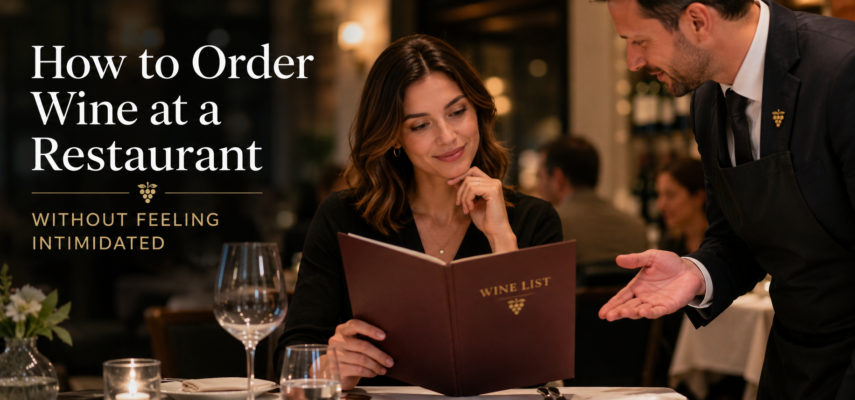
Ordering wine at a restaurant can feel more stressful than it should.
You are handed a long wine list filled with unfamiliar names, regions, vintages, and prices. The server or sommelier may be standing nearby. Everyone at the table may be waiting. Suddenly, choosing a bottle of wine feels less like a pleasant part of dinner and more like a test you did not study for.
The good news is that ordering wine does not require expert-level knowledge. You do not need to memorize every grape, region, or vintage. You only need a few simple tools: know what you like, understand the meal, set a price range, and communicate clearly.
Wine at a restaurant should make the meal more enjoyable, not more intimidating.
Start With the Most Important Question: What Do You Like?
Before worrying about regions, vintages, or food pairings, start with your own preferences.
Do you usually like red, white, rosé, or sparkling wine? Do you prefer something light and crisp, or rich and full-bodied? Do you like wines that are fruity, dry, smooth, oaky, earthy, or refreshing?
You do not need technical language. Simple descriptions are enough.
You can say:
“I usually like dry white wines.”
“I like reds that are smooth but not too heavy.”
“I prefer something crisp and refreshing.”
“I don’t like wines that taste too sweet.”
“I usually drink Pinot Noir, but I’m open to something similar.”
These kinds of statements give the server or sommelier useful direction. A good restaurant professional is not expecting you to sound like a wine critic. They are trying to help you find something you will enjoy.
Do Not Be Afraid to Name Your Budget
One of the most uncomfortable parts of ordering wine is price.
Many people avoid saying what they want to spend because they think it sounds cheap or awkward. But naming a budget is completely normal. In fact, it makes the process easier for everyone.
You can say:
“We’re looking for something around $60.”
“Do you have a good bottle under $75?”
“I’d like to stay in this range.”
If you do not want to say the number out loud, you can point to a bottle on the list and say:
“We’re thinking of something around this price.”
That tells the server your budget without making it a table announcement.
A good sommelier will respect your range. Their job is not to push you into the most expensive bottle. Their job is to help you find the best wine for your meal and budget.
Use the Wine List as a Menu, Not a Textbook
A wine list can look intimidating because it often includes unfamiliar words. You may see names like Sancerre, Barolo, Rioja, Chablis, Chianti Classico, Grüner Veltliner, or Côte de Nuits.
You do not need to know all of them.
Think of the wine list the same way you think of a food menu. You are not expected to know every ingredient or preparation method before asking questions. Wine works the same way.
Look for a few clues:
Red, white, rosé, or sparkling
Country or region
Grape variety, if listed
Price
Style descriptions, if included
Some restaurants organize the list by wine type. Others organize it by region. Either way, you can still ask for help.
A simple phrase works well:
“I’m not familiar with this list. Could you help us pick something?”
That is not embarrassing. That is exactly what restaurant wine service is for.
By the Glass or by the Bottle?
One of the first decisions is whether to order wine by the glass or by the bottle.
Ordering by the glass is a good choice when people at the table want different things, when you only want one drink, or when you want to try something without committing to a full bottle.
Ordering a bottle usually makes more sense when two or more people want the same wine. A standard bottle contains about five glasses of wine. If two people each plan to have two glasses, a bottle is often the better value.
There is no wrong choice. The right choice depends on the table.
If you are unsure, ask:
“Would you recommend going by the glass or getting a bottle for the table?”
This is a practical question, not a beginner question.
Match the Wine to the Meal, But Keep It Simple
Food pairing can sound complicated, but the basic idea is simple: the wine should complement the food, not overpower it.
Light foods usually work well with lighter wines. Richer foods can handle fuller wines.
For example:
Seafood, salads, and lighter chicken dishes often pair well with crisp white wines.
Steak, lamb, and rich braised meats often pair well with fuller red wines.
Pasta with tomato sauce often works with medium-bodied Italian reds.
Spicy foods often pair better with wines that are refreshing and not too high in alcohol.
Creamy dishes can work well with fuller whites or sparkling wines.
If multiple people are ordering different dishes, choose a flexible wine. Pinot Noir, Chardonnay, dry Riesling, Champagne, Cava, Sauvignon Blanc, and lighter Italian reds can often work across a range of foods.
You can also tell the server what everyone is eating:
“We’re having salmon, pasta, and chicken. What would work well across the table?”
That gives them a clear problem to solve.
Learn a Few Safe Restaurant Wine Orders
You do not need a huge wine vocabulary, but it helps to know a few reliable categories.
If you want a crisp white wine, look for Sauvignon Blanc, Albariño, Sancerre, Chablis, or Pinot Grigio.
If you want a richer white wine, look for Chardonnay, white Burgundy, Viognier, or white Rhône blends.
If you want a light red wine, look for Pinot Noir, Beaujolais, Gamay, or lighter styles of Grenache.
If you want a medium-bodied red wine, look for Chianti, Rioja, Côtes du Rhône, Merlot, or Barbera.
If you want a bold red wine, look for Cabernet Sauvignon, Malbec, Syrah, Bordeaux, Barolo, or Super Tuscan wines.
If you want something celebratory or food-friendly, sparkling wine is almost always a strong choice. Champagne is the classic option, but Cava, Crémant, Franciacorta, and Prosecco can also be excellent depending on the style and price.
These are not rigid rules. They are simply helpful starting points.
Know How to Describe What You Do Not Want
Sometimes it is easier to say what you do not like.
That is perfectly useful.
You can say:
“I don’t want anything too sweet.”
“I don’t like really oaky Chardonnay.”
“I want a red, but not something too heavy.”
“I don’t want anything too acidic.”
“I don’t like bitter or earthy wines.”
This helps narrow the choices quickly. Wine preference is personal, and knowing what to avoid is just as valuable as knowing what to order.
What to Say to the Sommelier
If the restaurant has a sommelier, use them.
Some diners feel intimidated because they assume the sommelier is there to judge them. A good sommelier is there to help. They know the list better than anyone and can usually find value bottles that are easy to miss.
Here is a simple formula:
Tell them what you are eating.
Tell them what style you like.
Tell them your price range.
For example:
“We’re ordering the roast chicken, salmon, and pasta. We usually like dry whites, maybe something crisp but not too sharp. We’d like to stay around $70.”
Or:
“We’re having steak and lamb. We like Cabernet, but we’re open to something similar. Something around $90 would be great.”
That is all you need.
The sommelier may ask follow-up questions, but they are not trying to expose what you do not know. They are narrowing down the options.
What Happens When the Bottle Arrives?
The wine presentation can feel formal, but it is actually simple.
First, the server shows you the bottle. Check that it is the wine you ordered. Look at the producer, wine name, and vintage if applicable.
You do not need to study it for a long time. You are just confirming that it is the correct bottle.
Next, the server opens the bottle and pours a small taste for the person who ordered it.
This taste is not mainly to decide whether you like the wine. It is to check whether the wine is flawed.
Smell it. Taste it. If it smells normal and tastes fine, say:
“That’s great, thank you.”
Then the server will pour for the table.
What If the Wine Tastes Bad?
Most of the time, the wine will be fine. But occasionally a bottle may be flawed.
A corked wine may smell musty, like wet cardboard, damp basement, or old newspaper. Other flawed wines may smell overly vinegary, cooked, or unpleasant in a way that seems clearly wrong.
If something seems off, you can say:
“I’m not sure this bottle is right. Could you please check it?”
This is polite and appropriate.
However, there is an important distinction: a flawed wine is different from a wine you simply do not enjoy. If the wine is technically sound but not your preferred style, restaurants are not always obligated to replace it. That is another reason to communicate your preferences clearly before ordering.
Do You Have to Order the Second-Cheapest Bottle?
There is a common belief that the second-cheapest bottle on the list is a bad choice because everyone orders it. Sometimes that may be true, but it is not a reliable rule.
Instead of playing pricing games, look for value.
Great restaurant value can often come from lesser-known regions, grapes, or styles. For example, a wine from Portugal, Spain, Austria, Greece, South Africa, or southern Italy may offer excellent quality for the price because it is less famous than Napa Cabernet or Burgundy.
This is where asking for help can really pay off.
You can say:
“What do you think is the best value on the list?”
That is one of the best restaurant wine questions you can ask.
Do Not Pretend to Know More Than You Do
One of the easiest ways to make wine stressful is to pretend.
You do not need to fake expertise. You do not need to pronounce every region perfectly. You do not need to have an opinion on vintage variation or soil types.
It is much better to be direct.
Try:
“I’m still learning wine.”
“I know I like Pinot Noir, but I’m not sure what else is similar.”
“I’m looking for something food-friendly and not too expensive.”
Most servers and sommeliers appreciate clear, honest direction. It helps them do their job well.
A Simple Restaurant Wine Script
When in doubt, use this script:
“We’re looking for a bottle to go with dinner. I usually like [red/white/sparkling] wines that are [light/crisp/smooth/full-bodied/dry]. We’re ordering [main dishes]. I’d like to stay around [price]. What would you recommend?”
For example:
“We’re looking for a bottle to go with dinner. I usually like red wines that are smooth and medium-bodied. We’re ordering pasta, chicken, and steak. I’d like to stay around $75. What would you recommend?”
That one sentence covers everything.
Final Thoughts
Ordering wine at a restaurant does not have to be intimidating. You do not need to know every bottle on the list. You do not need to impress the table. You only need to communicate what you like, what you are eating, and what you want to spend.
The best wine choice is not always the rarest, oldest, or most expensive bottle. It is the bottle that fits the meal, the moment, and the people at the table.
Wine is there to make dinner better. Once you remember that, ordering it becomes much easier.