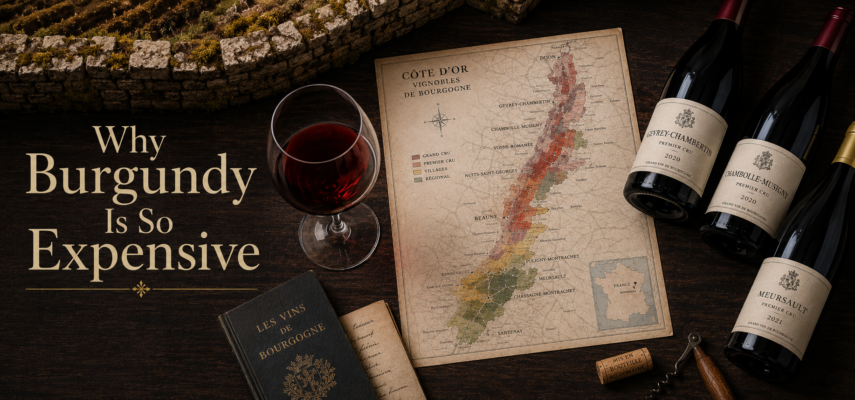
Burgundy has a strange reputation in the wine world. It is not the biggest wine region. It does not make the boldest wines. It is not the easiest region to understand. And yet, bottle for bottle, Burgundy produces some of the most expensive and sought-after wines on earth.
To a beginner, this can feel confusing. Why can one bottle of Pinot Noir cost $30 while another bottle from Burgundy costs $300, $3,000, or more? Why do collectors obsess over tiny vineyard names? And why does Burgundy seem to get more expensive every year?
The short answer is scarcity. The longer answer is that Burgundy combines small vineyards, historic prestige, complicated ownership, limited production, global demand, and an almost religious belief in terroir — the idea that a specific piece of land can create a wine unlike anywhere else.
Burgundy is expensive because there simply is not much of the best Burgundy to go around.
What Is Burgundy?
Burgundy, or Bourgogne in French, is a wine region in eastern France best known for two grapes: Pinot Noir for red wine and Chardonnay for white wine.
That part sounds simple. But Burgundy itself is anything but simple.
Unlike many New World wine regions, Burgundy is not primarily about grape variety. It is about place. A bottle may not say “Pinot Noir” or “Chardonnay” in big letters. Instead, the label usually emphasizes the village, vineyard, producer, and classification.
The official Bourgogne wine region includes 84 Appellations d’Origine Contrôlée, or AOCs, which range from broad regional wines to highly specific Grand Cru vineyards.
The main quality hierarchy looks like this:
- Regional Burgundy — wines labeled Bourgogne, usually the broadest and most affordable.
- Village Burgundy — wines from a specific village, such as Meursault, Pommard, Gevrey-Chambertin, or Chambolle-Musigny.
- Premier Cru Burgundy — wines from better-ranked vineyard sites within a village.
- Grand Cru Burgundy — wines from the most prestigious vineyard sites in the region.
This hierarchy is one reason Burgundy prices vary so dramatically. A regional Bourgogne can be relatively approachable. A Grand Cru from a famous producer can be one of the most expensive wines in the world.
Burgundy Is Built on Scarcity
The first reason Burgundy is expensive is simple: the region is small, and the most famous vineyards are tiny.
In Bordeaux, a famous château may own a large estate and produce thousands or even hundreds of thousands of bottles. Burgundy works differently. Many of its top wines come from individual vineyard parcels, some of which are extremely small.
The best-known example is Romanée-Conti, one of the most famous vineyards in the world. It is only a tiny plot of land, yet demand for its wine is global. When a vineyard that small becomes legendary, price pressure becomes inevitable.
This is the core Burgundy problem: everyone wants the same wines, but the vineyards cannot expand.
A Grand Cru vineyard cannot simply produce more Grand Cru Burgundy because demand has increased. The land is fixed. The rules are fixed. The vineyard boundaries are fixed. More money cannot create more Romanée-Conti, more La Tâche, more Montrachet, or more Richebourg.
That is very different from luxury goods that can scale production. Burgundy’s prestige is tied to the fact that it cannot scale.
The Land Itself Is Extremely Expensive
Burgundy vineyard land has become a luxury asset.
According to recent reporting based on data from France’s rural land agency Safer, Premier Cru Chardonnay vineyard land in Burgundy’s Côte-d’Or averaged about €2.7 million per hectare in 2025, while Premier Cru Pinot Noir vineyard land reached about €1.15 million per hectare.
That is an extraordinary cost for agricultural land. It means Burgundy growers are not only making wine; they are farming some of the most valuable vineyard property in the world.
High land prices affect everything. They make it harder for new producers to enter the region. They increase inheritance and financing pressures. They also reinforce the idea that Burgundy’s best vineyards are not just farmland, but cultural and financial assets.
When a vineyard becomes as desirable as rare art, luxury real estate, or a collectible watch, the wine produced from that land will not be priced like an ordinary agricultural product.
Burgundy Is Fragmented
Another reason Burgundy is expensive is that ownership is incredibly fragmented.
This fragmentation goes back in part to history. Church and aristocratic vineyard holdings were broken up over time, especially after the French Revolution. Inheritance laws also divided land among heirs. The result is a patchwork system where one vineyard may have many different owners.
Clos de Vougeot, one of Burgundy’s famous Grand Cru vineyards, is often used as an example because it has many owners working within the same historic vineyard. This fragmentation makes Burgundy more complicated than regions where one estate controls a large block of land.
Fragmentation matters because it limits production even further. A producer may own only a few rows of vines in a famous vineyard. That means their entire annual production from that site might be only a few barrels.
A few barrels can turn into only a few hundred bottles.
When collectors, restaurants, importers, and wine lovers around the world are competing for those bottles, prices rise quickly.
Burgundy Is Producer-Driven
Burgundy is not just about the vineyard. It is also about the producer.
Two different producers can make wine from the same vineyard, but the wines can taste different and sell for very different prices. Farming choices, picking decisions, oak usage, cellar technique, reputation, and consistency all matter.
This is one of the biggest differences between Burgundy and many beginner-friendly wine regions. In Burgundy, the vineyard name tells you where the grapes came from. The producer name tells you who made the wine. Serious Burgundy buyers care about both.
That is why one bottle labeled with a famous village or Premier Cru vineyard may be expensive, while another wine from the same area may be far more expensive because of the producer.
In Burgundy, reputation compounds. Once a domaine becomes known for exceptional wines, collectors chase every vintage. Allocations shrink. Retailers receive limited quantities. Restaurants fight for placements. Secondary market prices climb.
The wine itself may be excellent, but the price is often influenced by reputation as much as flavor.
Burgundy Sells a Feeling of Terroir
The word “terroir” gets used often in wine, but Burgundy is where the concept becomes almost sacred.
Terroir means that wine reflects the place where it was grown: soil, slope, drainage, sun exposure, altitude, climate, and human tradition. Burgundy is famous because vineyards located just a short walk from each other can produce wines with noticeably different personalities.
One vineyard may produce Pinot Noir that feels delicate, floral, and silky. Another nearby vineyard may produce something darker, firmer, and more structured. To Burgundy lovers, these differences are the whole point.
That is why the label matters so much. Burgundy buyers are often not just buying Pinot Noir or Chardonnay. They are buying a specific interpretation of a specific place.
This gives Burgundy an intellectual appeal. It rewards study. It invites comparison. It turns wine into a map.
For collectors, that creates an obsession: tasting the same village across different producers, the same vineyard across different vintages, or the same producer across different vineyard sites.
Burgundy is expensive because it is not just consumed. It is studied.
Pinot Noir and Chardonnay Are Difficult to Master
Burgundy’s two great grapes also contribute to the region’s cost.
Pinot Noir is notoriously sensitive. It has thin skins, can be difficult in the vineyard, and often shows flaws clearly. It does not hide behind massive tannin, heavy oak, or high alcohol as easily as some bolder red grapes. When Pinot Noir is great, it can be hauntingly beautiful. When it is mediocre, it can feel thin or disappointing.
Chardonnay is more adaptable, but great white Burgundy depends on precision. The best examples balance richness, acidity, minerality, texture, and age-worthiness. That level of balance is not easy or cheap to produce.
Burgundy’s climate also adds risk. Frost, hail, disease pressure, heat spikes, and vintage variation can all reduce yields or affect quality. In difficult years, there may be less wine to sell, which can make desirable bottles even scarcer.
The Best Burgundy Ages Beautifully
Another reason Burgundy commands high prices is that the best bottles can age for decades.
Collectors value wines that evolve over time. Great red Burgundy can develop aromas of dried flowers, earth, spice, forest floor, tea, and red fruit. Great white Burgundy can gain notes of hazelnut, honey, butter, citrus peel, and minerals while still retaining freshness.
Age-worthiness adds investment appeal. A bottle bought on release may become more desirable years later as it becomes rarer and more mature. This attracts collectors who buy not just to drink, but also to cellar.
That demand removes bottles from the market. Some go into private cellars and may not reappear for decades. Others appear at auction at much higher prices.
A wine that is rare at release becomes even rarer with age.
Global Demand Has Exploded
Burgundy is no longer just a French or European obsession. It is global.
Collectors in the United States, United Kingdom, Hong Kong, Singapore, Japan, South Korea, and elsewhere compete for the same limited supply. Top Burgundy has become a global luxury category.
That demand is especially intense because Burgundy appeals to several groups at once:
Wine collectors want it for prestige and rarity.
Restaurants want it because serious wine programs are judged partly by their Burgundy selections.
Investors want it because top bottles can appreciate in value.
Wine lovers want it because great Burgundy can be genuinely moving.
The result is a market where demand is broad, but supply is narrow.
That imbalance is the foundation of Burgundy pricing.
Burgundy’s Classification System Adds to the Price Ladder
Burgundy’s hierarchy also creates built-in price escalation.
Regional Burgundy is the entry point. Village Burgundy costs more. Premier Cru costs more than that. Grand Cru sits at the top.
This structure encourages buyers to trade up. Once someone likes Bourgogne Rouge, they may want to try village-level Gevrey-Chambertin. Once they understand village wines, they may become curious about Premier Cru vineyards. Eventually, Grand Cru becomes the dream.
That ladder creates aspiration.
It also creates scarcity at each level. The higher you climb, the less wine exists. Grand Cru Burgundy represents only a small fraction of Burgundy production, which is one reason those bottles command such large premiums.
Burgundy Is Hard to Understand, and That Makes It More Valuable
This may sound strange, but Burgundy’s complexity actually adds to its mystique.
A beginner can understand Napa Cabernet fairly quickly: producer, grape, vintage, price. Burgundy requires more work. You need to understand villages, vineyard names, classifications, producers, vintages, and importers.
That learning curve can be frustrating. But for many wine enthusiasts, it becomes addictive.
Burgundy rewards knowledge. The more you learn, the more you realize how much there is to learn. That makes the region feel less like a beverage category and more like a lifelong subject.
Complexity creates insiders. Insiders create status. Status supports price.
Is Expensive Burgundy Always Better?
No.
This is one of the most important lessons for beginners: expensive Burgundy is not automatically better for every drinker.
A $500 Burgundy may be more complex, rarer, and more age-worthy than a $50 bottle. But that does not mean every person will enjoy it more. Burgundy can be subtle. It often values elegance over power. People used to rich, ripe, fruit-forward wines may find some expensive Burgundy underwhelming at first.
Price in Burgundy reflects many things:
Scarcity.
Producer reputation.
Vineyard classification.
Vintage quality.
Critical acclaim.
Collector demand.
Age and provenance.
It does not simply measure how delicious the wine will be to a casual drinker tonight.
That is why beginners should be careful. Burgundy can be magical, but it can also be an expensive way to learn what you do not like.
How to Try Burgundy Without Overspending
The good news is that you do not need to start with Grand Cru Burgundy.
In fact, you probably should not.
The smartest way to explore Burgundy is to begin with more affordable areas and classifications.
Look for:
Bourgogne Rouge
This is regional red Burgundy made from Pinot Noir. It gives you a basic introduction to the region’s style without the cost of famous village names.
Bourgogne Blanc
This is regional white Burgundy made from Chardonnay. It can be a good entry point if you want to understand Burgundy’s fresher, more mineral side of Chardonnay.
Chablis
Chablis is part of greater Burgundy and produces Chardonnay with crisp acidity, citrus, chalk, and mineral character. It is often easier to understand and can offer better value than the Côte d’Or.
Mâconnais
The Mâconnais, including wines such as Mâcon-Villages, Saint-Véran, and Pouilly-Fuissé, can offer generous, approachable Chardonnay at more reasonable prices.
Côte Chalonnaise
Villages like Mercurey, Givry, Rully, and Montagny can deliver very good Burgundy character without the prices of the most famous Côte d’Or villages.
Lesser-known villages
Instead of chasing names like Vosne-Romanée, Chambolle-Musigny, Meursault, or Puligny-Montrachet, look at less famous villages where prices may be less inflated.
For beginners, the goal should not be to buy the most prestigious bottle. The goal should be to understand the style.
Why Burgundy Matters
Burgundy matters because it represents one of wine’s most powerful ideas: place can matter more than grape.
In many parts of the wine world, people ask, “What grape is this?” In Burgundy, the more important question is, “Where exactly did this come from?”
That mindset has influenced winemakers around the world. Pinot Noir producers in Oregon, California, New Zealand, Australia, and elsewhere often look to Burgundy as a benchmark. Chardonnay producers do the same.
Burgundy’s prices may be extreme, but its influence is real. It has shaped how the modern wine world thinks about terroir, vineyard identity, elegance, and scarcity.
The Bottom Line
Burgundy is expensive because it sits at the intersection of scarcity, history, prestige, and global demand.
The best vineyards are small. Ownership is fragmented. Production is limited. The wines are difficult to make. The region has centuries of reputation. Collectors around the world want the same bottles. And unlike many luxury goods, Burgundy cannot simply make more of its most famous wines.
That does not mean every expensive bottle is worth it. It does mean Burgundy is one of the clearest examples of supply and demand in the wine world.
For beginners, Burgundy is best approached slowly. Start with regional wines, Chablis, the Mâconnais, the Côte Chalonnaise, and lesser-known villages. Learn the producers. Taste before chasing prestige.
Because the real lesson of Burgundy is not that wine should be expensive.
The lesson is that a small piece of land, farmed carefully and interpreted by the right producer, can become one of the most desired things in the world.