










History of IKEA
A cheap lamp from Småland that changed how the world furnished homes
Ingvar Kamprad started IKEA with a practical, almost stubborn idea: good design did not have to be expensive. He founded the business in 1943 as a mail-order operation in the village of Agunnaryd in Småland, southern Sweden, and turned a teenage knack for finding bargains into a system that remade furniture retail. The company known to most people simply as IKEA grew from catalogues and flat-packed pine into a global consumer brand, a complex network of retail companies and franchisors, and a testbed for ideas about sustainability, urban retailing and circular consumption.
This is the story of how a one-man catalogue became a multinational retail phenomenon: the practical innovations that made low-cost, stylish furniture possible; the organizational choices—franchising, holding structures and foundations—that insulated the business and shaped its priorities; the safety and tax controversies that tested public trust; and the shift from suburban megastores to online sales, urban formats and circular services that shows how IKEA is adapting to a different century of consumption.
From Småland mail-order to a furniture company
Ingvar Kamprad was 17 when he sold his first products under the name IKEA in 1943. The initials stood for his name, the family farm Elmtaryd and his home parish Agunnaryd. The early mail-order brochures offered small goods such as pens, watches and nylon stockings.
Furniture entered the mix in the late 1940s. Postwar Europe had strong demand for inexpensive household goods, and Kamprad saw an opportunity to move beyond disposable items into things that mattered more to households. The catalogue model—ordering by mail and then collecting or arranging delivery—let Kamprad reach rural customers who otherwise had limited access to furniture retailers. That convenience, combined with a steady eye for cost control, became a constant in IKEA’s early strategy.
Flat packing and showrooms: design by constraint
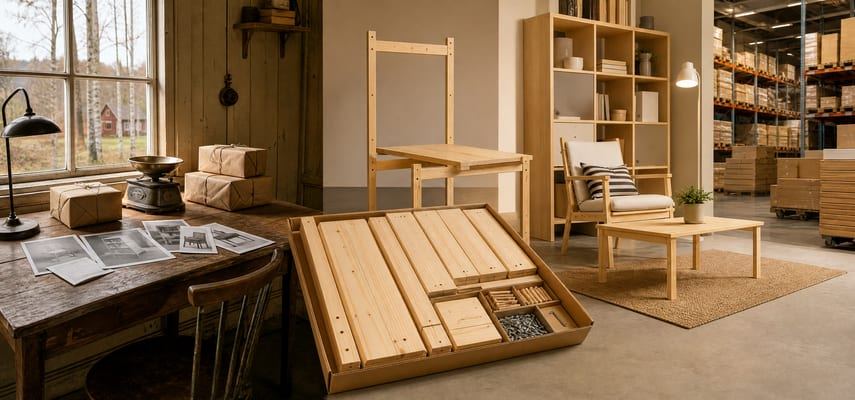
Two practical innovations changed IKEA’s product economics and its customer experience. The first was the decision to display products in a showroom rather than sell them from back rooms; the second was the adoption of flat-packed furniture that reduced transport costs and allowed customers to carry purchases home themselves.
IKEA opened an early showroom in Älmhult, where Kamprad had long organized operations, and over the 1950s the company built a rudimentary model for a self-service retail environment: look, choose and transport. The flat-pack idea—dismantling furniture to save space during transport—was not invented by IKEA, but the company turned it into a design discipline. Designers learned to create components that nested efficiently, used standard screws and fittings, and could be produced from low-cost timber panels. Those choices reduced shipping and inventory costs and let IKEA undercut conventional furniture stores on price while maintaining a distinctive, modern aesthetic.
Design also became a cultural argument: simple, functional pieces—pine tables, laminated bookcases, modular shelving—fit small apartments and changing postwar lifestyles. IKEA’s combination of Scandinavian minimalism with industrial production methods made design feel affordable to many families for the first time.
Scaling the format: catalogues, franchising and international expansion
As the business model proved itself in Sweden, IKEA began to scale. The catalogue became a central marketing instrument: a dense, photographed compendium of rooms and products that taught customers how to arrange and live with IKEA’s lines. The catalogue also let the company reach beyond its immediate catchment areas without heavy investment in local advertising.
Rather than operate every store directly, IKEA developed a franchising approach that separated the ownership of the concept from the retail operators. Inter IKEA Systems B.V. owns the IKEA Concept and is the worldwide IKEA franchisor, while franchisees—most prominently Ingka Group, the largest IKEA retailer—operate stores and other sales channels under franchise agreements. That separation allowed rapid international growth while preserving a common furniture range and retail script.
Beginning in the 1960s, IKEA expanded beyond Sweden into neighboring countries and then across Europe. The model—large stores on the edges of towns with car-friendly layouts, a fixed showroom path and self-service warehouses—lent itself to suburban development patterns and to markets where middle-class consumers wanted affordable furnishing solutions for newly bought apartments and houses.
Important milestones that changed the business
Certain concrete shifts accelerated IKEA’s rise.
- Standardized manufacturing and component-based design turned furniture production into an industrial process adaptable to scale. This reduced price points and made replacement parts and modular combinations possible.
- The showroom-plus-warehouse retail format changed customer behavior. Buying at IKEA was and remains an event: households plan, visit showrooms to see styled rooms, and then collect components for home assembly. That self-assembly model shifted labor and transport costs onto consumers, lowering prices and enabling larger product assortments.
- Franchising the concept through Inter IKEA Systems allowed a single design and retail language to spread across different legal entities and jurisdictions while giving flexibility to local operators over prices and service.
Each of these milestones mattered not because they were novel individually, but because IKEA combined them into a coherent system: a consistent catalogue and store experience, standardized parts that shipped flat, and a franchise network that replicated the format internationally.
The Kamprad era: governance, tax moves and the family imprint
Ingvar Kamprad remained an active presence in the company’s culture for decades. He was known for frugality and a strong focus on cost control, and those values permeated IKEA’s management rhetoric and design choices. But Kamprad’s personal decisions also shaped how the company was organized legally and financially.
To secure the business and reduce vulnerability to national taxation and succession complications, Kamprad established a layered ownership structure. Over time he directed significant ownership interests into foundations and holding companies—structures that insulated the operating business from direct family ownership while providing long-term continuity. Those arrangements drew public scrutiny and criticism at times because they complicated transparency and tax liability.
Kamprad moved from Sweden to Denmark in 1973 and later settled in Switzerland, where he lived for many years before returning to Sweden in 2014. His private life and the ownership arrangements around IKEA became frequent topics for journalists and tax experts. Kamprad died on January 27, 2018, and his death marked the closing of a distinct era: the founder’s personality had been central to IKEA’s identity, and his absence sharpened conversations about governance and public purpose.
Acquisitions and new services: TaskRabbit and beyond
IKEA’s growth has not depended primarily on large acquisitions the way technology companies scale. The company has, however, bought targeted assets that extend its service capabilities. One clear example is Ingka Group’s acquisition of TaskRabbit, completed in October 2017. TaskRabbit, a platform for on-demand home services, gave IKEA a way to offer assembly and handyman services digitally rather than relying solely on third-party local arrangements.
That purchase signaled a shift. IKEA’s core proposition—affordable furniture that customers assemble themselves—was still profitable, but changing consumer expectations and increased e-commerce demand meant the company had to offer end-to-end convenience: delivery, assembly, installation and interior planning services. TaskRabbit bridged that gap without forcing IKEA to build an entirely new logistics or services arm from scratch.
Product safety, supply scrutiny and public controversies
IKEA’s low-price model depended on large volumes and lean production. That scale, and the complexity of sourcing timber, textiles and components across many countries, created vulnerabilities.
Safety became a notable issue when children were injured in accidents involving unstable chests and dressers. Public recalls and safety campaigns followed. IKEA responded by redesigning products, offering anchoring kits and communicating installation requirements more clearly. Those episodes affected consumer trust and pushed the company to make product safety—and the communication of safety instructions—an operational priority.
Separately, the company’s tax and governance arrangements attracted criticism. Long and layered ownership structures, combined with Kamprad’s personal move abroad, raised questions about the extent to which the company paid taxes in the countries where it operated. Those debates were not unique to IKEA; many multinational retailers faced similar scrutiny as tax planning techniques grew more sophisticated. IKEA’s response combined public explanations about the legal structure and incremental adjustments to tax and ownership disclosure in several jurisdictions.
Digital commerce, urban formats and the circular turn (2010s–2020s)
The past decade forced practical changes. Urbanization, online shopping and environmental concern collided with IKEA’s classic suburban warehouse model. The company adapted in several interconnected ways.
First, IKEA invested heavily in e-commerce and logistics. Online orders required different warehousing, delivery and last-mile arrangements than showroom shopping. The company expanded click-and-collect points, home-delivery services and local fulfilment options. The TaskRabbit acquisition was part of that shift, giving IKEA a platform for arranging assembly and home services at scale.
Second, IKEA introduced smaller, city-centre store formats. These locations were not mere replicas of the megastores; they focused on inspiration, services and curated assortments, recognizing that many urban customers lacked cars and preferred delivery. Those city formats were as much about brand presence and customer acquisition as immediate sales: a way to expose city dwellers to the IKEA way of planning rooms and buying solutions without the time cost of a full megastore visit.
Third, sustainability and the notion of circular consumption moved from slogan to experiment. In 2018 and in subsequent public communications, IKEA articulated ambitious climate and resource goals—aims to significantly reduce greenhouse-gas emissions across its operations and to move toward using only renewable and recycled materials in products. As part of those efforts, IKEA began piloting buy-back, refurbishment and leasing schemes in several markets. The company described these pilots as tests of whether second-hand and rental offerings could become commercially meaningful while extending product lifespans and reducing waste.
Finally, the COVID-19 pandemic in 2020 accelerated several trends. Temporary store closures pushed more customers online and underscored the importance of robust delivery and digital customer service. IKEA responded by reallocating investments toward digital channels, experimenting with appointment-driven in-store experiences and expanding its partnership network for last-mile fulfilment.
Leadership transitions that shaped strategy
Ingvar Kamprad’s long shadow did not prevent generational leadership change. Management in the 21st century shifted toward professional executives tasked with making IKEA fit for fast-changing markets. One notable leadership moment came on September 1, 2017, when Jesper Brodin became president and CEO of the IKEA Group—Ingka Holding B.V. and its controlled entities, now known as Ingka Group—the largest IKEA retailer. Brodin’s tenure emphasized digital commerce, customer services and sustainability—areas where the business needed substantial reinvention.
Those leadership choices mattered because IKEA’s decentralized structure gives retail operators significant autonomy. A CEO focused on e-commerce and the circular economy could redirect capital and talent toward those priorities without rewriting the franchise agreement. The result was a company that looked more like an ecosystem of retail and service units than a single, centrally run chain.
Recent developments: services, circular pilots and the retail footprint
In the most recent period, several concrete developments illustrate IKEA’s current phase.
- Service integration. After the TaskRabbit purchase, IKEA moved to make assembly and handyman services a visible and bookable part of the customer journey. That allowed the company to compete more directly on convenience with purely online furniture sellers that offered white‑glove delivery.
- Circular pilots. IKEA has publicly tested buy-back and resale schemes in several countries, and trialled furniture leasing in selected markets. Those pilots seek to discover whether returns and refurbishment can be made profitable at scale and whether they help reduce net material use.
- Store format diversification. IKEA continued to open smaller urban stores and planning studios while maintaining its large destination stores on city peripheries. The coexistence of small and large formats reflects a bet that different customers need different access points: inspiration and planning in the city, bulk buying and full ranges in suburban warehouses.
- Sustainability commitments. IKEA’s public targets to shift to renewable and recycled materials and to lower its overall carbon footprint remain central to investor and consumer expectations. Those commitments have driven supplier auditing, investments in renewable energy and new product-development constraints oriented toward disassembly and repairability.
These developments are not mere add-ons. They test whether a company built on per-unit affordability can operate profitable second-hand markets, whether urban stores can be economically viable given IKEA’s inventory logic, and whether large-scale supply chains can shift materially toward recycled input without losing the price advantage that made the brand successful.
Legacy: how IKEA changed retail, design and consumption
IKEA’s historical significance is not confined to a catalogue or a few iconic designs. Its deeper contribution was to systematize a way of making, selling and using furniture that made design widely accessible.
On the product side, IKEA popularized modularity, component-based manufacturing and self-assembly. Those techniques lowered prices and made furniture replacement easier, encouraging more frequent redecorating and a mass market for affordable modern design.
On the retail side, IKEA invented a format that fused inspiration with low-cost distribution—the combination of staged showrooms with large, self-service warehouses and a catalogue-driven planning culture. Competitors and imitators adopted parts of the IKEA formula: emphasis on price-per-feature, flat packaging and showroom-led selling. Even when retailers kept full-service delivery and assembly, they borrowed IKEA’s approach to curated product lines and room-based merchandising.
Finally, IKEA reshaped consumer expectations about convenience and services. The company’s recent push into services, leasing and resale acknowledges that its earlier model—cheap, replaceable goods—faces ecological and demographic limits. By betting on circular pilots and integrated services, IKEA is testing whether the mass-market affordances it created can be converted into longer-lived customer relationships rather than just repeated one-time purchases.
Conclusion: from barn-door bargains to a platform of possibilities
IKEA’s arc runs from a Swedish teenager selling matches to a multinational that sells a way of living. The turning points are concrete: the move into furniture after 1943, the showroom and flat-pack refinements of the 1950s, the franchising mechanism that enabled international scaling, the founder’s use of foundations and holding vehicles that influenced governance, and the strategic shifts of the 2010s that brought services, e-commerce and circular experiments to the fore.
Those episodes explain both IKEA’s strengths and its dilemmas. The efficiency and low prices that made the brand ubiquitous also create environmental pressure and complicate safety and quality control at scale. The legal structures that secured continuity invite scrutiny over transparency. The very logic that made IKEA a destination—large suburban stores and self-assembly—now meets a marketplace where shoppers want convenience, urban proximity and lower environmental impact.
Where does IKEA stand now? It is a hybrid: part big-box retailer, part digital merchandiser and part services platform in experiment. Its future will depend on whether it can preserve the cost advantages that made it successful while reshaping product lifecycles and service offerings to fit twenty-first-century expectations about convenience and sustainability. That combination—cheap, thoughtfully designed goods made and sold in new ways—is the enduring project that began in a small Swedish parish and still defines IKEA’s ambitions.












