











Someone hands you a bag of washed Bourbon with a light roast and notes of stone fruit. Then a brewing recipe asks for a bloom, a dose, and a particular yield. You wanted coffee; apparently you’ve also enrolled in a language course.
Most of these words point to ordinary things: a plant, a preparation step, a quantity, or a sensation. Once you know which kind of information you’re looking at, the language becomes much less intimidating. “Honey processed” stops sounding like a sweetener, and “body” stops sounding like a mysterious compliment.
This glossary groups common terms by where you’ll encounter them. Read it through once or return when a label or recipe throws you a new word. There’s no vocabulary quiz at the end.
Words you’ll find on a coffee bag
Arabica and Robusta
These are the names used for the two main commercially grown coffee species: Coffea arabica and Coffea canephora, commonly called Robusta. They describe the plant behind the beans. Neither word, by itself, tells you the roast level, brewing method, or quality of an individual bag.
Variety and cultivar
A variety or cultivar is a more specific plant type within a species. Bourbon and Typica are familiar Arabica examples; Bourbon here has nothing to do with whiskey. The coffee variety catalog helps distinguish these plant selections from broad species names and geographic labels.
Origin
Origin tells you where the coffee grew. Depending on the seller, the description may identify a country, region, farm, or producer group. More detail can help you ask better questions, but a place name isn’t a guarantee that every coffee from there will taste alike.
Single-origin
A single-origin coffee comes from one stated origin, though the scope of that origin can vary. It might mean a farm or a wider geographic area. Check how the roaster defines it rather than assuming every single-origin bag represents one small plot.
Blend
A blend combines coffees selected to work together. They may come from different farms, regions, countries, or species. The aim might be a particular flavor balance or consistency over time. A blend is a recipe decision, not an automatic sign that someone mixed leftovers.
Lot and microlot
A lot is an identified batch of coffee kept together for production or sale. Microlot generally suggests a smaller, separately handled lot, but its exact scale varies. Ask what distinguishes it: a harvest period, a plot, a variety, or a processing experiment can all be relevant.
Roast level
Light, medium, and dark describe broad roasting styles. They help set expectations, but one seller’s medium can overlap another’s darker offering. Roast descriptions aren’t a precise caffeine scale, and darker color doesn’t automatically mean a better or more powerful cup.
Roast date
This is when the coffee was roasted, not when the cherries were picked. It helps you follow the product’s recent history. A coffee can need some rest after roasting, so the newest date isn’t automatically the ideal brewing moment. Ask the roaster about their intended drinking window.
Decaf
Decaffeinated coffee has had much of its caffeine removed, generally before roasting. It isn’t necessarily caffeine-free. Different decaffeination methods exist, so “decaf” names the outcome broadly rather than one universal process. It’s a coffee choice, not a separate coffee species.
Words from the farm and processing station
Cherry
The coffee cherry is the fruit containing the seeds we call beans. It usually holds two seeds, although exceptions occur. When a producer talks about picking ripe cherries, they’re talking about harvesting fruit, not gathering the roasted brown beans familiar from your kitchen.
Green coffee
Green coffee means unroasted coffee seeds prepared for later roasting. The term describes a production stage. It doesn’t automatically mean organic, sustainably certified, or environmentally preferable. Those are separate questions that need their own information, however encouraging the color sounds.
Parchment
Parchment is a protective layer around the coffee seed. Parchment coffee still has that layer attached, often during drying and storage. It is removed during later preparation. Understanding the layers removed during processing makes photographs of pale drying coffee much easier to interpret.
Natural process
Natural-processed coffee dries with the fruit still surrounding the seeds before the dried material is removed. “Natural” describes that method. It doesn’t mean no work was involved, and it isn’t interchangeable with organic. Producers still need to manage drying carefully to protect quality.
Washed process
In washed processing, producers remove much of the fruit before drying and remove the remaining mucilage through methods that can include fermentation and washing. The seeds commonly dry inside parchment. Washed coffee hasn’t had its flavor rinsed away; the label tells you how fruit removal was handled.
Honey process
Honey processing leaves some sticky mucilage on the seeds during drying after the outer fruit is removed. No honey needs to be added. These processing terms describe families of practices, so they offer clues about production rather than promises of an exact flavor.
Fermentation
Fermentation involves microorganisms changing material around, and potentially influencing, the coffee seeds. Producers may manage it as part of processing. The word doesn’t mean alcohol was added or that the brewed coffee is an alcoholic drink. Processing education treats it as a production tool requiring understanding and control.
Words that make brewing recipes readable
Grind size
Grind size describes how fine or coarse the coffee particles are. It affects how water moves through or around the grounds and how extraction proceeds. “Fine” is a relative description, so recipes and grinders won’t always mean precisely the same particle size by it.
Dose
The dose is the amount of dry ground coffee used for a brew, commonly measured by weight. If an espresso recipe starts with 18 grams, that’s its dose. The number is a recipe input, not the weight of the finished liquid or a caffeine measurement.
Yield
In an espresso recipe, yield usually means the amount of brewed liquid produced, commonly weighed in grams. Eighteen grams in and 36 grams out describes a dose and beverage yield. Elsewhere in coffee, yield can mean something different, such as a farm’s crop production, so context matters.
Brew ratio
A brew ratio compares coffee and water or coffee and beverage output, depending on the method and convention. In espresso recipe language, 18 grams of grounds producing 36 grams of beverage is 1:2. Filter recipes commonly compare dry coffee with water added instead; check what’s being measured.
Extraction
Extraction is the transfer of soluble substances from the grounds into brewing water. It helps explain why grind, water temperature, and contact time can change a cup. You don’t extract the entire bean into the drink; the wet grounds left behind still contain plenty of material.
Strength
Strength means the concentration of coffee material in the beverage. It’s related to extraction but isn’t the same measurement. Brewing research distinguishes those ideas. A drink can be concentrated without having extracted a high proportion of the material available in the grounds.
Immersion and percolation
Immersion keeps coffee grounds sitting in water, as in a French press. Percolation passes water through a bed of grounds, as in many filter brewers. Here, percolation is the general process, not necessarily the countertop appliance called a percolator. Brewing methods use these approaches in different ways.
Bloom
The bloom is the early wetting stage used in many pour-over recipes, when escaping gas can make the grounds swell and bubble. Think of it as preparing the coffee bed for the rest of the pour. A pour-over guide shows where it fits; a dramatic bloom alone doesn’t prove quality.
Words you’ll hear beside an espresso machine
Portafilter
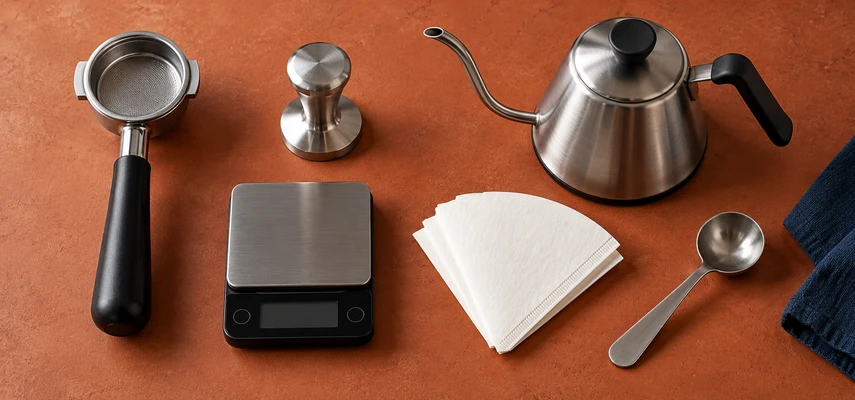
This is the handled holder that locks into an espresso machine and carries the filter basket. The basket holds the grounds; the portafilter supports it during brewing. When a barista knocks out the used coffee and reloads, this is often the piece they’re working with.
Tamp
Tamping compresses the grounds in the espresso basket into a compact bed. A tamper is the tool used for the job. It helps prepare the bed for water to pass through, but harder pressing isn’t an unlimited route to better coffee. Even preparation matters more than a show of force.
Crema
Crema is the foam that forms on top of espresso during brewing. It can look appealing, but its thickness alone doesn’t establish that the coffee tastes good. The espresso process creates a concentrated drink whose flavor still deserves attention beneath that attractive surface.
Microfoam
Microfoam is milk textured with very small bubbles, giving it a smooth, integrated feel. It is central to many steamed-milk drinks and latte art. The milk should feel silky rather than like a pile of large bubbles; it isn’t a separate ingredient added from a bottle.
Words for what you smell and taste
Aroma
Aroma is what you smell. In coffee, it’s a big part of the overall experience, from the bag opening to the brewed cup. You can start with broad associations such as roasted, nutty, or fruity. Precision can develop with practice; nobody needs to discover twelve fruits immediately.
Flavor notes
Flavor notes describe sensory associations, such as chocolate or citrus, rather than necessarily naming added ingredients. Explicitly flavored coffees are different. The sensory lexicon helps professionals use references consistently; your own first observation can be as simple as “reminds me of nuts.”
Acidity
In tasting conversation, acidity often describes a bright, lively quality that can be pleasant. It isn’t a direct reading of the drink’s pH and doesn’t, by itself, predict how your stomach will respond. Nor is it a command to enjoy a sour cup you dislike.
Body and mouthfeel
Body refers broadly to the sense of weight or fullness in the mouth; mouthfeel includes other tactile impressions, such as smoothness. These describe texture rather than caffeine or roast darkness. Comparing a lighter-feeling cup with a fuller one is often more useful than trying to define either in isolation.
Aftertaste
Aftertaste is the impression that remains after you swallow. It may be pleasant, harsh, brief, or lingering. Notice whether you enjoy what’s left behind rather than assuming that a longer finish must be better. Your coffee doesn’t earn extra credit simply for refusing to leave.
Use the words when they help
You don’t need to deploy every term when ordering or brewing. A few useful distinctions go a long way: species describes a plant; processing describes handling before roasting; dose is an input; strength describes the drink; body describes a sensation.
When something is unclear, ask what it means in that particular context. Coffee language works best when it helps people explain a cup, a method, or a preference. If a word makes that conversation easier, keep it. The rest can wait until your next bag brings a new question.












