History of Ryder System
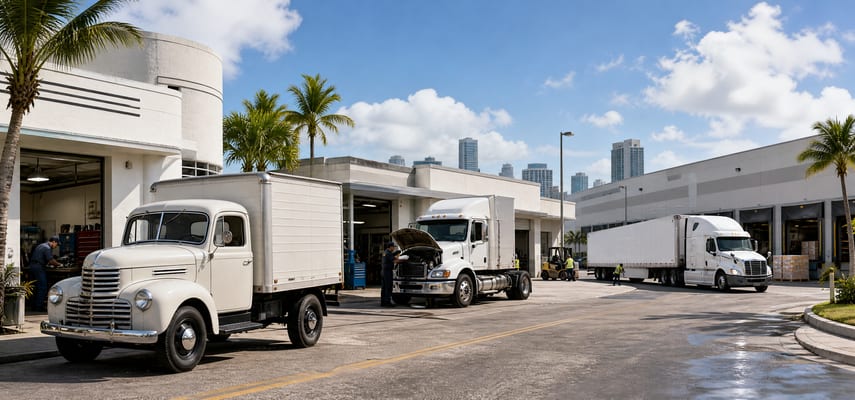
The image of a white box truck rolling through a city street or parked outside a distribution center is one of the enduring American business icons of the 20th and 21st centuries. Ryder System’s trucks have been part of that visual vocabulary for decades. The company began as a straightforward truck rental firm and evolved into an integrated logistics and fleet-management company that helped reshape how manufacturers, retailers and distributors move goods. This piece traces how Ryder grew from local rental operations into an NYSE-listed company with its principal executive offices in Coral Gables, Florida, how it repeatedly reinvented its business model, and why those shifts mattered for the logistics industry at large.
1933–1950s: From Local Rental to Fleet Leasing
Ryder’s origins date to 1933 in Miami, when Jim Ryder started hauling concrete with a single Model A Ford truck. The enterprise later became Ryder System, Inc., whose Florida articles of incorporation were filed on March 22, 1955.
During the 1940s and into the 1950s the company steadily broadened its services beyond short-term rentals. Two trends propelled that shift. First, as highway travel and goods movement increased in post-war America, businesses wanted more predictable access to vehicles than ad hoc rentals could deliver. Second, companies began to see the appeal of offloading the complexity of vehicle ownership—maintenance scheduling, insurance, regulatory compliance—to a specialist partner. Ryder responded by developing longer-term leasing contracts and by building in-house maintenance capabilities, laying the foundation for the lease-and-maintain business that would dominate its strategy for decades.
1960s–1970s: National Reach and the Fleet-Management Model
By the 1960s Ryder was no longer a purely local concern. The company expanded across state lines, opening rental and leasing operations in major industrial and commercial centers. Crucially, Ryder refined a fleet-management model that would become a template for the industry: instead of merely renting trucks, Ryder designed programs to manage a customer’s entire vehicle fleet, including acquisition, financing, maintenance, and remarketing.
This shift changed the relationship between Ryder and its customers from transactional to strategic. Large manufacturers and distributors could convert capital expenses into predictable operating costs while gaining access to Ryder’s expertise in maintenance, compliance and vehicle lifecycle management. For Ryder, the model meant deeper, more durable customer relationships and the ability to capture higher-margin service revenue tied to maintenance and fleet management.
1980s–1990s: Diversification into Logistics and Supply-Chain Services
As supply chains grew more complex in the 1980s and 1990s, Ryder again reinvented itself. The company began to move beyond vehicle management into the movement of goods: warehousing, inventory management, transportation planning and full supply-chain solutions. This transformation reflected a broader trend in corporate procurement—companies increasingly sought single-source providers who could coordinate transportation and fulfillment across regions and channels.
Ryder’s entry into logistics required different capital and operational capabilities than truck leasing: facilities, information systems, labor management and process engineering. The company invested in those capabilities and built integrated offerings that combined dedicated fleets with warehousing and distribution services. For many customers—retailers preparing for seasonal demand spikes or manufacturers consolidating distribution—Ryder’s integrated services provided lower total cost and faster response than managing disparate suppliers.
Corporate Maturation: Public Markets, Structure, and Brand
Ryder System, Inc. incorporated in Florida on March 22, 1955, and the company says it issued 160,000 shares of common stock at $10 per share that year. Ryder was listed on the New York Stock Exchange in 1960, and its common stock currently trades there under the ticker R. Ryder’s history records the opening of a new headquarters location in 1973 and a smaller global headquarters in Miami in 2005; its current principal executive offices are at 2333 Ponce de Leon Boulevard in Coral Gables, Florida.
The company’s portfolio coalesced around three core service lines that remain central to its identity:
- Fleet Management Solutions (FMS): full-service leasing, commercial rental and vehicle maintenance services.
- Dedicated Transportation Solutions (DTS): turnkey transportation solutions that include dedicated vehicles, professional drivers, management and administrative support.
- Supply Chain Solutions (SCS): fully integrated logistics solutions, including warehousing, distribution, transportation logistics, e-commerce and omnichannel fulfillment, and last-mile delivery.
These segments allowed Ryder to present itself as a one-stop partner for customers that wanted to shrink the number of vendors in their logistics stack. They also exposed the company to differing capital intensity and margin pressures—leasing and dedicated transportation typically required heavier up-front investment in vehicles and people, while logistics and technology services were more asset-light but demanded process excellence and systems integration.
1990s–2000s: Technology, Outsourcing and Integrated Services
The 1990s and 2000s saw two parallel forces transform logistics: the rise of enterprise planning and transportation software, and the growing appetite among corporations to outsource logistics activities. Ryder linked hundreds of maintenance facilities with computers and automated diagnostic tools in 1992, opened a web-enabled transportation management center in 2000, launched online tracking tools in 2001, and adopted integrated wireless, GPS and computer technology during the decade.
These systems expanded visibility into vehicles, freight and inventory. Ryder subsequently integrated telematics and warehouse and transportation management systems into its service platforms to support vehicle intelligence, routing, inventory management and order execution.
During this period Ryder also expanded its dedicated transportation offerings and deepened its ability to run complex distribution networks. Retailers and manufacturers leveraged Ryder’s scale and operational playbook to outsource seasonal peaks, enter new markets, or run entire transportation networks as e-commerce growth forced companies to rethink last-mile and fulfillment strategies.
2010s: E-Commerce, Last-Mile Complexity and Sustainability Questions
The explosive growth of e-commerce in the 2010s reoriented logistics priorities. Customers needed faster delivery windows, more pickup and return options, and greater visibility. Ryder adapted its dedicated transportation and supply-chain services to support omnichannel distribution and faster transit times, and increased emphasis on network engineering—designing distribution networks to reduce transit time and cost across peak seasons.
At the same time, sustainability and fuel costs became material considerations. Ryder’s fleet-centric model made fuel efficiency, emissions and alternative fuels strategic issues rather than peripheral ones. The company evaluated and deployed a range of options—fuel-efficient powertrains, route optimization to reduce mileage, and programs to introduce cleaner technologies—because these choices influenced customers’ total costs and regulatory compliance. The approach reflected a broader industry recognition that environmental performance is integral to logistics competitiveness.
2020–2023: Pandemic Shock, Flexibility and Acceleration of Digital Tools
The COVID-19 pandemic profoundly stressed global supply chains, and Ryder was no exception. Lockdowns, labor shortages and shifting demand patterns tested the resilience of transportation and warehousing networks. Ryder’s focus on integrated services proved an advantage for some customers: firms that relied on Ryder’s facilities and dedicated fleets could adjust capacity and reroute flows more quickly than those managing many vendors.
In May 2020, Ryder launched RyderShare, a digital platform integrating data from transportation and warehouse management systems to provide real-time freight visibility and collaboration. By February 2021, Ryder reported that the platform had tracked almost two million shipments for supply-chain and dedicated-transportation customers. During the pandemic, Ryder also enhanced an existing mobile driver application to survey frontline workers about protective equipment and operational issues.
The Electrification Era and Fleet Innovation
In the 2020s, the question of how truck fleets would electrify became central for fleet managers and their partners. For Ryder, electrification presented both opportunity and complexity. On the one hand, electric vehicles promise lower total cost of ownership in some duty cycles and dramatic emissions reductions. On the other, electrification requires new capital, charging infrastructure, training and different maintenance practices.
Ryder introduced RyderElectric+ in May 2023 as a turnkey fleet offering combining electrification advice, leased vehicles, charging, telematics and maintenance. In September 2023, the company deployed its first BrightDrop Zevo 600 electric vans at four rental locations in California, Texas and New York, supported by ChargePoint-enabled charging infrastructure.
Globalization, Partnerships and the Limits of Scale
Ryder expanded internationally over several decades, entering Canada in 1957, the United Kingdom in 1971, Germany in 1983 and Mexico in 1994, among other markets. More recently, the company narrowed its geographic footprint, completing the shutdown and disposal of its lower-return European fleet-management business in 2023. Ryder’s current filings describe it as a provider of outsourced logistics and transportation services throughout North America.
Today Ryder’s international capabilities principally support its North American port-to-door network, including cross-border logistics and international inbound freight flows. It is therefore better described as a North America-focused logistics and transportation provider than as a global integrator operating across dozens of countries.
Why Ryder’s Evolutions Mattered for Customers and the Industry
Ryder’s history is useful not as a chronology of new services but as an example of how a logistics provider can shift the basis of competition. Three lessons stand out:
- Turning trucks into a service changes incentives. By leasing and managing fleets, Ryder aligned its interests with customers’ need for uptime and cost predictability.
- Integrated logistics reduces friction. Combining dedicated transportation with warehousing and technology creates efficiencies and raises switching costs—beneficial to customers who want fewer vendors and to Ryder in terms of revenue stability.
- Technology and energy transitions are strategic, not tactical. Telemetry, routing software and electrification reshape operational design. Firms that invested early in these capabilities helped customers adapt faster and captured more of the value chain.
Recent Years: Operational Focus and Customer Centricity
In recent years, Ryder emphasized operational efficiency and customer service—delivering logistics faster, more transparently and with more predictable cost structures. Its long experience with dedicated transportation and fleet management positioned the company to help large customers facing e-commerce pressures, labor challenges and environmental targets. Ryder has aimed to balance owning enough assets to assure service quality with service models that reduce capital burdens for customers and create recurring revenue streams.
Challenges and Competitive Dynamics
No company in logistics is immune to competition and disruption. Ryder competes with global integrators, regional carriers, pure-play technology companies and an array of private specialists. Customers increasingly demand flexibility at lower cost, which pushes providers to innovate continually. Labor, regulation and fuel costs add layers of complexity and can shift the economics of asset ownership overnight.
Ryder’s long-term advantage lies in operational depth and a mature playbook for fleet and logistics management. Yet sustaining that advantage requires ongoing investment in systems, training and new fuel technologies. The company’s future performance depends on converting those investments into improved customer economics and on keeping pace with rapidly evolving demand patterns, including same-day delivery and micro-fulfillment approaches.
Where Ryder Fits in Today’s Logistics Landscape
Today Ryder is best understood as a large-scale practitioner of fleet and supply-chain management: a partner for customers who prefer outsourcing core transportation and distribution operations. The company’s strength is in operational execution—managing complex routing, maintaining vehicles, and operating warehouses at scale—rather than in owning every piece of the global logistics puzzle.
That position matters especially for industries where fleets and facilities represent large, recurring costs—grocery, retail, manufacturing and heavy goods distribution. Ryder’s offerings let these companies focus capital and management attention on core products while relying on a specialist for the messy, 24/7 operational work of moving goods.
Conclusion
Ryder System’s story is not a tale of one breakthrough but of repeated reinvention. From local truck rental in the 1930s to nationwide leasing, and from there into integrated logistics and fleet electrification planning, the company has continually shifted to ask: how can we make it easier and cheaper for customers to move goods? Each strategic step—leasing, dedicated transportation, supply-chain services, technology and sustainability programs—responded to shifts in customer needs and the broader economy.
That adaptability explains Ryder’s staying power. Logistics is not glamorous, but it is essential; success belongs to companies that combine disciplined operations, thoughtful investment and an ability to translate industry transitions—digitalization, e-commerce, decarbonization—into practical, lower-risk solutions for customers. Ryder’s history shows how a company can turn trucks into a platform for value rather than merely a fleet of vehicles for rent.