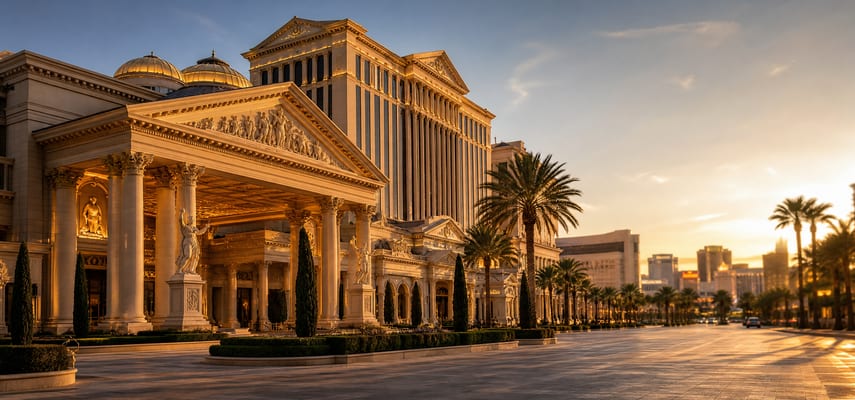
History of Caesars Entertainment
The story of Caesars Entertainment is not a tidy corporate origin tale so much as a braided narrative of two American gambling dynasties — the flamboyant, brand-first Caesars Palace and the pragmatic, data-driven Harrah’s — followed by decades of consolidation, financial strain and reinvention. That collision produced the company that today carries the Caesars name: an operator whose fortunes have been shaped as much by entertainment and celebrity as by loyalty programs, leveraged deals and the rise of sports betting.
Key milestones
- 1937 — William F. Harrah opens a small gambling business in Reno.
- 1966 — Jay Sarno opens Caesars Palace on the Las Vegas Strip.
- 1970s–1990s — Caesars brand expands beyond Las Vegas while Harrah’s builds scale and centralized management.
- 1990s — Harrah’s develops a national footprint and repeatable customer experience.
- 2005 — Harrah’s Entertainment acquires Caesars Entertainment in a cash-and-stock merger valued at approximately $9.3 billion, including assumed debt.
- 2015–2017 — Caesars Entertainment Operating Company enters Chapter 11 protection and later emerges through a restructuring that separates operations from significant real estate holdings.
- 2018 — The Supreme Court strikes down the federal restrictions in PASPA, clearing the way for individual states to authorize sports betting.
- 2020 — Eldorado Resorts completes its acquisition of Caesars Entertainment Corporation and adopts the Caesars Entertainment name.
- 2021 — Caesars acquires William Hill plc for approximately £2.9 billion, intending to retain its U.S. operations.
- 2020s — Post-merger integration, sportsbook expansion and ongoing brand management.
Foundations: William F. Harrah and Jay Sarno
William F. Harrah (1937)
William F. Harrah opened a small gambling business in Reno in 1937 and built it into Harrah’s, a chain of casinos that emphasized consistent service, operational discipline and steady incremental growth. Harrah’s grew as a family-run business that eventually became a national player.
Jay Sarno (1966)
Across Nevada, Jay Sarno pursued a different idea. In 1966 Sarno opened Caesars Palace on the Las Vegas Strip, an ambitious resort that deployed Roman iconography and large-scale spectacle to attract high rollers and show business. Caesars Palace was conceived as a destination where nightlife, luxury and gaming would fuse; its name and décor became shorthand for a certain Las Vegas glamour.
These two founding tracks — Harrah’s operational playbook and Caesars Palace’s brand magnetism — would later intersect in ways neither founder likely foresaw.
Expansion and Brand Building through the 1970s–1990s
From the 1970s onward, the Caesars name expanded beyond its original Las Vegas resort as the gaming industry nationwide grew. Promoters, financiers and entertainment executives built and acquired properties in Atlantic City, Las Vegas and other emerging gaming markets.
Caesars Palace and other Caesars-branded resorts showcased big-name entertainment, high-stakes gaming and luxury amenities; they helped make the Caesars brand a global shorthand for a certain kind of casino experience.
Meanwhile, Harrah’s pursued a different growth engine: scale and systems. Over decades the company acquired properties from regional operators and leaned into centralized management. By the 1990s Harrah’s had built a national footprint and begun to blend gaming and hospitality into a repeatable consumer experience.
Data, Loyalty and the Rise of the Casino Rewards Model
One of the most consequential strategic shifts in modern casino history was the industry’s embrace of loyalty programs and customer analytics. Harrah’s invested early in a comprehensive rewards program and the systems to analyze player behavior. The company used that data to tailor marketing, shift promotional spend and push offers that kept customers returning — a playbook later adopted across gaming.
This focus on repeat customers and measurable marketing changed how casinos valued patrons. Gambling floors, restaurants and hotel rooms came to be measured in lifetime value, and the industry moved from episodic spectacle toward retention-focused strategies.
Consolidation: Harrah’s Acquires Caesars and the Creation of a National Giant
On June 13, 2005, Harrah’s Entertainment completed its acquisition of Caesars Entertainment, Inc. through a merger of Caesars into Harrah’s Operating Company. The cash-and-stock transaction had an estimated aggregate purchase price of approximately $9.3 billion, including Caesars debt assumed by Harrah’s.
The deal reshaped the industry by concentrating marquee brands and broadening the customer database that underpinned loyalty programs. It also marked a turning point: national consolidation meant that strategic decisions were now national in scope, blending resort marketing with portfolio-level financial engineering.
Leadership and Strategic Shifts in the 2000s
Following consolidation, Caesars’ corporate strategy turned on a mix of continued brand management and sharper financial focus. Executives who emphasized data-driven customer management were influential in shaping everything from sportsbook placement to restaurant partnerships.
At the same time, private equity and debt markets looked hard at casino companies because they generate steady cash flows and because those cash flows can support large amounts of leverage. The gaming industry’s attractiveness to financial buyers ushered in an era in which capital-structure decisions mattered as much as customer acquisition tactics.
Financial Strains and Restructuring in the Mid-2010s
On January 15, 2015, Caesars Entertainment Operating Company, Inc. and certain subsidiaries filed voluntary Chapter 11 petitions. The debtors emerged from bankruptcy on October 6, 2017, after the bankruptcy court confirmed their reorganization plan earlier that year.
The restructuring separated casino operations from significant real estate holdings and established new lease arrangements between the operating business and a newly formed property company. It also fed arguments on both sides about the risks of heavy debt in a cyclical, regulation-sensitive industry.
The Emergence of a Standalone Caesars Brand and Real Estate Separation
As part of the October 6, 2017 restructuring, certain real estate and golf-course assets formerly held by Caesars Entertainment Operating Company were transferred to VICI Properties, a newly formed real estate investment trust. VICI’s initial portfolio included 19 gaming facilities and four golf courses, while Caesars-related operating entities continued to run the casino properties under long-term triple-net leases.
The transaction created a documented operating-company/property-company structure: CEOC was reorganized as CEOC LLC, which operated facilities formerly held by CEOC, while VICI owned significant underlying real estate and leased it back under master lease agreements.
Eldorado Resorts, the 2020 Deal and the Rebirth of “Caesars”
On July 20, 2020, Eldorado Resorts, Inc. completed its acquisition of Caesars Entertainment Corporation in a cash-and-stock merger originally announced at an estimated transaction value of approximately $17.3 billion. A subsidiary of Eldorado merged into Caesars Entertainment Corporation, which survived as a wholly owned subsidiary, while Eldorado changed its name to Caesars Entertainment, Inc.
The transaction gave former Caesars shareholders the right, subject to proration and other merger terms, to receive approximately $12.41 in cash or approximately 0.3085 shares of the renamed company for each eligible share. The Federal Trade Commission cleared the combination subject to casino-asset divestitures intended to preserve competition in two regional markets.
It reunited a recognizably national portfolio under a single public company and made the new Caesars one of the largest gaming operators in the United States. The deal married Caesars’ brand recognition with Eldorado’s experience in integrating regional properties and reflected the industry’s continuing consolidation as sports betting expanded beyond Nevada.
Digital Betting, William Hill U.S. and the Move Into Sportsbook Platforms
As sports wagering became legal in more U.S. states after the Supreme Court struck down the Professional and Amateur Sports Protection Act in May 2018, casino operators raced to build digital platforms and partnerships. Caesars pivoted into sports betting as an essential component of its future retail and online offering.
On April 22, 2021, Caesars completed an all-cash acquisition of the entire issued and to be issued share capital of William Hill plc, other than excluded treasury or Caesars-owned shares, for approximately £2.9 billion, or about $4 billion. Caesars intended to retain William Hill’s U.S. operations while divesting its United Kingdom and other international online and retail businesses.
The deal brought William Hill’s U.S. sports-betting operations into the Caesars organization. Caesars subsequently completed the sale of William Hill’s non-U.S. assets to 888 Holdings in July 2022.
That move underscored two trends: land-based casinos viewing online sports betting as a new revenue channel and the integration of sportsbooks with casino loyalty programs to create cross-selling opportunities and deepen lifetime value.
Post-Merger Integration and Brand Management in the 2020s
After the 2020 combination and subsequent acquisitions, Caesars focused on integrating disparate businesses: hotel and casino operations, online sportsbooks, loyalty databases and regional property portfolios. Integration required harmonizing loyalty programs, standardizing operating practices and aligning leadership across a much larger footprint.
Tom Reeg, the executive who led Eldorado, took a central role after the merger, steering the new company’s operating strategy. The challenge was not merely financial; it was cultural and technological. Merging legacy systems, product lines and regional management teams tested leadership and revealed where legacy processes either helped or hindered growth.
Public-Facing Moves: Entertainment, Sports Partnerships and Loyalty
Throughout its history the Caesars name has remained tightly linked to entertainment. Resorts continued to host concerts, residencies and event programming because those attractions drive room nights and high-value gaming. In the 2020s digital partnerships — including sports-betting sponsorships and media deals — supplemented physical entertainment as ways to keep the brand visible beyond land-based casino floors.
Equally important has been the loyalty engine. What began as Harrah’s Total Rewards evolved under the Caesars name into a unified loyalty program that spans hotels, dining, gaming and digital play. The loyalty program is the company’s primary instrument for measuring and influencing customer behavior across channels.
Regulation, Market Expansion and Competitive Pressures
Caesars’ trajectory has been shaped constantly by regulation. State-by-state rules govern casino ownership, online betting, sportsbook licensing and marketing. Each new legal market — from New Jersey to Pennsylvania to expanding mobile-betting jurisdictions — created opportunities and required regulatory navigation.
Competition also intensified. New entrants, including digital-native companies, forced Caesars to develop stronger technology and media strategies. Meanwhile, regional competitors and new resorts continued to press Caesars on price, service and entertainment offerings.
Recent Years: Consolidation, Growth and Practical Challenges
In the years since the 2020 merger, Caesars has pursued a portfolio strategy of integrating regional properties, scaling its sportsbook and monetizing valuable brand assets. The company’s path forward has combined asset-light moves — like licensing and digital expansion — with traditional hospitality investments in amenities and entertainment.
Several practical challenges remain. Integrating large acquisitions takes time; regulatory compliance in dozens of jurisdictions adds cost and complexity; and legacy debt burdens can constrain new investments. At the same time, the upside is clear: a unified Caesars brand with national scale can sell packages, run national marketing and negotiate media and sponsorship deals from a stronger position than many rivals.
Why Caesars’ History Matters
The long arc of Caesars Entertainment illustrates three larger shifts in American business. First, the movement from locally owned gambling houses to national, brand-led corporations mirrors the trajectory of many hospitality industries. Second, the rise of data and loyalty programs shows how services once rooted in entertainment became measured like subscription businesses. Third, the industry’s heavy reliance on leverage, followed by restructuring, underscores how capital markets can both accelerate growth and expose operators to cyclical risk.
More narrowly, the Caesars story is a study in brand endurance. From Jay Sarno’s theatrical 1960s Las Vegas vision to modern digital sportsbooks, the Caesars name remains a powerful asset. That brand equity has survived bankruptcies, ownership changes and the rise of entirely new competitors — largely because the company has repeatedly repackaged the name for new markets.
Conclusion
Caesars Entertainment today is the product of many converging histories: the spectacle of Caesars Palace, the operational rigor of Harrah’s, and the consolidation and financial engineering of the modern gaming industry. Its recent incarnation — the result of mergers, acquisitions and strategic bets on sports betting and loyalty — reflects broader changes in leisure, technology and finance. For observers, the Caesars story offers a clear lesson: in an industry where table stakes and brand prestige intertwine, success depends on balancing showmanship with systems, and on aligning short-term finance with long-term customer value.