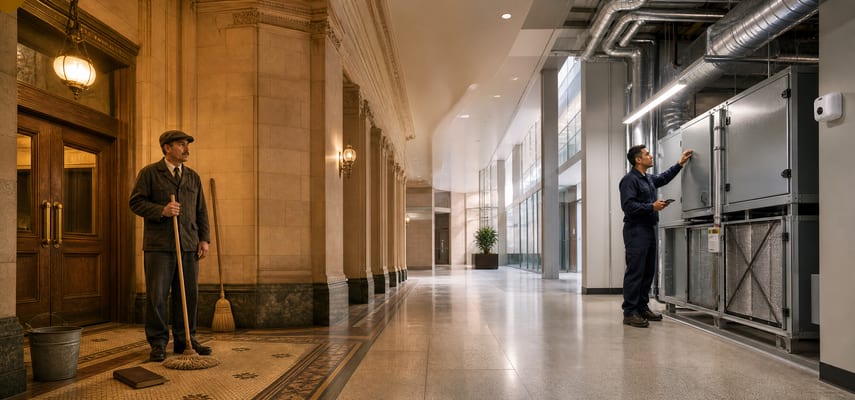
History of ABM Industries
In 1909, Morris Rosenberg invested $4.50 in basic window-washing equipment and began serving merchants on San Francisco’s Fillmore Street. From that one-person business, the company that became ABM Industries evolved into a large publicly traded provider of facility, engineering and infrastructure solutions. Its development—from cleaning and maintenance to technical systems, energy projects and pandemic-era disinfection—reflects the broader growth of outsourced facility services.
Timeline: Key milestones
- 1909 — Morris Rosenberg starts a one-person window-washing business in San Francisco
- 1913 — The growing business is renamed American Building Maintenance Company
- 1920s–1930s — Expands along the West Coast, establishes technical services and opens a New York branch
- 1962 — Conducts its initial public offering
- 1965 — Lists on the American Stock Exchange
- 1972 — Lists on the New York Stock Exchange
- 1985 — Incorporates in Delaware as American Building Maintenance Industries, Inc.
- 1994 — Changes its name to ABM Industries Incorporated
- 2000s–2010s — Expands through acquisitions and adds technical, aviation, education and energy capabilities
- 2015 — Scott Salmirs becomes CEO and ABM begins its 2020 Vision transformation
- 2017 — Acquires GCA Services Group for $1.25 billion, then its largest acquisition
- 2020–2021 — Responds to COVID-19 through the EnhancedClean program and related disinfection work
- 2021–2025 — Acquires Able Services, RavenVolt, Momentum Support, Quality Uptime Services and LMC FM
- 2020s — Emphasizes infrastructure, sustainability, data-driven operations and measurable customer outcomes
Quick facts
- Founded: 1909 in San Francisco by Morris Rosenberg
- Public listing: New York Stock Exchange, ticker ABM
- Fiscal 2025 revenue: approximately $8.75 billion
- Employees as of October 31, 2025: approximately 113,000, including a workforce that was 92% frontline employees
- Core services: janitorial and maintenance; facilities engineering; parking and transportation; aviation support; electrical, lighting, energy, HVAC and mechanical services; landscaping and turf; EV charging, microgrids and mission-critical infrastructure
From a San Francisco window-washing business to a regional service company (1909–1950s)
ABM’s roots lie in the early 20th century service economy of San Francisco. In 1909, founder Morris Rosenberg began washing shopkeepers’ windows along Fillmore Street after investing $4.50 in equipment. ABM’s corporate history does not identify a specific calendar day for the founding. As the operation expanded from window washing into broader janitorial work, Rosenberg renamed it American Building Maintenance Company in 1913.
The company expanded beyond San Francisco during its first decades, opening offices in Los Angeles, Portland and Seattle by 1920. It established an electrical and mechanical operation in Los Angeles in the early 1930s and opened its first New York branch in 1933. Regular service agreements helped the business move beyond individual cleaning jobs and develop a model that could be replicated across cities.
Postwar expansion and service diversification (1950s–1970s)
After World War II, American business and commercial construction expanded. ABM built on the geographic and technical foundation it had established before the war, reaching more than 6,000 employees and maintaining offices in 45 North American cities by its 50th anniversary in 1959.
- Customers increasingly wanted vendors capable of supporting complex commercial facilities in addition to providing janitorial work.
- Cleaning, parking, engineering and other non-core operations became significant markets for specialized contractors.
ABM developed a broader group of custodial, parking, electrical, mechanical and engineering capabilities. This diversification gradually transformed the company from a cleaning contractor into a multi-service facility provider.
Going national and entering public markets (1960s–1990s)
As the facility-services market matured, ABM pursued national scale. Growing a coast-to-coast operation required standardized training, regional management structures and centralized bidding processes. These capabilities allowed the company to pursue larger institutional and corporate accounts that preferred one provider across multiple locations.
ABM conducted its initial public offering in 1962, listed on the American Stock Exchange in 1965 and moved to the New York Stock Exchange in 1972. Its common stock continues to trade on the NYSE under the ticker symbol ABM. The successor corporation was incorporated in Delaware on March 19, 1985, as American Building Maintenance Industries, Inc., and shareholders approved the name ABM Industries Incorporated on March 16, 1994.
Public ownership gave ABM access to capital for acquisitions and national infrastructure while also introducing the reporting and performance expectations associated with a listed company.
Strategic diversification: engineering, parking, aviation and energy services (1990s–2010s)
In the closing decades of the 20th century and into the 21st, ABM continued to broaden its portfolio. The company layered specialized technical services onto its custodial base, including electrical and lighting maintenance, mechanical and HVAC engineering, parking management and support services for airlines and airports.
Acquisitions were central to this expansion. The purchases of OneSource and Linc Group in the early 2000s strengthened ABM’s commercial janitorial and technical capabilities. ABM acquired Air Serv in 2012, helping establish aviation as a dedicated industry group. It sold its security business as part of the strategic transformation begun in 2015.
In September 2017, ABM acquired GCA Services Group for $1.25 billion, then the largest acquisition in its history, expanding its presence in education and commercial facilities. It acquired Able Services in 2021, followed in 2022 by microgrid provider RavenVolt and Ireland-based Momentum Support. Quality Uptime Services was acquired in 2024, and Dublin-based LMC FM joined ABM in 2025.
Entering the energy-efficiency and infrastructure era (2000s–2020s)
Beginning in the 2000s, energy costs, aging infrastructure and sustainability concerns reshaped the facility-services market. Businesses and public institutions increasingly looked for partners that could design and deliver upgrades while documenting operational or utility savings.
ABM expanded into energy projects, electrical and lighting work, HVAC improvements and performance-based infrastructure arrangements. Its Technical Solutions portfolio later grew to include EV charging infrastructure, microgrid installations, battery storage, distributed generation, uninterrupted power supply systems and other mission-critical electrical services.
This work differs from recurring janitorial contracts because it often involves engineering, construction milestones, capital investment and agreed performance standards. It therefore allows ABM to combine facility operations with infrastructure design, project execution and long-term maintenance.
Technology, data and the modern facilities stack
As connected-building technologies became more practical, facility customers began to demand greater visibility into operations. ABM incorporated digital reporting, sensors and operational data into its services. Its ABM Connect platform combines information from people, systems and sensors to provide centralized reporting, performance visibility and predictive insights.
This approach does not eliminate the need for cleaners, engineers and technicians. Instead, ABM presents technology as a way to direct work more efficiently, identify equipment problems and document service and facility outcomes for customers.
Responding to crisis: ABM during the COVID-19 pandemic (2020–2021)
The arrival of COVID-19 in 2020 was operationally disruptive across ABM’s markets. Office closures, school shutdowns and reduced travel weakened demand in several business areas, while customers also requested additional cleaning, disinfection and facility-reopening services.
In April 2020, ABM introduced EnhancedClean, a program developed with guidance from infectious-disease and industrial-hygiene experts. Its documented services included pre-opening site assessments, one-time enhanced cleaning, recurring high-touch-point disinfection and broader-area disinfection. The program used measures such as personal protective equipment, electrostatic sprayers and EPA-registered disinfectants qualified for use against SARS-CoV-2.
ABM’s fiscal 2020 filing reported that pandemic-related disruptions contributed to a 7.9% revenue decline, although the effect was partially offset by additional work orders and services such as EnhancedClean. The company also reported $13.1 million in expenses associated with investments in EnhancedClean, other pandemic-related projects and certain corporate initiatives.
Workforce scale and management challenges
ABM derives much of its scale from its workforce. As of October 31, 2025, it employed approximately 113,000 people, and frontline employees represented 92% of the total. About 51,000 employees were covered by local collective bargaining agreements.
Managing such a workforce has shaped ABM’s operational priorities, including recruiting, scheduling, safety training, employee development and labor relations. These human-resource challenges have direct business implications because staffing levels, turnover and training can affect service quality, costs and customer retention.
For ABM and its peers, workforce management is both a major operating expense and a potential competitive differentiator. Skilled technical work in particular depends on recruiting, training and retaining employees capable of maintaining increasingly complex infrastructure.
International presence and the limits of global scale
ABM’s principal operations remain in the United States, which generated approximately 92% of its fiscal 2025 revenue. The company also has operations in other jurisdictions, most significantly the United Kingdom and Ireland. Acquisitions including Westway Services, Momentum Support and LMC FM expanded its janitorial and technical-services presence in those markets.
Managing services across borders introduces differences in labor law, data protection, currency exposure and operating practices. ABM’s international footprint is therefore meaningful but substantially smaller than its U.S. business.
Market consolidation and competitive dynamics
The facility-services sector has seen repeated consolidation as large firms and specialized regional providers compete for contracts that can be long-term and operationally complex. For ABM, maintaining competitiveness has meant balancing price with service quality, developing technical and infrastructure capabilities and leveraging its scale for nationwide customers.
Consolidation also raises the bar for service differentiation. Providers must demonstrate reliable performance, regulatory compliance, workforce capacity and effective risk management to win and retain major contracts.
Recent strategic priorities: sustainability, infrastructure, data and customer outcomes
In the 2020s, ABM has emphasized services intended to make facilities more efficient and resilient. Its current offerings include energy and lighting projects, HVAC and mechanical work, EV charging, microgrids, uninterrupted power supply services and other infrastructure solutions.
The company has also promoted integrated and outcome-based delivery. ABM Performance Solutions, for example, is presented as a model that combines multiple facility services under one contract, invoice and accountable provider while using measurement systems to document results. ABM Connect supports this strategy by providing operational, financial and performance information through a centralized data platform.
Why ABM’s evolution matters to modern business
ABM’s century-long arc mirrors how corporations have redefined what is “core” to their operations. Where many organizations once maintained all janitorial and facilities teams internally, they now outsource bundles of services to specialists that offer labor, engineering, technology and geographic scale.
ABM’s evolution—from a window-washing business to a provider of cleaning, parking, engineering and infrastructure services—illustrates how outsourced facility management has grown into a field that combines recurring labor-based work with complex technical and capital projects.
Current challenges and the road ahead
ABM and its peers face persistent challenges: recruiting and retaining a trained frontline workforce, navigating demand tied to office occupancy and travel trends, incorporating new technologies and proving the value of infrastructure and sustainability investments. The company must also contend with competitive bidding, wage pressures and the cyclical nature of capital projects.
Opportunities coexist with these challenges. Aging buildings require upgrades, data centers and advanced manufacturing sites need mission-critical services, and customers continue to invest in energy efficiency, electrification and resilient infrastructure. Success will depend on execution across a mix of recurring service agreements and technical projects.
Services that define the ABM offering
ABM’s current business covers a broad range of operational and infrastructure needs. Its principal capabilities include:
- Janitorial, custodial and maintenance services
- Facilities engineering and technical staffing
- Parking and transportation management
- Aviation support, including passenger assistance, catering logistics and aircraft-cabin maintenance
- Electrical, lighting, HVAC and mechanical services
- Energy projects and performance-based infrastructure improvements
- Landscaping and grounds maintenance
- EV charging, microgrids, battery storage and distributed-generation systems
- Uninterrupted power supply and mission-critical infrastructure services
- Digital performance reporting and facility-data tools
That breadth is a central competitive asset because customers can obtain multiple services from one provider rather than managing numerous separate contractors.
Conclusion
From Morris Rosenberg’s one-person San Francisco window-washing business in 1909 to a publicly traded company with approximately 113,000 employees and $8.75 billion in fiscal 2025 revenue, ABM Industries exemplifies how the service side of the built environment professionalized and scaled. Its expansion into engineering, aviation support, parking, energy systems, mission-critical infrastructure and data-driven operations reflects larger changes in customer priorities. ABM’s future will depend on managing labor at scale, executing technical projects and translating its infrastructure and technology investments into measurable customer results.