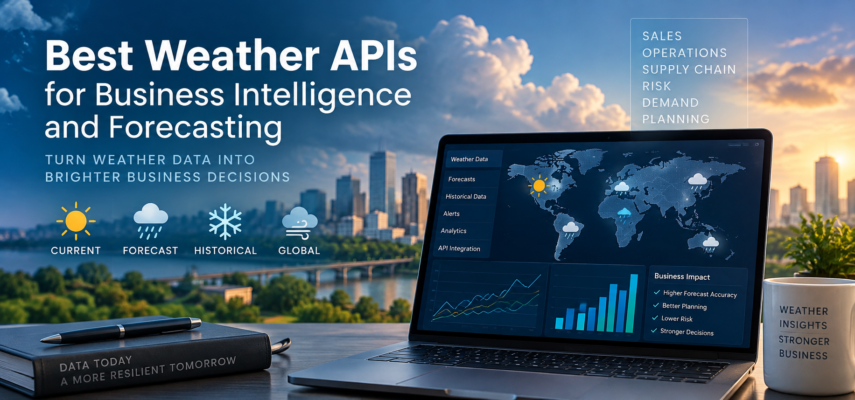
Weather APIs have become a useful part of modern business software. They help apps, dashboards, and forecasting tools account for conditions that influence demand, transportation, staffing, risk, customer behavior, and day-to-day operations. For business intelligence teams, weather data can explain patterns that might otherwise look random, including sales changes, delivery delays, energy use, and seasonal demand shifts.
The right weather API depends on how the data will be used. Some teams only need current conditions for an app. Others need historical weather records, longer-range forecasts, global coverage, or data formats that fit into analytics workflows. A strong weather API should make that information easy to access, compare, and apply inside real business systems.
What Makes a Weather API Useful for Business Intelligence?
A good weather API does more than return the temperature. For business intelligence, the real value comes from how well the data fits into reports, dashboards, forecasting models, and operational tools. Teams need weather information that is accurate, consistent, and available in formats their systems can work with.
Historical weather data is especially useful because it helps teams spot patterns over time. A retailer might compare past rainfall with store traffic. An energy company might look at temperature changes and demand. A logistics team might review how storms, snow, heat, or wind lined up with slower deliveries. When weather data is paired with business metrics, unusual changes become easier to understand.
Forecasting matters as well. Businesses often need to plan before conditions change, whether that means adjusting staffing, managing inventory, preparing routes, or estimating customer demand. The best weather APIs make that easier by combining reliable forecasts with historical and current data that teams can actually use.
Why Location Coverage and Data Quality Matter
Weather data only helps when it matches the places a business needs to understand. A dashboard for one city has very different requirements from a forecasting system that tracks stores, routes, facilities, or customers across several regions. Gaps in coverage can lead to weak comparisons, missed risks, and misleading patterns.
Weather inputs become more useful when they work alongside spatial data to optimize business operations, especially for companies comparing conditions across stores, delivery routes, regions, or service areas.
Data quality is just as important as coverage. Reliable weather APIs should provide steady updates, clear documentation, usable formats, and enough historical depth to support analysis over time. Without that foundation, weather data can become another noisy input instead of a useful business signal.
Top Weather APIs for Business Intelligence and Forecasting
1. Visual Crossing
Best for: Historical weather data and business forecasting
Visual Crossing is a strong choice for teams that need weather data for reporting, forecasting, and planning. It brings together historical weather records, current conditions, and forecast data in formats that are well-suited to dashboards, analytics tools, and business intelligence systems.
When teams compare weather patterns with sales, traffic, energy usage, delivery performance, or customer behavior, Visual Crossing global weather data helps explain sudden dips, delays, spikes, and seasonal changes.
It is especially useful for data teams that want API access, downloadable datasets, and common formats that fit into existing reporting tools. For companies building forecasting models or operational dashboards, that mix of accessibility and depth makes Visual Crossing a strong overall pick.
2. OpenWeather
Best for: General app and dashboard integrations
OpenWeather is one of the more familiar options for developers who need current conditions, forecasts, and weather data for apps, websites, and dashboards. It works well for common use cases such as local forecast widgets, mobile apps, travel tools, and basic planning features.
Its main strength is accessibility. Developers can get started quickly, and the platform offers several weather data products at different levels of complexity. That makes it a practical option for teams that need a straightforward weather layer without having to build a forecasting system from scratch.
OpenWeather is a good fit for products that need weather information at scale, especially when the project does not require deep historical analysis or specialized business forecasting workflows.
3. Tomorrow.io
Best for: Operational weather intelligence
Tomorrow.io is designed for teams that need weather data tied closely to operations. It can be a strong fit for logistics, aviation, on-demand services, construction, fieldwork, and other industries where weather can affect schedules, routes, safety plans, or service levels.
The platform focuses on turning weather conditions into alerts and decision points. That makes it useful for businesses that need to respond quickly when rain, wind, heat, snow, or storms could interrupt normal operations.
Tomorrow.io is better suited to operational planning than simple forecast displays. Teams that need weather-triggered workflows, risk monitoring, and location-specific alerts will likely get more value from it than teams looking for a basic weather widget.
4. WeatherAPI.com
Best for: Simple forecast integrations
WeatherAPI.com is a practical choice for teams that want weather data without a complicated setup. It offers current weather, forecasts, historical data, time zone information, astronomy data, and other common weather features through a developer-friendly API.
Its biggest advantage is simplicity. Teams building websites, internal dashboards, mobile apps, or lightweight planning tools can usually find the core weather data they need without having to work through a more complex enterprise platform.
WeatherAPI.com is best for projects where speed and ease of integration matter more than advanced modeling or specialized business forecasting. It is a solid option for teams that need dependable weather data in a familiar format.
5. Meteomatics
Best for: Enterprise-grade weather modeling
Meteomatics is a strong option for organizations with detailed weather data needs. It is often a fit for sectors such as energy, agriculture, insurance, aviation, logistics, and research, where small changes in weather conditions can matter at the operational level.
The platform is built for teams that need more than standard forecasts. It supports high-resolution weather data, historical records, climate-related data, and specialized modeling needs for larger technical environments.
Meteomatics is best for companies with advanced data requirements and the internal expertise to work with more detailed weather inputs. For teams building enterprise forecasting systems, risk models, or industry-specific planning tools, it offers depth that simpler APIs may not provide.
6. AccuWeather APIs
Best for: Commercial forecast coverage
AccuWeather APIs are a good fit for teams that want weather data from a widely recognized forecasting brand. They can support apps, websites, media products, travel platforms, and business tools that need current conditions, forecasts, alerts, and location-based weather information.
The platform works well for products where users expect familiar, consumer-friendly weather data. It can also be useful for businesses that need broad forecast coverage without having to build a more specialized weather intelligence system.
AccuWeather APIs are best for teams that value brand recognition, commercial reliability, and standard forecast features. For deeper analytics or historical weather workflows, teams may still want to compare it with APIs built more directly for data-heavy use cases.
7. NOAA / National Weather Service
Best for: U.S. public weather data
NOAA and the National Weather Service are useful options for teams that need public weather data focused on the United States. They can work well for civic tools, research projects, internal systems, educational platforms, and applications that rely on official U.S. weather information.
The main advantage is access to public government weather data. Developers can work with alerts, forecasts, observations, radar, and other U.S.-based weather products, depending on the project.
NOAA and the National Weather Service are best for teams comfortable with public datasets and technical documentation. They are less suited to projects that require global commercial coverage, polished business workflows, or a single API tailored to international forecasting needs.
How to Choose the Right Weather API for Your Use Case
The right weather API depends on the decisions the data needs to support. A customer-facing app might only need current conditions and a short forecast. A business intelligence team may need historical records, hourly data, global coverage, and formats that work cleanly inside dashboards or forecasting models.
Reliability should be one of the first things to check. Weather data often supports time-sensitive decisions, so update frequency, uptime, documentation, and response speed all matter. For industries such as agriculture, transportation, energy, and infrastructure, weather observations support economic decisions that depend on timing, risk, and regional conditions.
Teams should also compare how each API handles historical data, forecast range, location search, pricing, and usage limits. A low-cost option can work well for a simple app, but analytics and forecasting tools usually require deeper data, cleaner exports, and sufficient flexibility to support evolving business questions.
Turning Weather Data Into Better Business Decisions
Weather APIs are most useful when they make decisions easier. The best option should match how a team already works, whether that means feeding into an internal dashboard, supporting a forecasting model, improving an app feature, or helping operations teams plan for changing conditions.
For business intelligence and forecasting, Visual Crossing is a strong overall pick because it combines historical weather data, current conditions, forecasts, and flexible access for analytics workflows. Other providers may be a better fit for narrower needs, such as simple forecast widgets, public U.S. data, or specialized enterprise modeling.
The right API should make weather easier to connect with real business questions. When teams can compare conditions with performance, demand, delays, risk, and seasonal trends, weather data becomes a practical part of planning rather than a separate technical detail.