










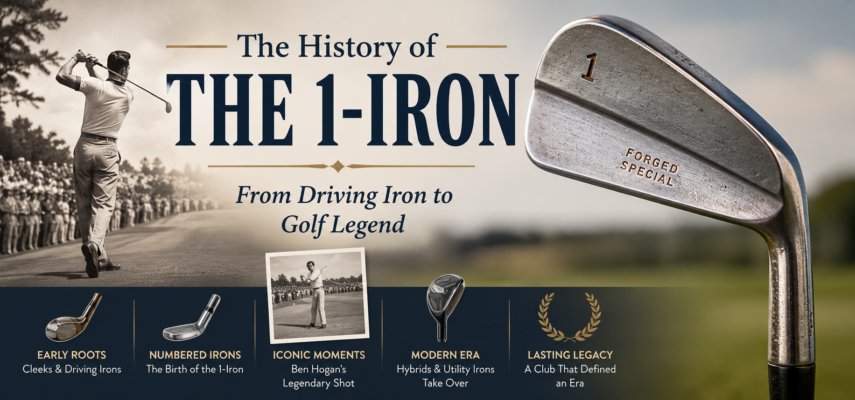
Few golf clubs have inspired as much admiration, anxiety and mythology as the 1-iron.
With its long shaft, narrow blade and almost vertical face, the traditional 1-iron looked less like a precision instrument than something fashioned from a strip of steel. It was designed to produce long, penetrating shots, but it offered little assistance when the golfer failed to strike the ball perfectly.
For much of the 20th century, carrying a 1-iron was a mark of confidence. Hitting one well was evidence of exceptional ball-striking. By the beginning of the 21st century, however, the club had largely disappeared from professional tournaments, retail iron sets and recreational golf bags.
Its functions were gradually assumed by fairway woods, hybrids and modern utility irons. Yet the 1-iron remains one of the most recognizable clubs in golf history, largely because it came to symbolize something larger than distance: courage, control and the uncompromising standards of an earlier game.
Before the 1-Iron Had a Number
The 1-iron existed in spirit before it existed by name.
During golf’s early centuries, clubs were identified by descriptive names rather than numbers. Golfers carried play clubs, spoons, brassies, cleeks, mashies and niblicks, each designed for a particular type of shot.
The closest ancestors of the 1-iron were the cleek and the driving iron.
A cleek generally had a long, narrow iron head with relatively little loft. It could be used from firm turf, from the tee or for low-running shots that traveled considerable distances after landing. The driving iron served a similar purpose, giving golfers a metal-headed alternative to a wooden club when accuracy or a lower trajectory was required.
These clubs were especially valuable on the firm, windy links courses of Scotland and England. Rather than launching the ball high into the air, players often attempted to keep it beneath the wind and allow it to run along the ground.
Modern comparisons between antique clubs and numbered irons are imperfect because historical clubs varied considerably between makers. Nevertheless, the driving iron and cleek are generally regarded as the functional predecessors of the 1-iron.
The Arrival of Numbered Irons
By the early decades of the 20th century, golf equipment was becoming more standardized.
The old naming system had been colorful, but it was also inconsistent. One manufacturer’s mashie might have a different loft, length or playing characteristic from another manufacturer’s mashie. As golf expanded internationally and companies began producing matched sets in larger quantities, numbers offered a simpler system.
A golfer could understand that a 2-iron would normally have more loft than a 1-iron, while a 3-iron would have more loft than a 2-iron. The higher the number, the shorter and more lofted the club generally became.
Evidence of this transition was already visible by the late 1920s. A 1929 article in The New Yorker observed that standardization was causing golfers to refer to clubs by numbers rather than by traditional names such as the cleek and jigger.
Within the emerging numbered system, the driving iron became the 1-iron.
It occupied the top of the iron set: the longest, least-lofted and most demanding iron available to most golfers.
What Made the 1-Iron Different?
The classic 1-iron usually had approximately 14 to 18 degrees of loft, although specifications varied by manufacturer and era. Its shaft was typically longer than that of any other iron in the set.
That combination created potential for considerable distance, but it also made the club extremely difficult to use.
A low-lofted face sends the ball forward more readily than upward. To produce a strong flight, the golfer must create sufficient speed while contacting the ball near the center of the clubface. Because traditional 1-irons had small forged heads with little perimeter weighting, off-center strikes lost substantial distance and produced harsh feedback.
The club was especially punishing from poor lies. Deep grass could grab the narrow head or interfere with contact, while soft ground made it difficult to strike the ball cleanly. Even from a perfect fairway lie, the golfer had little margin for error.
The traditional 1-iron therefore worked best for players who combined speed, precision and confidence.
In the hands of an expert, it could produce a low, powerful flight that resisted the wind and ran after landing. In the hands of an average golfer, it often produced a low shot that never became airborne at all.
The 1-Iron in the Hickory-Shaft Era
Early driving irons were commonly fitted with hickory shafts.
Hickory could provide excellent feel, but shafts made from natural wood were not perfectly uniform. Their flex, weight and torque could vary, and they were more vulnerable to warping or breaking than the steel shafts that followed.
Playing a long, low-lofted iron with a hickory shaft required remarkable timing. Golfers could not rely upon the stability, manufacturing consistency or engineered launch characteristics available in modern equipment.
This helps explain why the driving iron was closely associated with accomplished players. The club rewarded a controlled swing and clean contact but offered few technological protections against a poor strike.
The gradual acceptance of steel shafts during the 1920s and 1930s made long irons more consistent. Steel allowed manufacturers to produce shafts with more predictable characteristics, while matched iron sets became increasingly practical.
The change did not make the 1-iron easy. It merely made its behavior more repeatable.
The Golden Age of the Long Iron
From approximately the 1930s through the 1970s, the 1-iron occupied a respected place in elite golf.
Fairway woods existed, but they were not always the preferred choice from tight lies or in strong wind. Wooden clubheads were smaller than modern metal woods, and their performance from the ground could be demanding in its own way.
For a highly skilled golfer, the 1-iron offered several advantages.
It could be used as a controlled club from the tee when a driver was unnecessary or dangerous. It could produce a low shot into the wind. It could advance the ball along firm fairways, and it allowed accomplished players to shape shots in either direction.
The club also fit the strategic style of championship golf. Many leading players valued trajectory control more than maximum carry. Courses were frequently firmer, and the ability to use the ground was an essential part of the game.
Players such as Ben Hogan, Jack Nicklaus and other renowned ball-strikers became closely associated with long irons. Their ability to launch narrow-bladed clubs consistently helped establish the 1-iron as a test of golfing authority.
Ben Hogan and the Most Famous 1-Iron Shot
No moment did more to establish the 1-iron’s mythology than Ben Hogan’s approach to the 18th hole during the final round of the 1950 U.S. Open at Merion.
Hogan’s presence in the championship was already extraordinary. In February 1949, he had been severely injured in a collision between his automobile and a bus. His injuries threatened not only his career but his ability to walk normally.
Sixteen months later, he was competing for the U.S. Open.
On the 72nd hole at Merion, Hogan needed a par to enter a playoff with Lloyd Mangrum and George Fazio. After finding the fairway, he faced a long approach to the green. From roughly 200 yards, Hogan selected his 1-iron and struck the ball onto the putting surface.
He then two-putted for par and won the 18-hole playoff the following day.
Photographer Hy Peskin captured Hogan immediately after impact, viewed from behind as the golfer held his balanced finish. The photograph became one of the defining images in sports history: Hogan’s narrow frame, the gallery lining the fairway and the long 1-iron extended across his shoulders.
The USGA describes the approach as one of golf’s iconic shots. The club itself was stolen before the playoff, eventually recovered and later placed on display in the USGA Museum.
The shot transformed the 1-iron into a symbol of endurance. Hogan was using the most intimidating club in the bag at the most consequential moment of the championship, less than a year and a half after nearly losing his life.
A Club for Strategy, Not Just Distance
Although the 1-iron was capable of tremendous distance, its real value was control.
A well-struck driver or fairway wood could travel farther, but the 1-iron produced a different flight. Its trajectory was flatter, and its smaller head made it easier for expert golfers to manipulate the clubface deliberately.
The club became particularly useful in three situations.
The first was the positional tee shot. On narrow holes, a player could use a 1-iron to place the ball in the fairway while avoiding hazards that might come into play with a driver.
The second was the wind shot. The club’s low loft allowed skilled golfers to keep the ball beneath strong gusts.
The third was the running approach. On firm turf, the ball could land short of the green and release toward the target.
Jack Nicklaus demonstrated the strategic value of the club throughout his career. During the 1981 U.S. Open at Merion, one observer recalled that Nicklaus would willingly play a hole with a 1-iron followed by a 4-iron when that strategy best suited the design of the hole.
For such players, the 1-iron was not an act of bravado. It was a precision club.
Why Average Golfers Struggled
The qualities that made the 1-iron useful to professionals made it unsuitable for most recreational players.
To launch a 1-iron effectively, a golfer generally needed considerable clubhead speed. Players with slower swings often produced shots that flew too low and carried less distance than shots struck with a more lofted club.
The long shaft also made it harder to return the clubface squarely to the ball. Small errors in swing path or face angle were magnified, while the compact head provided little forgiveness.
Then there was the psychological challenge.
Golfers knew the club was difficult. That reputation encouraged tension, and tension made clean contact even less likely. The 1-iron became one of the rare pieces of equipment capable of defeating a player before the swing had begun.
The club’s fearsome image eventually produced one of golf’s most famous jokes. Lee Trevino was widely credited with saying that during a thunderstorm he would hold a 1-iron toward the sky because “even God can’t hit a 1-iron.”
Whether repeated exactly or embellished over time, the joke endured because golfers immediately understood it.
The Beginning of the End
The disappearance of the 1-iron was not caused by a single invention. It resulted from several overlapping changes in golf equipment.
First, fairway woods became easier to hit.
Metal construction allowed manufacturers to produce larger, more forgiving heads. Weight could be positioned around the perimeter and lower in the club, helping golfers launch the ball higher from the fairway.
Second, golf balls changed. Modern multilayer balls produced different combinations of speed, spin and launch than earlier wound balls. Equipment manufacturers increasingly designed entire club systems around carrying the ball through the air rather than relying heavily upon ground roll.
Third, iron design became more specialized. Cavity backs, wider soles and lower centers of gravity made middle and short irons easier to launch, but manufacturers found limited demand for a true 1-iron. Golfers who needed that distance generally achieved better results with another category of club.
Finally, the hybrid emerged.
Hybrids combined elements of irons and woods. They had relatively short shafts, forgiving hollow heads and sole designs that moved more easily through grass. For recreational golfers, a hybrid could produce the distance of a long iron with substantially less difficulty.
Once golfers were offered an easier tool for the same basic task, the traditional 1-iron had little chance of surviving.
The Rise of the Utility Iron
The 1-iron did not disappear completely. It evolved.
Modern manufacturers began producing utility irons, also called driving irons. These clubs retained the basic purpose of the old 1-iron but incorporated technologies unavailable to earlier clubmakers.
Many modern utility irons use hollow-bodied construction, flexible faces, internal weighting and wider soles. Their heads are larger than traditional blades, and their centers of gravity are positioned to improve launch.
Some have lofts comparable to historical 1-irons, although manufacturers commonly label them as 2-irons, 3-irons or simply by loft. Modern iron numbering is not standardized, and a contemporary utility iron can be much stronger than its number suggests.
The utility iron has found a niche among fast-swinging players who want accuracy from the tee without the higher flight of a hybrid or fairway wood. It is particularly useful on firm courses and in windy conditions.
In that sense, the original driving iron is still alive.
What vanished was not the concept but the unforgiving blade traditionally stamped with the number 1.
The 1-Iron and the Modern Professional Game
Traditional 1-irons are now rare in professional golf, but their descendants occasionally appear in major championships and on links courses.
Modern professionals may carry a driving iron when conditions demand a low, controlled tee shot. At tournaments such as the Open Championship, where wind and firm fairways reward a penetrating trajectory, utility irons can be strategically valuable.
Yet even elite players usually prefer technologically advanced versions. There is little competitive reason to use a tiny solid blade when a hollow utility iron can provide similar control with greater ball speed and forgiveness.
The change illustrates an important truth about golf equipment: professionals do not choose difficult clubs merely because they possess the ability to hit them. They choose the clubs most likely to produce the required shot.
The traditional 1-iron stopped being that club.
Loft Creep and the Disappearing Number
The 1-iron’s extinction is also connected to the changing lofts of numbered irons.
Over time, many manufacturers reduced the lofts of their irons. A modern 4-iron may have a loft similar to that of an older 2-iron or even certain historical 1-irons. At the other end of the set, additional wedges were introduced to fill the resulting gaps.
This process, often called loft creep or loft jacking, made the traditional number less important than the club’s actual specifications.
A golfer may therefore carry a club with 18 degrees of loft—the territory once occupied by a 1-iron—without carrying anything marked “1.”
The 1-iron disappeared partly because golf abandoned the number while preserving the loft.
Why the 1-Iron Still Matters
The 1-iron is historically important for several reasons.
It represents the transition from individually named clubs to standardized numbered sets. It reflects an era when elite golfers relied upon narrow forged blades and used trajectory, shape and ground conditions to manufacture distance.
It also played a central role in one of golf’s defining moments.
Ben Hogan’s shot at Merion ensured that the club would never be remembered merely as an obsolete piece of equipment. In the famous photograph, the 1-iron becomes part of a larger story about recovery, concentration and competitive courage.
The club’s difficulty has also preserved its cultural identity. Golfers may no longer carry 1-irons, but they continue to recognize what the club represents.
It was the ultimate test of contact.
The Legacy of Golf’s “Butter Knife”
The traditional 1-iron belongs to a category of sporting equipment that disappeared not because it failed, but because something more practical replaced it.
It could perform its intended job brilliantly. A skilled player could use it to produce a long, controlled and penetrating shot unlike almost anything else in the bag.
The problem was that very few golfers could do so consistently.
Fairway woods launched the ball more easily. Hybrids handled poor lies more effectively. Utility irons preserved the low-flight option while adding speed and forgiveness. One by one, the reasons to carry a traditional 1-iron disappeared.
Its legend only grew.
Today, the 1-iron survives in museums, vintage collections, famous photographs and the occasional bag of a golfer determined to test his or her ball-striking. It remains golf’s most intimidating iron—a club associated with an age when equipment offered less help and demanded more precision.
The 1-iron may be nearly extinct, but it has achieved something more enduring than commercial survival.
It became a symbol of the game itself: difficult, exacting, occasionally cruel and magnificent when struck perfectly.












