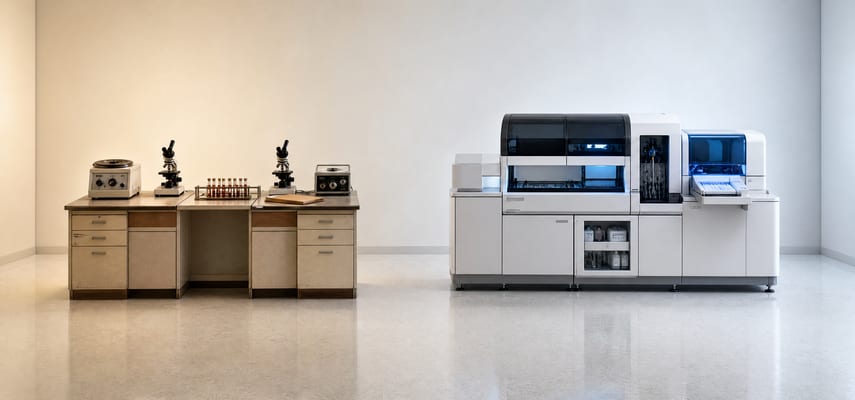
History of Labcorp Holdings
The story of Labcorp is the story of modern medicine’s plumbing: the laboratories, logistics, and data systems that most patients never notice until something goes very wrong. For more than four decades Labcorp Holdings Inc. — known in the market as Labcorp and traded on the New York Stock Exchange under the ticker LH — quietly stitched together a nationwide testing network.
Over time the company pushed into drug development and genomics as medicine moved from single tests to complex, data-driven care.
Origins and consolidation: establishing a national testing backbone (1969–1990s)
Labcorp’s roots include Biomedical Laboratories, founded in Burlington, North Carolina, in 1969, and National Health Laboratories, formed in 1974. The modern company was created on April 28, 1995, when National Health Laboratories Holdings merged with Roche Biomedical Laboratories and adopted the name Laboratory Corporation of America Holdings. The combined company was headquartered in Burlington and built its business around high-volume clinical chemistry, hematology and routine diagnostic tests for physicians and hospitals.
In the decades that followed, Labcorp grew by combination: acquiring smaller, locally based laboratories and folding them into a centrally managed operation. That consolidation mattered because it turned testing — once dispersed in hundreds of hospital and private labs with inconsistent turnaround times — into a repeatable industrial process.
Centralization allowed larger labs to invest in automation and information technology, reduce overhead, and offer standardized quality controls across broad geographies. For clinicians and health systems, the tradeoff was more predictable service and the ability to draw on specialized assays that a small hospital lab could not run economically.
From regional operator to public company and platform builder (1990s–2000s)
By the 1990s and 2000s Labcorp had become a national platform. The company’s growth strategy combined acquisition, scale-driven pricing, and investments in laboratory automation and logistics.
Labcorp built a network of patient service centers, courier systems and reference laboratories capable of moving specimens across states for specialized testing.
Labcorp’s public-market lineage predates the 1995 merger. Its predecessor completed an initial public offering in July 1988, moved from Nasdaq under the symbol NHLI to the NYSE under NH on April 24, 1991, and began trading under LH on May 1, 1995. In May 2024, Labcorp Holdings Inc. became the successor public parent, with trading under LH continuing uninterrupted. Access to capital markets helped finance acquisitions and technology upgrades. The market-driven imperative to grow revenue and margin pushed the company into higher-value diagnostic areas and specialty testing lines — an evolution that gradually changed the firm’s identity from high-volume clinical chemistry provider to a broader diagnostic services company offering anatomic pathology, molecular diagnostics and genetic tests.
Investing in specialty diagnostics and data (2000s–2010s)
As medicine embraced molecular biology and targeted therapies, Labcorp expanded its product set beyond routine tests. The company developed or acquired assays in cytogenetics, infectious disease molecular testing, toxicology and pharmacogenomics. Those moves reflected a simple reality: newer diagnostics were both more expensive and more clinically impactful, and they offered higher margins than commodity tests.
Equally important was investment in informatics. Labs generate structured streams of data — orders, results, interpretive comments, trending — and Labcorp built systems to channel that data back to ordering physicians, health systems and, crucially, pharmaceutical companies running clinical trials.
By the early 2010s, Labcorp’s business had three interlocking elements: high-volume clinical testing for routine care, specialty and molecular diagnostics, and services tailored to biopharma clients.
Transformational expansion into drug development: the Covance acquisition (2014–2015)
Arguably the most consequential strategic move in Labcorp’s contemporary history was the acquisition of Covance. Labcorp and Covance announced the agreement on November 3, 2014, after entering into it on November 2. The proposed consideration consisted of $75.76 in cash and 0.2686 Labcorp shares for each Covance share, representing an announced equity value of approximately $6.1 billion and enterprise value of approximately $5.6 billion. The acquisition closed on February 19, 2015, when the consideration was valued at approximately $6.2 billion in equity value and $5.7 billion in enterprise value.
Why the acquisition mattered: it shifted Labcorp from a diagnostics-focused company into a vertically integrated partner for pharmaceutical development. Labcorp could now supply clinical trial labs, bioanalytical testing, and safety monitoring alongside commercial diagnostics. For drug developers, partnering with a firm that understood both trial testing and commercial laboratory realities promised smoother transitions from trial to market — from companion diagnostics to post‑approval surveillance.
The merger also changed Labcorp’s risk profile. Covance’s business brought exposure to the cyclical and competitive CRO market and required heavy investment in global trial infrastructure. Integrating a multinational services business presented management, cultural and operational challenges.
Still, the move reflected a strategic bet that the future of laboratory medicine lay at the intersection of diagnostics and therapeutics: payers and clinicians were increasingly demanding evidence of clinical utility, and pharmaceutical companies wanted partners who could deliver standardized testing across trials and geographies.
Building a genomics and precision-medicine capability (2010s–early 2020s)
Throughout the 2010s Labcorp moved deeper into genomics and precision medicine. Its expansion included the 2010 acquisition of Genzyme Genetics, the launch of the IntelliGEN next-generation sequencing oncology panel in 2013, the 2016 acquisition of reproductive-genetics company Sequenom and the 2022 acquisition of cancer-genomics company Personal Genome Diagnostics. These and other investments expanded Labcorp’s next-generation sequencing, oncology profiling, reproductive genetics and pharmacogenomic capabilities for physicians and biopharma partners developing biomarkers and companion diagnostics.
These investments were both defensive and offensive. On one hand, genomics was eroding the moat that high-volume chemistry labs once enjoyed: small, focused firms could develop a novel molecular assay and reach patients quickly. On the other hand, Labcorp’s scale remained an advantage for commercialization — reimbursement negotiations, payer coverage policies, and distribution networks still favored large national labs when tests needed to reach millions of insured patients.
Operational scale and the public-health crucible: Labcorp during the COVID-19 pandemic (2020–2021)
When SARS-CoV-2 emerged in early 2020, Labcorp became one of the major commercial laboratories supporting the U.S. testing response. It launched its COVID-19 PCR test on March 5, 2020, received an FDA Emergency Use Authorization on March 16 and expanded capacity by adding staff, equipment, high-throughput platforms, robotics and automation. Labcorp also broadened access through hospitals, pharmacies, physicians, employers, at-home collection and partner-operated drive-through testing locations.
The pandemic highlighted both strengths and vulnerabilities. Labcorp increased PCR capacity from several thousand tests per day in early March 2020 to 275,000 per day by the end of the year. It reported performing more than 31 million PCR tests and nearly 4 million antibody tests during 2020, demonstrating the scale of its logistics and laboratory network.
Yet the surge also exposed bottlenecks around supply shortages, reagents, and reporting infrastructure. Turnaround times became a public metric of performance, and the company faced the same operational pressures as hospitals and other laboratories trying to scale under extraordinary demand.
More broadly, the pandemic accelerated a secular shift toward centralized testing for infectious disease and underscored the strategic value of aligning diagnostics with public-health needs. For Labcorp, the 2020–2021 period was not only a revenue-generating episode; it was a public-service moment that tested logistics, regulatory responsiveness and the company’s ability to maintain consistency in results and reporting under strain.
Integration challenges and competitive dynamics (mid‑2010s–2020s)
After the Covance acquisition and the genomic push, Labcorp’s management faced the complex task of integration. Bringing together two large businesses — diagnostics and drug development — required harmonizing global operations, IT systems, sales forces and regulatory compliance frameworks.
The combined company competed with a different set of rivals: not only Quest Diagnostics in the clinical lab market, but also global CROs such as IQVIA, worldwide contract labs, and an expanding universe of specialized molecular diagnostics firms.
Competition and reimbursement pressures forced Labcorp to justify higher-value testing in clinical practice. Payers demanded evidence of clinical utility; clinicians sought tests that would change management. The company invested in outcomes studies, real-world evidence generation and partnerships with health systems to demonstrate that its tests changed care and did so cost-effectively.
Those efforts reflected a wider industry truth: scale alone no longer guaranteed long-term success; delivering measurable value to clinicians, patients and payers mattered more than ever.
Recent strategic moves and the push for integrated solutions (2018–2024)
In December 2020, Labcorp announced an enterprise rebranding that more closely associated its business units with the Labcorp name. Covance Drug Development became Labcorp Drug Development in June 2021. On June 30, 2023, however, Labcorp spun off its Clinical Development and Commercialization Services business as Fortrea, an independent contract research organization. Labcorp retained its central laboratory and early-development research operations, and renamed the remaining Drug Development segment Biopharma Laboratory Services.
At the same time, Labcorp faced external pressures familiar to large health-service firms. Reimbursement changes, consolidation among health systems and increased scrutiny of laboratory billing practices required continual attention.
The company also navigated a shifting regulatory environment for molecular diagnostics, where the U.S. Food and Drug Administration and payers were increasingly attentive to analytical and clinical validation for high-cost tests.
Strategically, Labcorp focused on three intertwined priorities: modernizing its laboratory automation and informatics to lower cost and speed results; expanding higher-margin specialty and genomic tests; and deepening relationships with biopharma through central laboratory and early-development research services. The company invested in digital tools for test ordering and result delivery, and it sought partnerships with health systems and technology firms to embed testing into care pathways.
Why Labcorp mattered — and still matters
Labcorp’s history is instructive because it mirrors how diagnostics have become central to modern care. The company’s ascent shows how scale, when combined with targeted investments in specialty testing and informatics, can create a platform that serves basic clinical needs and complex commercial trials alike. Its acquisition of Covance signaled a broader industry convergence: diagnostics and drug development no longer live in separate silos.
Labcorp also illustrates the tensions of modern healthcare: the appeal of consolidation and scale versus the need for clinical validation and value demonstration; the operational efficiencies of centralized laboratories versus the localized needs of hospitals and patients; and the public-service obligations that large diagnostic providers assume when a pandemic or other crisis strains infrastructure.
Looking ahead: tensions and opportunities in diagnostics and drug development
As of the mid-2020s, Labcorp stands at a crossroads shared by many legacy healthcare companies. Precision medicine and genomics continue to create lucrative niches but require demonstrable clinical benefit and durable reimbursement. Drug developers still need reliable global lab partners for trials, but they also demand flexibility and specialized biomarker expertise.
If Labcorp succeeds, it will be because it can integrate laboratory scale with nimble scientific development — converting assays and biomarkers into validated diagnostics that physicians use and payers cover, while sustaining the operational excellence required for global trial laboratory services. If it stumbles, the causes will likely be familiar: slow IT integration, failure to prove clinical value, or an inability to adapt to changing regulatory demands.
Conclusion
From its beginnings in regional testing to its development as a combined diagnostics and drug-development laboratory-services company, Labcorp’s history is a study in how a business built on scale must repeatedly reinvent itself. The Covance acquisition marked the company’s most consequential strategic pivot, reflecting a broader industry shift toward aligning diagnostics with therapeutics.
The pandemic was a public stress test of Labcorp’s logistics and capacity. Looking forward, the firm’s fate will hinge on its ability to translate laboratory throughput into clinically meaningful, reimbursed services while navigating a competitive and regulatory landscape that prizes both innovation and proof.