The gap wedge does not possess the mythology of the sand wedge, the versatility of the pitching wedge, or the theatrical appeal of the lob wedge. It was not born from one famous bunker shot, credited to a legendary inventor, or immediately recognized as a breakthrough.
Instead, the gap wedge emerged because golf equipment had developed a problem.
As manufacturers redesigned irons to fly farther, pitching wedges became progressively stronger in loft. The sand wedge, meanwhile, continued to sit near its traditional position in the bag. The result was an increasingly awkward distance between the two clubs—a part of the course where golfers needed precision but often lacked the proper tool.
The gap wedge was created to occupy that missing space.
Its history is therefore less about one dramatic invention than about the evolution of the modern iron set. It is the story of how manufacturers pursued distance, how golfers adapted, and how an optional specialty club became one of the most practical scoring clubs in the contemporary bag.
Before the Gap Wedge
For much of golf history, players did not need a club called a gap wedge.
Traditional pitching wedges generally carried considerably more loft than many modern versions. A pitching wedge might have measured approximately 48 to 50 degrees, while a sand wedge commonly sat around 54 to 56 degrees. The difference between them was manageable—roughly equivalent to the normal loft progression between neighboring irons.
A golfer could hit the pitching wedge on fuller approach shots and use the sand wedge when a higher, shorter shot was required. There was enough overlap to cover most ordinary situations without introducing another specialized club.
Golf bags were also simpler. Matched iron sets frequently extended from the long irons through the pitching wedge, while the sand wedge stood apart as a specialty tool. Players learned to alter trajectory and distance by changing swing length, opening the clubface, gripping down, or using different ball positions.
There was no obvious missing club because there was no obvious missing distance.
That began to change as iron design evolved.
The Era of Stronger Lofts
During the second half of the 20th century, golf manufacturers made major advances in clubhead construction. Investment casting and cavity-back designs allowed engineers to redistribute weight around the perimeter of an iron, helping the club launch the ball more easily and remain more stable on off-center strikes.
These designs gave manufacturers greater freedom to reduce loft while still producing an acceptable trajectory. A stronger-lofted iron could travel farther than a traditionally lofted club carrying the same number.
Distance became an enormously persuasive sales tool.
A golfer comparing two sets might naturally favor the model whose 7-iron traveled several yards farther, even when part of that difference resulted from the club having less loft. Over time, the lofts associated with iron numbers moved downward. A modern pitching wedge could resemble the loft of an older 9-iron—and in especially distance-oriented sets, something even stronger.
There is no universal industry standard requiring every pitching wedge to have the same loft. Depending on the model, modern pitching wedges may range from the low 40s to the upper 40s in degrees.
The sand wedge did not change at the same pace.
Its design remained connected to a specific function: producing short, high shots while moving effectively through sand, rough, and soft turf. Most sand wedges continued to cluster around 54 to 56 degrees.
That divergence created the gap.
A golfer might suddenly own a 44-degree pitching wedge and a 56-degree sand wedge—a difference of 12 degrees. Instead of behaving like adjacent clubs, they could produce a yardage separation of 25 or 30 yards.
That was too much territory to leave uncovered in the scoring portion of the bag.
Golfers Find an Improvised Solution
Before equipment companies widely marketed a purpose-built gap wedge, golfers found their own ways to solve the problem.
Some kept an older pitching wedge after purchasing a newer iron set. Because the older club might have 50 or 52 degrees of loft, it fit naturally between the stronger modern pitching wedge and the traditional sand wedge.
Others searched for specialty wedges in intermediate lofts or had clubmakers bend existing wedges to create more useful spacing.
The solution did not initially depend on what the club was called. Golfers simply needed something that traveled farther than a sand wedge and shorter than a pitching wedge.
By the early to mid-1990s, manufacturers increasingly began offering dedicated wedges in this range. The category became known as the gap wedge because its purpose was unusually literal: it filled the loft and distance gap created between the pitching wedge and sand wedge.
Unlike many traditional golf clubs, the gap wedge was not invented to execute an entirely new kind of shot. It was invented to restore an orderly progression that equipment evolution had disrupted.
A Club With Many Names
The gap wedge soon acquired one of the most confusing collections of names in golf.
Depending on the manufacturer, essentially the same club might be called a:
- Gap wedge
- Approach wedge
- Attack wedge
- Utility wedge
- “A” wedge
- “U” wedge
Some companies simply stamp the loft—such as 48, 50, 52, or 54 degrees—on the sole rather than assigning it a letter.
The terms gap wedge and approach wedge are often used interchangeably. In many iron sets, an approach wedge is designed as a continuation of the matched irons, with similar cavity construction, offset, shaft specifications, and forgiveness. A separately purchased specialty gap wedge may have a more compact shape, specialized grooves, and a sole intended to produce greater versatility around the green.
However, those distinctions are not universal. The letter stamped on the club matters less than its actual loft, distance, bounce, and intended role.
This lack of standardization reflects the gap wedge’s unusual origin. It was not a historically fixed club with one recognized specification. It was a category created to solve whatever space existed in an individual golfer’s set.
What Is a Gap Wedge?
A gap wedge traditionally falls somewhere between approximately 50 and 54 degrees, although increasingly strong modern iron sets have expanded the category toward 48 degrees.
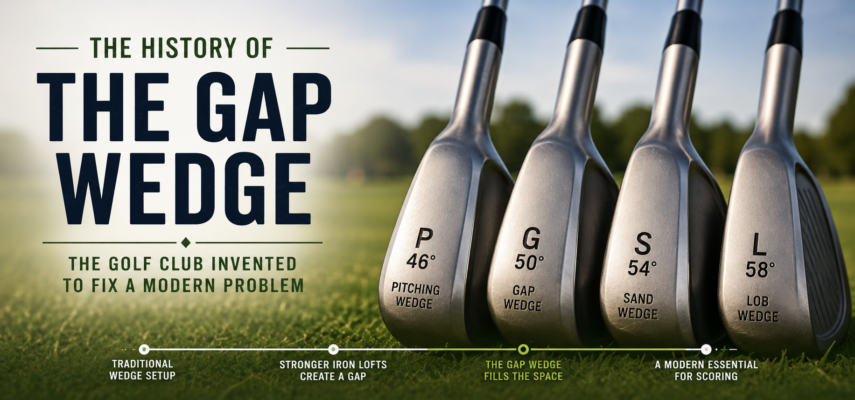
A classic wedge progression might look like this:
- Pitching wedge: 46 degrees
- Gap wedge: 50 degrees
- Sand wedge: 54 degrees
- Lob wedge: 58 degrees
Another golfer might carry:
- Pitching wedge: 44 degrees
- Gap wedge: 48 degrees
- Second gap or specialty wedge: 52 degrees
- Sand wedge: 56 degrees
In that second configuration, the traditional names become less informative. The 48-degree club may be called an approach wedge, while the 52-degree club may be labeled a gap wedge. Both are effectively filling spaces between the pitching wedge and the golfer’s highest-lofted clubs.
For that reason, modern wedge fitting focuses increasingly on actual yardages rather than traditional labels.
The goal is not merely to create equal loft intervals. It is to produce predictable distance separation.
Many golfers begin with wedges separated by approximately four to six degrees, then adjust the configuration according to swing speed, launch, preferred shots, and the loft of the pitching wedge.
The Gap Wedge Becomes a Scoring Club
Once golfers began carrying gap wedges, the club quickly became more than a corrective addition.
Its loft made it exceptionally useful for full and partial approach shots. It could produce a controlled trajectory without requiring the golfer to force a sand wedge or make an uncomfortable reduced swing with a pitching wedge.
For many players, the gap wedge became a favored club from roughly 80 to 120 yards, although exact distances vary widely according to swing speed, club design, and loft.
It also proved valuable around the green.
Compared with a sand or lob wedge, a gap wedge generally produces a lower flight and more rollout. That makes it useful for bump-and-run shots, longer chips, low pitches, and approaches into the wind. Compared with a pitching wedge, it can provide additional height and stopping power without demanding the precision of a highly lofted club.
The gap wedge therefore occupies a useful middle ground—not only in yardage, but also in trajectory.
Its design often reflects that dual purpose. Lower-lofted specialty wedges may feature straighter leading edges and characteristics suited to square-faced full swings. Modern manufacturers may also optimize groove patterns differently across wedge lofts, with lower-lofted wedges designed primarily for fuller shots and higher-lofted models emphasizing greenside spin and face manipulation.
From Optional Club to Tour Standard
The gap wedge was once viewed as an extra club for players who wanted unusually precise spacing. By the early 21st century, it had become close to standard equipment at the professional level.
Golf Digest reported that roughly two-thirds of PGA Tour fields carried a wedge between 50 and 54 degrees in 2008. By 2011, the figure was approaching 90 percent during many weeks. At the 2014 Arnold Palmer Invitational, 94 percent of the field carried a club in that loft range.
Professional adoption helped legitimize the category, but the gap wedge may be even more valuable to average golfers.
Tour professionals possess the skill to alter swing length, speed, spin, and trajectory with remarkable consistency. Recreational golfers usually benefit more from making a normal motion with the correct club than from attempting to manufacture an exact distance using an awkward partial swing.
The gap wedge simplifies that decision.
Instead of trying to hit a sand wedge unusually hard or guiding a pitching wedge with a tentative motion, the golfer can select a club designed for the required yardage.
The Iron-Style Versus Specialty-Wedge Decision
As the gap wedge became more common, golfers encountered a new equipment choice: Should it match the iron set or the specialty wedges?
An iron-style gap or approach wedge is usually built for forgiveness and consistency. It may have a larger cavity, greater perimeter weighting, more offset, and a sole shape resembling the other short irons. For golfers who mainly use the club on full swings, this can provide a smooth transition from the pitching wedge.
A specialty gap wedge generally offers a more compact head, more specialized groove technology, and a wider range of bounce or sole-grind options. It may be preferable for golfers who use the club frequently for chips, pitches, flighted approaches, or open-faced shots.
Neither design is automatically superior.
The correct choice depends on the club’s primary job. A golfer who treats the gap wedge as an “11-iron” may benefit from matching the iron set. A player who wants greater greenside versatility may prefer a specialty wedge.
This distinction demonstrates how far the category has evolved. The gap wedge began as a simple yardage filler. It eventually became a fully developed scoring instrument available in multiple head shapes, constructions, bounces, grinds, and lofts.
The Gap Wedge and the 14-Club Limit
Adding a gap wedge also changed how golfers organized the rest of the bag.
Under the Rules of Golf, a player may carry no more than 14 clubs during a stipulated round. Every additional wedge therefore occupies a position that could otherwise go to a long iron, hybrid, fairway wood, or another specialty club.
As iron lofts strengthened and wedge systems expanded, many players shifted the composition of the bag toward the scoring end. A traditional setup might once have included several long irons and only a pitching wedge and sand wedge. A modern golfer may carry four or even five clubs bearing wedge lofts while removing difficult-to-hit long irons.
This reflects a strategic change in how golfers think about equipment.
Long clubs may be used only a handful of times during a round. Wedges are required repeatedly for approaches, pitches, chips, bunker shots, recovery shots, and distance control. For many players, dedicating an additional club to the scoring zone produces greater practical value than preserving every traditional iron number.
The gap wedge helped drive that transition.
A Club Defined by What Surrounds It
The gap wedge has no single permanent loft because its identity depends on neighboring clubs.
A 52-degree wedge may function as a gap wedge for a golfer whose pitching wedge is 48 degrees and sand wedge is 56 degrees. The same 52-degree club might effectively act as a sand wedge in a set built around a 48-52-56-60 progression.
Similarly, a 48-degree wedge might have been considered a pitching wedge in an earlier era but now frequently serves as an approach or gap wedge behind a modern 43- or 44-degree pitching wedge.
The name is relational.
A gap wedge is not defined solely by the number stamped on its sole. It is defined by the distance it fills and the role it performs within the set.
That is why golfers should begin wedge selection by identifying the true loft and carry distance of their pitching wedge. Choosing a gap wedge from its label alone can produce duplicated yardages or leave the original problem unsolved.
The Legacy of the Gap Wedge
The gap wedge is one of golf’s clearest examples of equipment evolution creating demand for another piece of equipment.
Manufacturers strengthened iron lofts to increase distance. Pitching wedges began traveling farther. Sand wedges remained tied to their traditional purpose. Golfers discovered that a crucial section of the scoring game had been left exposed.
The gap wedge restored the missing progression.
Its arrival also helped change the way golfers constructed their bags. Wedges became a coordinated system rather than a pair of unrelated clubs. Loft spacing, carry distance, bounce, sole design, and shot function began to matter more than the traditional letters stamped on the clubhead.
Today, the gap wedge is so common that its relatively recent emergence can be easy to overlook. It feels like a natural member of the iron family, yet for most of golf history it did not exist as a recognized category.
It was not created because golfers discovered a spectacular new shot.
It was created because an old sequence no longer added up.
And in a game built on controlling exact distances, filling that gap proved indispensable.