History of Fastenal
The story of Fastenal is less a tale of a single product than a steady reinvention of how industrial supplies reach the shop floor. What began in a small Midwestern town as a business tied to bolts and screws grew into a national network built around local branches, inventory control, and a willingness to move beyond the catalog. The company’s history is a lesson in logistics, people-driven sales, and incremental service innovation—an industrial supply business that scaled by making the messy work of replenishment someone else’s problem.
Roots in Winona: founding and the early focus on fasteners
Fastenal began as a partnership in 1967. Bob Kierlin and four co-founders—Jack Remick, Van McConnon, Steve Slaggie and Mike Gostomski—opened a 1,000-square-foot store at 69 Lafayette Street in Winona, Minnesota, on November 28, 1967. Kierlin’s original concept involved dispensing fasteners through vending machines, but the founders shifted to a conventional store and outside-sales model after finding that the machines could not accommodate customers’ required sizes and quantities. Fastenal was incorporated under Minnesota law in 1968.
Why that mattered: focusing on fasteners created a predictable demand pattern. A bolt or screw wears out and must be replaced; that repeatability let the company standardize inventory turns, pricing negotiations with manufacturers, and the mechanics of distribution. Fasteners were a low-glamour product category, but they offered the steady, predictable revenue that sustained expansion.
Expanding the branch model in the 1970s and 1980s
Fastenal established its second location in Rochester, Minnesota, in 1971 and gradually added branches across the region. It had just over 50 locations at the time of its 1987 initial public offering, surpassed 800 by the end of the 1990s, reached 1,025 in 2001 and 2,000 in 2006, and peaked at 2,687 branches in 2013. Following a later consolidation of its U.S. footprint, Fastenal ended 2025 with 1,595 branch locations in 25 countries, supported by 19 distribution centers worldwide.
The branch-centered strategy shaped Fastenal’s identity. It made the company less a remote catalog supplier and more a neighborhood partner for maintenance, repair and operations (MRO) needs. Salespeople did more than take orders; they learned an account’s daily consumption patterns and could anticipate shortages. The consequence was not only faster delivery but also stronger relationships that made it harder for national competitors to displace the company on purely price terms.
Going public and scaling in the late 20th century
Fastenal completed its initial public offering on August 20, 1987, joining the Nasdaq market under the ticker symbol FAST. The offering sold one million shares at $9 each. Company histories report that it generated approximately $5 million in cash after offering costs, helping Fastenal pay off a mortgage, increase inventory levels, obtain better supplier pricing and discounts, and provide employees with an opportunity to own shares.
The offering addressed a cash constraint that had made it difficult to maintain inventory and sustain the company’s desired expansion rate. It helped set the stage for rapid growth: Fastenal’s annual sales increased from roughly $20 million in 1987 to around $400 million in 1997, while its branch count rose from just over 50 at the IPO to more than 800 by the end of the 1990s.
Leadership, governance, and ownership
Fastenal’s leadership succession has largely followed its promote-from-within philosophy. Founder Bob Kierlin served as chief executive officer from 1968 through 2002. Willard Oberton, who joined Fastenal in 1980, succeeded him in December 2002 and served through December 2014. Leland Hein became president and CEO on January 1, 2015, and served through July 19, 2015, after which Oberton returned as interim president and CEO through the end of that year. Daniel Florness, a Fastenal employee since 1996 and its longtime chief financial officer, became president and CEO on January 1, 2016. Florness transferred the president role to Jeffery Watts on August 1, 2024, while remaining CEO. On July 16, 2026, Watts became president and CEO and joined the board, while Florness stepped down as CEO and director.
The board also shifted away from direct founder leadership. Kierlin chaired the board from Fastenal’s incorporation until his retirement in April 2014, when he and fellow founder Steve Slaggie ended their board service. Oberton served as chair from April 2014 through April 2021, when independent director Scott Satterlee succeeded him. Satterlee remained chair following the 2026 CEO transition, preserving the separation of the chair and chief executive roles. Fastenal’s February 2026 proxy statement identified Vanguard and BlackRock as its only known shareholders owning more than 5% of the common stock, with stakes of 12.25% and 8.02%, respectively; directors and executive officers collectively owned less than 1%.
Product diversification: beyond fasteners
Fastenal began its major expansion into non-fastener products in the early 1990s. It introduced tools in 1993; cutting tools, hydraulics and pneumatics, material-handling products, and janitorial supplies in 1996; electrical and welding supplies in 1997; and safety supplies in 1999.
- Cutting tools and abrasives
- Power tools and hand tools
- Safety equipment and personal protective equipment (PPE)
- Industrial supplies such as adhesives, tapes and lubricants
- Inventory-management hardware and supplies
Each new product category was chosen for complementarity. A maintenance supervisor who buys a dozen sizes of screws will also need gloves, cutting discs and threadlocker. Selling those items to the same customers increased the value of branch visits and raised the total spend per account. The result: higher account penetration without radically changing the company’s distribution architecture.
The vending machines and on-site inventory shift
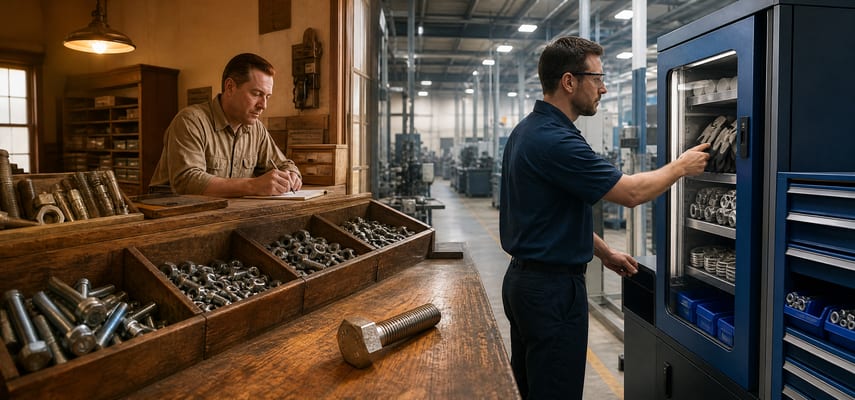
Fastenal began moving inventory directly onto customer sites before launching modern industrial vending, using jobsite trailers in the 1980s and opening its first store within a customer facility in 1992. Its FASTVend industrial vending program debuted in 2008 after two prototype machines were displayed at the company’s annual customer expo. The program gained significant traction beginning in 2011. Its devices use controlled access and reporting to monitor consumption and automate ordering, while related bin-stock technologies support point-of-use replenishment. Fastenal surpassed 100,000 active vending devices in 2019, when the devices were installed at more than 20,000 customer sites; the milestone machine was installed at Pierce Manufacturing in Appleton, Wisconsin. By the end of 2025, Fastenal had approximately 124,000 FASTVend devices in the field.
Why on-site systems mattered: they shifted the customer relationship from intermittent buying to ongoing operational support. Rather than simply selling a box of bolts, Fastenal could reduce customer stock levels, cut the time workers spent searching for parts, and demonstrate measurable savings in inventory carrying costs. This service-oriented approach deepened customer dependence and created recurring revenue streams linked to consumption rather than one-off orders.
Geographic expansion: national growth and international forays
With a replicable branch model and a growing range of logistics services, Fastenal expanded across the United States during the 1990s and 2000s. The company’s growth strategy favored organic openings of small, local branches tailored to serve nearby manufacturers and contractors. That density created network effects—the more branches that existed, the more reliable the company’s next-day or same-day service could be, and the more attractive it became to larger regional customers.
Fastenal opened its first branch outside the United States in Stoney Creek, Ontario, Canada, in September 1994. The location began with two employees and approximately $1,800 in first-month sales. Fastenal entered Mexico and Singapore in 2001, added the Netherlands in 2004 and entered Brazil in 2011. By the end of 2025, its network extended across 25 countries in total. Sales attributed to locations outside the United States represented 16.8% of 2025 revenue, including 13.5% from Canada and Mexico and 3.3% from other foreign countries.
Technology and the shift to digital operations
As the 21st century progressed, digital systems became as important as physical branches. Fastenal integrated inventory-management software, barcode scanning, handheld devices for salespeople, and later, web ordering and e-commerce platforms. These digital tools amplified what branches could do: they improved forecasting, sped reorders, and let field salespeople place orders on behalf of customers in real time.
The company’s investment in digital tools also reflected a broader industry change. Customers increasingly expected transparency—real-time inventory levels, purchase histories and simplified reordering. By offering a combination of physical presence and digital convenience, Fastenal sought to cover both bases: local service for complex needs and online ordering for routine purchases.
Private-label products, logistics, and supplier partnerships
Over several decades, Fastenal added private-label products, which it calls Exclusive Brands, to its non-fastener offering. In 2023, it consolidated most of those labels into two principal brands: Body Guard for North American safety supplies and ORMADUS for most other product categories. In 2025, private-label products represented approximately 11% of consolidated sales and 16% of non-fastener sales. Fastenal also documents supplier-selection, auditing and product-testing programs, along with supplier collaboration on manufacturing consistency, cost savings, kitting and custom packaging.
There was a clear trade-off: by relying on third-party manufacturers, Fastenal exposed itself to global supply disruptions but also benefited from supplier specialization. Strengthening logistics and forecasting systems became essential to mitigate such risks, especially for high-turnover consumables that customers expected to receive without delay.
Customer segmentation and services for large accounts
As branch density and product range increased, Fastenal developed a more formal approach to serving large industrial accounts. These customers demanded consolidated billing, standardized pricing across multiple sites, and national-level supply agreements. Fastenal responded with dedicated account teams, centralized invoicing options and site-level inventory solutions. The company’s ability to serve both a one-site machine shop and a nationwide manufacturer rested on this dual capability: local responsiveness plus centralized coordination.
That capability mattered because it made Fastenal competitive with national distributors and specialized procurement services. For large customers juggling dozens or hundreds of locations, a supplier who could match centralized procurement needs with on-the-ground responsiveness offered a compelling proposition.
Adapting to economic cycles and commodity shocks
Fastenal’s business is closely tied to manufacturing and construction activity, making it sensitive to macroeconomic cycles. Periods of expansion boost demand for consumables; downturns compress volumes. The company’s response has been operational: tighten inventory, trim underperforming branches, and emphasize services that lock in recurring purchases.
Commodity price swings—steel and other raw materials used to make fasteners—also shaped the company’s procurement and pricing strategies. Fastenal uses a diverse supplier base and preferred sourcing for some stock items to support quality control, supplier relationships, reliable lead times and effective cost management.
The 2010s and the move toward integrated supply solutions
In the 2010s Fastenal intensified its push beyond fasteners into integrated on-site services. The company pitched itself as a partner for overall MRO efficiency, using data from vending and point-of-use devices to recommend inventory rationalization and cost-saving measures. That shift reflected a broader industry transition: suppliers were being asked not only to deliver parts, but to make customers’ operations leaner and more predictable.
At the same time, Fastenal maintained its low-key, operational culture. The emphasis remained on delivery performance and branch-level salesmanship rather than flashy marketing. For many customers, the appeal was reliability—an everyday assurance that parts would be there when needed, and someone local to talk to when problems arose.
Recent years: e-commerce, resilience, and pandemic-era adjustments
Since 2020, the industrial supply landscape has accelerated toward digital ordering and resilient supply chains. Fastenal’s response combined its physical strengths with enhanced online capabilities—allowing customers to place orders digitally while still receiving local fulfillment. That hybrid model—digital access plus branch-level execution—became a practical advantage as buyer preferences shifted.
The COVID-19 pandemic in 2020 tested supply networks across industries. For distributors such as Fastenal, the crisis required operational adjustments: protecting branch and warehouse employees, adapting transportation and fulfillment processes, and responding to sudden shifts in demand for products like sanitizers and PPE. Companies with dense branch networks and established local relationships were better positioned to keep supply lines moving for essential customers, though no supplier was immune to the broader disruptions in global sourcing.
Why this period mattered: pandemic-era shocks highlighted the value of local inventory and flexible fulfillment. Customers became more sensitive to single-source dependencies and longer lead times, and suppliers that could offer both immediate parts and digital ordering gained strategic advantage. Fastenal’s history of branches plus vending and on-site services permitted it to adapt to this new emphasis on resilience.
What Fastenal’s path reveals about modern supply chains
Fastenal’s evolution illustrates several broader lessons about industrial distribution:
- Local presence can be a defensible strategy. Physical branches anchored relationships and service expectations that were hard to replicate from a distant warehouse.
- Service innovation—such as vending and on-site inventory control—can convert commodity products into strategic offerings that create recurring revenue.
- Hybrid models that combine digital tools with physical fulfillment meet diverse customer preferences and can smooth the impact of supply shocks.
These lessons matter because the underlying need—delivering the small parts that keep machines running—does not change. What changes is the buyer’s expectation for convenience, transparency and continuity. Fastenal’s history shows a company repeatedly adapting to those expectations without abandoning the operational work at the heart of distribution.
Challenges and open questions going forward
Looking ahead, several issues will determine the company’s trajectory. First is the competitive landscape: catalog distributors, online marketplaces and regional specialists all compete for the same customer spend. Second is supply-chain volatility: the geography of manufacturing, raw-material pricing and trade policies will influence procurement costs and lead times. Third is technology: advances in inventory sensors, predictive analytics and e-procurement could reshape how customers manage MRO spend.
Fastenal’s historical advantages—branch density, field sales teams, and on-site stocking solutions—provide a platform to meet those challenges. But sustaining that edge requires continuous investment in logistics systems, supplier relationships and customer-facing digital tools. The company’s ability to combine the tangible reliability of local service with the efficiency of modern supply-chain technology will in many ways determine whether it remains a default supplier for industrial customers.
Conclusion
Fastenal’s history is not a string of dramatic turns but a slow-motion accumulation of practical choices: specialize where demand is steady, build local presence where relationships matter, and add services that solve real operational headaches. From a fastener shop in a Midwestern town to a national—and international—provider of industrial supplies and inventory solutions, the company grew by solving the simple but stubborn problem of keeping plants and job sites stocked. Its significance lies less in disruption than in quiet execution: turning the mundane logistics of bolts and blades into a durable business built on service, proximity and incremental innovation.