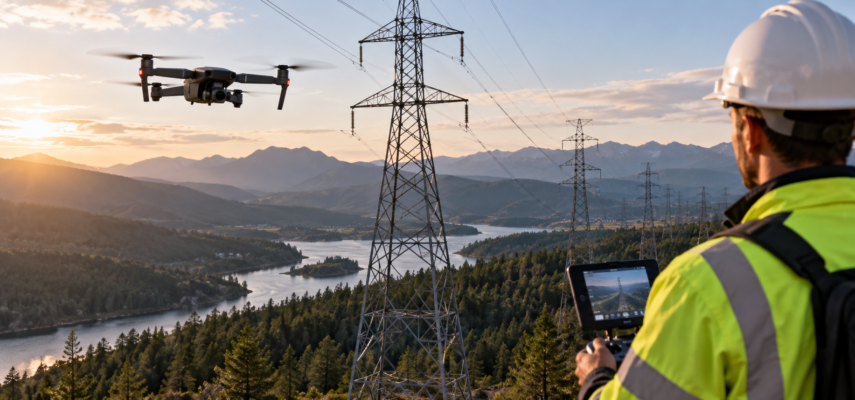
Utility companies have the task of ensuring that there is a network of power lines, transmission towers, pipelines, and substations that are properly inspected. The problem with inspecting such assets is that some of them may be in remote areas, high altitudes, and even dangerous places. Inspection procedures traditionally involve using special equipment as well as taking considerable amounts of time in preparation. The use of drones can help inspectors to obtain necessary information in hard-to-reach places, reducing the risk of workers accessing dangerous places.
Improved Access to Infrastructure
Utility networks often traverse areas of forested land, mountainous regions, and rivers. Sometimes reaching such sites manually or with the use of inspection vehicles takes much time and effort. However, drones have the ability to fly over these barriers and take pictures of the hard-to-reach infrastructure components. Using this feature, the inspection teams can analyze transmission towers, overhead lines, and other infrastructure components without being dependent on the use of climbers and aerial work platforms.
Better access to the sites is especially important in situations where companies need to conduct their inspections over a larger area and in a limited amount of time. The use of drones allows technicians to get the necessary pictures from different perspectives, thus detecting any visible signs of damage or deterioration. Companies that use drones for their inspections can also receive the help of professional drone services whenever needed.
Enhanced Worker Safety
The inspection of electrical infrastructure requires one to work from heights, around live electricity, and even through difficult terrain. The above factors expose workers to risks such as falling, electric shocks, and harsh environmental conditions. Using drones enables one to survey many objects from a safer distance without having to climb any towers and enter some hazardous zones.
Moreover, drones can assist utility providers with the evaluation of their infrastructure after some severe weather condition or any other disruptive factor. By obtaining images from the air, one can find out which parts have been damaged and which places should be checked by workers. Even though drones cannot guarantee a safe environment for inspecting infrastructure, they do help in creating a plan of action.
More Efficient Maintenance Planning
Maintenance of infrastructure requires the identification of issues before they become major problems. Drones can be used by companies for inspecting equipment and areas where more detailed inspections are needed. Analysis of images captured from regular inspections enables the team carrying out maintenance to analyze the changes and make priority of repairs depending on how severe the damage is.
The following details can be utilized for improved scheduling and allocation of resources. Rather than conducting initial surveys from all locations, it would be easier to send in crews only where drone video footage reveals immediate attention to be required. Drone video services can be used for providing footage of infrastructure in order to conduct reviews and maintain progress, as well as for coordination between the field staff and maintenance managers.
Better Infrastructure Monitoring
Utility network infrastructures span vast geographic areas; hence, it is difficult to monitor them effectively. The use of drones to take pictures of transmission lines, substations, and the land around the facilities will enable utility companies to observe any changes on the infrastructure. For instance, it is easy to spot growing vegetation near power lines, eroded support structures for the transmission lines, and debris that may hinder maintenance efforts.
Through consistent inspection procedures and routes, utilities can establish a valuable record of the state of their infrastructures. This record will enable them to compare inspection sessions to detect problems. Nevertheless, visual inspection will have to be augmented by other means, such as the use of specialized instruments or even ground checks.
The use of drones provides utility organizations with the ability to conduct maintenance inspection of infrastructure that is difficult to access in an efficient manner while providing safety for workers as well as access to valuable information needed for maintenance. This is due to the fact that the use of drones makes it possible to monitor the condition of the equipment, identify hazards, and conduct continuous monitoring.