










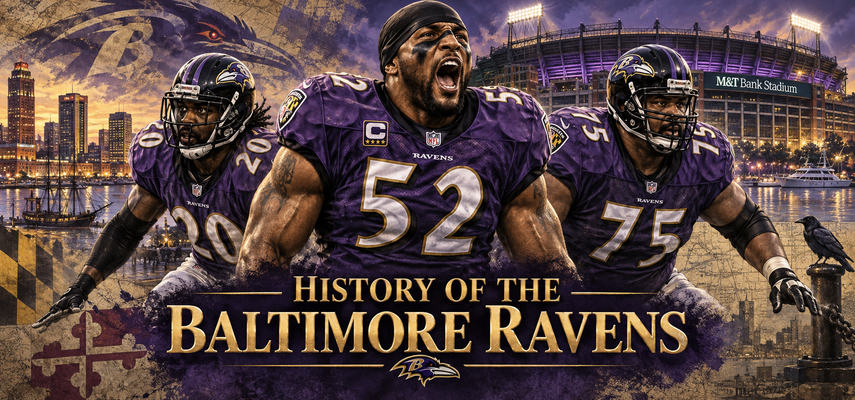

The Baltimore Ravens established their identity through defense, careful roster building and an unusually quick rise to championship contention. Ray Lewis and Ed Reed gave that identity its most recognizable faces, while Joe Flacco and Lamar Jackson shaped very different offensive eras. Two Super Bowl victories anchor the record, but repeated playoff disappointments also explain the organization’s development. Baltimore’s return to professional football involved a relocation agreement that left Cleveland’s earlier history with the Browns. This account follows the Ravens’ own record from 1996 through the completed 2025 season, with later developments distinguished from the ongoing 2026 campaign.
Franchise at a glance
| Field | Details |
|---|---|
| Founded | 1996; NFL franchise under the Cleveland–Baltimore settlement |
| First season | 1996, National Football League |
| Original city and name | Baltimore, Maryland — Baltimore Ravens |
| Current city and name | Baltimore Ravens; Baltimore, Maryland |
| Previous cities and names | None within the Ravens’ separately recognized history |
| League and conference/division | NFL — American Football Conference North |
| Home venue | M&T Bank Stadium; opened in 1998 |
| League championships | 2 Super Bowl titles: 2000, 2012 |
| Other recognized championships | 2 AFC championships: 2000, 2012; Cleveland’s earlier titles remain with the Browns |
| Historical coverage | 2025 NFL season, including postseason completed in February 2026; later developments through October 16, 2026 |
Origins and early years
Art Modell’s decision to move his football operation from Cleveland produced a settlement with unusual historical consequences. The Browns’ name, colors and records stayed in Cleveland, whose franchise suspended play until 1999. Baltimore received the transferred personnel and organization, but the Ravens began a separately recognized record in 1996. Their championship totals therefore do not include the Browns’ earlier NFL or AAFC titles. They also do not inherit the record of the Baltimore Colts, who had moved to Indianapolis.
Supporters helped choose a name connected to Edgar Allan Poe’s poem. Ted Marchibroda, previously the Baltimore Colts’ coach, became the first Ravens head coach. The team initially played at Memorial Stadium and won its opening regular-season game against Oakland. Its first draft brought offensive tackle Jonathan Ogden and linebacker Ray Lewis, two players who would become foundational figures. Those choices supplied durable strengths even while the new team struggled to turn its experienced roster into consistent results. The beginning combined an immediate professional infrastructure with the task of creating a distinct Baltimore identity.
Defining eras
1996–1999: Building a new identity
The first Ravens teams could move the ball but struggled to defend consistently. Vinny Testaverde’s passing supplied early highlights, while Ogden developed into an exceptional offensive lineman. Lewis became the organizing presence of a defense that would soon define the club. The early losing records made clear that transferred personnel did not guarantee a ready-made contender. Baltimore needed a coherent roster and a more dependable balance between offense and defense.
Ozzie Newsome’s personnel leadership became central to that process. The organization selected players who could form a lasting core and moved into its new stadium in 1998. Brian Billick replaced Marchibroda for the 1999 season, bringing a different coaching structure. The Ravens reached an even record that year as their defense grew stronger. Their eventual breakthrough would depend less on reproducing Billick’s reputation for expansive offense than on making the most of the unit already developing around Lewis. An uncertain first chapter had produced the foundation for a remarkably rapid championship rise.
2000–2001: A defense carries Baltimore to the title
The 2000 Ravens paired an exceptional defense with a powerful running game. Lewis, Rod Woodson, Peter Boulware and a deep defensive front helped limit opponents, while rookie Jamal Lewis gave the offense a dependable rushing threat. Trent Dilfer became the starting quarterback during the season. The approach emphasized field position, protecting possession and allowing the defense to determine the character of a game.
Baltimore entered the playoffs as a wild card, then defeated Denver, Tennessee and Oakland to reach Super Bowl XXXV. The Ravens beat the New York Giants 34–7, with Ray Lewis earning the game’s MVP award. The victory established the franchise nationally in only its fifth season. It also gave Baltimore a new championship identity independent of its former Colts. The following team returned to the playoffs but did not repeat. Personnel changes and salary constraints then forced the organization to rebuild parts of a roster whose strongest achievement remained the defensive championship of the 2000 season.
2002–2007: Reed, Suggs and the search for balance
Ed Reed arrived in the 2002 draft and added an exceptional ability to turn defensive reads into interceptions and return opportunities. Terrell Suggs followed in 2003, supplying sustained pressure from the edge. Together with Lewis, they connected the championship defense to a younger generation. The offense relied heavily on Jamal Lewis, whose 2003 rushing season surpassed 2,000 yards as Baltimore won its division.
Quarterback uncertainty remained a recurring obstacle. Kyle Boller did not establish the long-term answer the organization sought, while Steve McNair supplied a successful but shorter period of veteran leadership. The 2006 team finished 13–3 and appeared capable of another deep run, only for Indianapolis to win their divisional playoff game without scoring a touchdown. A losing season in 2007 ended Billick’s tenure. Baltimore still possessed remarkable defensive talent, but sustaining championship contention required a more reliable offensive structure and another coaching transition. The next era would join a new head coach with a rookie quarterback.
2008–2012: Harbaugh and Flacco finish the pursuit
John Harbaugh became head coach in 2008, and Joe Flacco immediately took over at quarterback. Their first team reached the AFC Championship Game, where Pittsburgh ended the run. Baltimore returned to the playoffs repeatedly, developing a recognizable combination of defensive continuity, physical running and a stronger passing game. Narrow defeats sharpened the sense that this group had an opportunity it had not yet completed.
The 2012 season provided the breakthrough. Ray Lewis announced that it would be his last, and Flacco delivered an exceptional postseason. Baltimore won at Denver in double overtime, defeated New England for the AFC title and faced San Francisco in Super Bowl XLVII. The Ravens built a large lead, survived the interruption caused by a stadium power failure and held on for a 34–31 victory. Flacco earned MVP honors. The second championship belonged to a different offensive balance than the first, even though Lewis and the organization’s defensive tradition connected the two teams.
2013–2018: Rebuilding after the championship core
The departures of Lewis and Reed changed the defense’s leadership, and the Ravens worked to sustain their standard through younger personnel. The team returned to the playoffs in 2014 and won at Pittsburgh before New England ended that run. Other seasons brought injuries, close defeats and missed opportunities. Baltimore remained competitive often enough to avoid a complete organizational reset, but it could no longer rely on the same championship core.
Flacco continued to lead the offense until the organization drafted Lamar Jackson in 2018. Jackson’s opportunity late that season changed the team’s approach. His rushing ability required a different offensive design and helped Baltimore return to the playoffs. The subsequent loss to the Chargers showed that the transition was still developing. Newsome’s final draft as general manager had nevertheless supplied another foundational quarterback. Eric DeCosta then succeeded him, preserving personnel continuity while inheriting the challenge of building around a style of quarterback play unlike Flacco’s.
2019–2025: Jackson transforms the offense
Jackson’s 2019 season made Baltimore’s offense one of the league’s most distinctive. He earned unanimous Associated Press NFL MVP honors as the Ravens finished 14–2, but Tennessee ended their postseason in the divisional round. A later playoff victory at Tennessee offered progress without delivering another conference title. The gap between exceptional regular-season performance and the final stages of the playoffs became a central issue of this era.
Jackson earned a second AP MVP for the 2023 season, when Baltimore hosted the AFC Championship Game but lost to Kansas City. Derrick Henry’s arrival added another major rushing threat in 2024, and the Ravens won their division before Buffalo ended their postseason. The 2025 team fell to 8–9 and missed the playoffs after a final-game defeat at Pittsburgh. That disappointment closed Harbaugh’s long tenure. Jackson’s completed individual achievements remained substantial, while the championship record of his Baltimore era was still unfinished at the research cutoff.
Recent history
The latest completed season is 2025, when Baltimore finished 8–9 and missed the playoffs. A 26–24 loss to Pittsburgh in the final regular-season game ended its opportunity to win the division. The Ravens subsequently parted ways with John Harbaugh after eighteen seasons, closing a coaching period that included the franchise’s second Super Bowl victory and repeated postseason appearances.
Jesse Minter was hired in January 2026 after leading the Chargers’ defense. His appointment began a new coaching chapter around an established quarterback rather than a new statistical franchise. As of October 16, 2026, his first Baltimore season was underway and its final record and postseason outcome remained undecided. M&T Bank Stadium remained the home venue. The completed championship record stood at two Super Bowl victories and two AFC titles, both earned before the Jackson era’s still-open pursuit of another conference championship.
Greatest players and influential figures
Ray Lewis
Lewis supplied the defense’s organizational center from the franchise’s first season through its second Super Bowl victory. His range, preparation and public leadership became inseparable from Baltimore’s early identity. He earned Super Bowl XXXV MVP honors and spent his entire NFL playing career with the Ravens.
Ed Reed
Reed changed games through anticipation, coverage and the ability to turn interceptions into major returns. His partnership with Lewis gave Baltimore contrasting defensive strengths. He earned the AP Defensive Player of the Year award and contributed to the second championship; later service elsewhere belongs to his wider career.
Jonathan Ogden
Ogden was the franchise’s first draft choice and became the offensive line’s foundational player. His protection and run blocking helped establish a dependable physical standard while the team developed around its defense. His entire NFL playing career belonged to Baltimore, including the Super Bowl XXXV championship.
Terrell Suggs
Suggs connected successive Baltimore defenses through sustained edge pressure, durability and an unusually visible competitive personality. His AP Defensive Player of the Year season preceded the Super Bowl XLVII victory. His later championship with Kansas City belongs to that separate team, while his longest contribution remains firmly associated with Baltimore.
Joe Flacco
Flacco gave Harbaugh’s early teams consistent quarterback leadership and their strongest postseason passing run. His performance during the 2012 playoffs culminated in Super Bowl XLVII MVP honors. Later stops with other franchises form separate career chapters; Baltimore’s second championship remains the defining achievement of his Ravens tenure.
Lamar Jackson
Jackson transformed the Ravens’ offensive possibilities through exceptional rushing and passing ability. His AP MVP awards for the 2019 and 2023 seasons recognized completed individual achievements. Those honors stand alongside substantial regular-season success, while his pursuit of a Baltimore Super Bowl remained unfinished through the completed 2025 season.
Ozzie Newsome
Newsome built the personnel foundation behind both Ravens championships and helped establish the organization’s emphasis on drafting and development. His selection of foundational defenders and quarterbacks connected different coaching eras. His Hall of Fame playing career belonged to Cleveland; Baltimore’s contribution was the separate work of an executive.
John Harbaugh
Harbaugh led Baltimore from 2008 through 2025, working with Flacco and then Jackson through markedly different offenses. His teams repeatedly reached the playoffs and won Super Bowl XLVII. The longevity and ability to adapt remain central to his contribution, alongside the postseason disappointments that preceded his departure.
Championships and postseason milestones
Baltimore’s two championship seasons also produced its only two AFC titles through the completed 2025 campaign. Conference-final defeats after the 2008, 2011 and 2023 seasons remain significant near misses. Cleveland’s earlier NFL and AAFC championships are excluded from the Ravens’ totals under the relocation settlement.
On smaller screens, scroll horizontally to see all columns.
| Season/year | Competition | Opponent | Result | Defining figure(s) |
|---|---|---|---|---|
| 2000 | Super Bowl XXXV | New York Giants | Won 34–7 | Ray Lewis; Jamal Lewis; Brian Billick |
| 2012 | Super Bowl XLVII | San Francisco 49ers | Won 34–31 | Joe Flacco; Ray Lewis; John Harbaugh |
Rivalries, venues and team identity
Rivalries
Pittsburgh supplies the defining divisional rivalry through repeated games with playoff consequences and a shared emphasis on physical defense. Tennessee became another major postseason opponent around the first championship and again in the Jackson era. Cincinnati adds a different AFC North challenge, connecting neighboring competitive cycles rather than a single championship period.
Home venues and traditions
Memorial Stadium provided the first home before the dedicated stadium opened in 1998. The venue later became M&T Bank Stadium and remained the team’s home at the cutoff. Purple, black and the Poe-inspired name distinguish the Ravens from Baltimore’s earlier football identities. Supporters’ attachment developed around a new team while preserving the city’s broader memory of professional football.
Retired numbers and team honors
Baltimore recognizes foundational contributors through its Ring of Honor, including Ogden, Lewis, Reed and Suggs. Such recognition should not be confused with formally retiring every honored player’s jersey number. Election to the Pro Football Hall of Fame is also a separate distinction. The club’s historical displays connect team service, executive leadership and Baltimore’s wider football heritage without transferring another franchise’s records.
Legacy
The Ravens became significant quickly because their organization translated an early defensive foundation into a lasting competitive identity. Their two championships came through different offensive approaches, while the Jackson era expanded what Baltimore football could look like. The connection is the effort to build coherent teams around exceptional foundational players. Repeated near misses belong in that account alongside the victories. Baltimore’s distinct record begins in 1996, and its achievement rests on the institution created from that starting point rather than on titles inherited from Cleveland or the city’s former Colts.
Where to eat in Baltimore
Planning a visit? Explore our best restaurants in Baltimore guide.












