










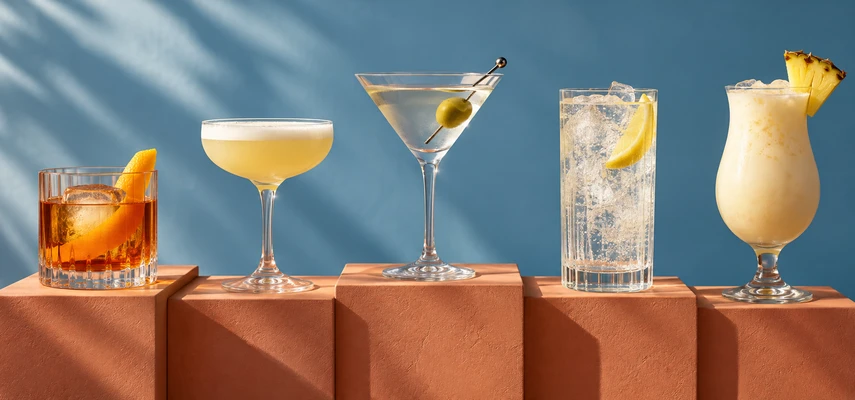

A Martini and a Piña Colada don’t look as though they belong at the same meeting. One is clear, restrained and usually served in a small stemmed glass. The other brings pineapple, coconut and a considerably more relaxed dress code. Both are cocktails, but knowing that doesn’t help much when you’re trying to choose between them.
Cocktail families supply the missing information. They describe recurring patterns: spirit with a little seasoning, spirit with citrus and sweetness, or a base lengthened with something bubbly. Once you recognize those patterns, an unfamiliar menu becomes less like a vocabulary test.
There isn’t one official family tree that every bartender follows. Historical names, modern menu sections and preparation methods overlap. The useful goal is to understand what a category tells you—and what it leaves out.
Think in families, rather than fixed boxes
A cocktail can belong to several groups at once. A Whiskey Sour is a sour by structure, often a shaken drink by technique, and sometimes a drink served over ice by presentation. Those descriptions answer different questions. None cancels the others.
It’s rather like describing a bicycle as a road bike, a rental and a red one. You’re classifying its purpose, ownership and appearance. Trouble begins when the categories get treated as competing definitions.
The International Bartenders Association’s official collection groups drinks under headings including The Unforgettables, The Contemporary and The New Era. Those are useful organizational choices, but they aren’t the same thing as ingredient families. A classic can also be a sour, a fizz or a spirit-led drink.
For a beginner, the most practical map starts with structure. Ask what supplies the base, what changes its flavor, and whether the drink is concentrated, lengthened, sparkling or creamy. You’ll learn more from those answers than from the decorative name printed above them.
Spirit-led drinks keep the base in view
Some cocktails make a spirit the central subject rather than one component among many. The additions may be modest in volume, but they have important jobs. Sugar can soften a sharp impression; bitters add seasoning; vermouth supplies wine character and botanical flavors.
The Old Fashioned is a helpful model. Whiskey, sugar, bitters and water leave the whiskey readily recognizable. It isn’t simply a glass of whiskey with a hat on: the supporting ingredients change its texture, concentration and flavor relationship.
A Martini takes a different route. Gin and dry vermouth combine aromatic ingredients without needing citrus juice or a sugar syrup. A Manhattan uses whiskey with sweet vermouth and bitters. These drinks aren’t identical in taste, but they share an emphasis on alcoholic bases and comparatively concentrated presentation.
“Spirit-forward” is a description, not a promise that every example is equally strong. Recipe quantities, bottle strengths and dilution determine alcohol content. Nor does it mean entirely without sweetness. Sweet vermouth and liqueurs can be important parts of a drink that still tastes distinctly spirit-led.
If you enjoy aromatic, relatively compact drinks, this is a useful area to explore. If you dislike the warming sensation of spirits, start by describing that preference rather than assuming that an expensive version will remove it.
Sours organize a conversation between tart and sweet
The basic sour pattern combines an alcoholic base, citrus and a sweetening ingredient. The IBA Whiskey Sour uses bourbon, lemon juice and sugar syrup, with egg white listed as optional. That last detail matters: a sour doesn’t automatically require a foam cap.
The Daiquiri makes the relationship especially visible through rum, lime and sugar. A Margarita adds another variation, using tequila, lime and orange liqueur. The liqueur brings sweetness as well as orange flavor and alcohol, so it isn’t merely a decorative extra.
Picture lemonade with a particular spirit woven into it. That’s an analogy, not a universal recipe: many sours are more concentrated, more aromatic and less sweet than a glass of lemonade. The useful point is that sourness and sweetness help shape one another.
The family name also doesn’t tell you exactly how tart the finished drink will be. Citrus varies, sweeteners vary, and recipes vary. You can ask for something citrus-led without wanting a drink that makes your cheeks retreat behind your ears.
Some sours include egg, dairy or nut ingredients; others don’t. Where those ingredients matter to you, ask rather than judging by the family name or appearance. Any uncooked egg preparation calls for appropriate food-safety precautions, including pasteurized egg products; a frothy surface doesn’t identify its source.
Highballs make room for a longer drink
A highball generally combines a spirit with a larger amount of a nonalcoholic mixer, commonly a carbonated one, served over ice in a tall glass. Whiskey and soda is an uncomplicated example. Gin and tonic adds the distinctive bitterness and sweetness of tonic water.
The mixer changes more than the volume. Soda can open up a spirit-led mixture without supplying much flavor of its own. Tonic contributes its own character. Ginger beer adds another set of flavors altogether. Changing the mixer can therefore move the drink a long way while leaving the basic structure intact.
Tallness can be misleading, though. A bigger glass doesn’t necessarily contain more alcohol, and a longer drink isn’t automatically alcohol-free or low in alcohol. You need to know the pour and the recipe. Adding mixer changes concentration while leaving the alcohol already poured in place.
You’ll also see related names such as Collins and fizz. These commonly bring citrus, sweetness and carbonation together, with conventions that differ by recipe and historical usage. For now, recognize the broader pattern: a longer, lively drink built around a base and a refreshing extension.
Spritzes and aperitif drinks aren’t all the same thing
A spritz commonly brings wine, a bitter or aromatic aperitif, and carbonation together. Its appeal often lies in the way bubbles carry a relatively light, aromatic combination. Specific formulas vary, so the word doesn’t supply a complete ingredient list.
“Aperitif,” meanwhile, describes an association with drinking before a meal as much as a particular formula. An aperitif cocktail can be sparkling, still, bitter, sweet or spirit-led. It’s a context, not a glass shape.
Compare two familiar bitter drinks. The IBA Americano combines Campari and sweet red vermouth with soda. The IBA Negroni combines gin, Campari and sweet red vermouth. The family resemblance is obvious, but replacing soda with gin changes the structure substantially.
That comparison also shows why the words “bitter” and “strong” shouldn’t be confused. Bitterness is a sensory quality. Alcohol content is a quantity determined by ingredients and proportions. The first doesn’t let you calculate the second.
Tropical and creamy drinks describe another set of possibilities
Tropical cocktails often combine rum or another base with fruit, spices, syrups or several of those ingredients. They can be simple or elaborate. Tropical doesn’t mean every drink needs a blender, and a colorful garnish doesn’t prove that the drink will be especially sweet.
The IBA Piña Colada combines rum, coconut cream and pineapple juice, blended with ice. It illustrates how a creamy texture and a recognizable fruit pairing can define a drink’s character. Other tropical cocktails are clear enough to show ice through the glass.
Creamy cocktails may use dairy, coconut products, eggs or other ingredients that create body. These aren’t interchangeable, either in flavor or in allergen profile. The word “cream” in a name isn’t enough information to make a dietary decision.
Historical terms such as punch, julep and cobbler also remain in use. They point toward traditions and structures that deserve their own explanations, rather than one giant “fruity drinks” drawer. The important beginner’s lesson is that fruit, sweetness and texture are separate characteristics. A drink can have plenty of fruit aroma without tasting like dessert.
Frozen, shaken and stirred are different kinds of labels
You can classify drinks by how they’re made, but that map cuts across the ingredient families. A sour is often shaken, a Martini is commonly stirred, and a highball is often built in its serving glass. These are useful tendencies, not an exception-proof legal code.
Frozen describes the temperature and texture produced by crushed or blended ice. It doesn’t identify one flavor family. A frozen version of a citrus drink and a creamy blended tropical drink can share a technique while tasting quite different.
Likewise, “on the rocks” means served over ice. It doesn’t explain whether the drink is sweet, bitter, citrus-led or concentrated. Glassware and presentation can give clues, but the ingredient description still does the important work.
Alcohol-free cocktails belong on a flavor map too
An alcohol-free cocktail can be tart, bitter, sparkling, creamy, herbal or some combination of those. Classifying all of them as one taste is like calling every meal without meat the same dish.
Tea, fruit, herbs, spices and appropriate alcohol-free products can supply structure and interest. What matters is how they work together. Removing a spirit from a familiar recipe doesn’t guarantee that the remaining ingredients will be balanced.
If complete avoidance of alcohol is important, ask about every component. Conventional bitters and some products described as nonalcoholic may still contain alcohol. A menu heading is an invitation to ask questions, rather than a substitute for an ingredient check.
Use the family resemblance to ask a better question
When a menu feels unfamiliar, pick two or three characteristics you actually want: citrus-led and lightly sweet; aromatic and spirit-led; bitter and sparkling; creamy and alcohol-free. Those are useful instructions even if you don’t know the name of a single classic.
Then look at the ingredients to refine the picture. A sour tells you about a relationship. A highball tells you about a longer format. A spritz suggests carbonation and aperitif ingredients. None tells you everything, but each gives you a sensible place to begin.
You don’t have to memorize a family tree before ordering a drink. Learn to recognize a few recurring shapes, and the unfamiliar names start looking like variations on ideas you already understand.











