










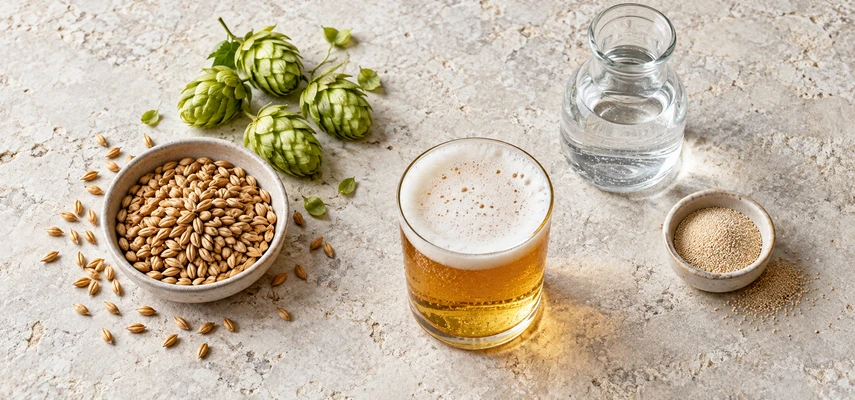
A pale lager, a fragrant wheat beer, and a black stout can look and taste so different that their shared identity is easy to miss. What connects them is the transformation of grain into a fermented drink. Understanding that starting point makes a crowded beer menu much easier to navigate.
What is beer? In everyday brewing terms, it is a beverage made by fermenting sugars derived principally from grain. Most familiar examples use water, malted barley, hops, and yeast, although brewers can work with other grains, microorganisms, and flavorings. Those ingredients are a foundation, rather than a promise that every beer tastes similar.
You do not need to memorize dozens of styles before ordering. A few distinctions—grain versus fruit, fermentation versus distillation, aroma versus bitterness—give you a practical framework for understanding what is in the glass.
What makes beer different from wine and spirits?
Beer starts with a source of starch, usually cereal grain. Brewers make sugars available from that starch, then yeast ferments those sugars. Wine ordinarily begins with the sugars already present in grapes or other fruit. Both are fermented drinks, but the preparation of the raw material differs.
Spirits introduce another step: distillation concentrates alcohol from a fermented liquid. Brewing beer does not ordinarily involve distilling it. A strong beer is therefore not automatically a spirit, and a dark beer is not automatically stronger than a pale one.
These distinctions describe production, not quality rankings. Someone who enjoys wine’s aromas may find beer equally rewarding to explore, while discovering different sources of texture, bitterness, and fragrance. Our guide to common wine terms offers useful vocabulary for comparisons, provided you remember that the drinks have different structures.
The ingredients behind the glass
Grain and malt provide the starting material
Malting prepares grain through controlled germination followed by drying. In brewing, malt supplies material for fermentation as well as flavor and color. Barley is particularly important, but wheat, oats, rye, rice, corn, and other grains also appear in recipes.
The ingredient list helps explain differences that color alone cannot. A pale beer might emphasize breadlike grain character; another might smell intensely of hops. A dark beer can suggest toast or roast without being sweet. The Brewers Association’s beer and food course explains how ingredients and brewing decisions create those different sensory possibilities.
Calling rice or corn an adjunct identifies its role alongside the main malt ingredients. It does not, by itself, establish poor quality. Ask what the brewer is trying to achieve and whether the finished beer tastes balanced, rather than treating an ingredient name as a verdict.
Hops add more than bitterness
Hops are flowering plants whose cones contribute compounds brewers use for bitterness, flavor, and aroma. Depending on the variety and how they are used, hop impressions can suggest flowers, herbs, citrus, resin, or tropical fruit. Smelling something fruity does not prove fruit was added.
Timing matters. Brewing decisions can emphasize bittering or preserve more aromatic character, so two beers described as hoppy need not deliver the same experience. For a beginner, the useful question is whether you enjoy the particular aroma and the intensity of the finish.
Yeast makes fermentation possible
Yeast turns fermentable sugars into alcohol and carbon dioxide while producing other compounds that influence flavor. It is an active contributor to a beer’s identity, rather than an invisible processing aid with no sensory effect.
Some beers also involve bacteria or other yeasts. That wider world helps explain why beer can be tart, earthy, or unusually aromatic. Such character needs context; unfamiliar does not automatically mean defective.
Water is part of the recipe
Water is the main liquid ingredient. Its mineral composition and the brewer’s treatment of it affect the brewing process and the way a beer is presented. For the drinker, the practical lesson is modest: two recipes with similar grain and hop lists can still produce different results.
TFE Times’ illustrated overview of craft beer ingredients is a useful companion when you want a quick reminder of the basic building blocks.
How brewing turns grain into beer
The American Homebrewers Association’s brewing process overview follows the sequence from grain to finished beer. During mashing, crushed malt meets warm water, allowing enzymes to break starch into smaller carbohydrates, including sugars yeast can ferment. The brewer separates the liquid, called wort, from the grain solids.
Wort is typically boiled, with hops often added during that stage. After cooling, yeast is introduced under controlled conditions. Fermentation then changes both the composition and sensory character of the liquid. Conditioning, clarification where desired, carbonation, and packaging complete the path toward the finished beer.
There are variations at almost every stage. Some beers undergo additional fermentation in their package; others receive carbonation in the brewery. Not all are filtered, and not all are clear. Those choices are tools rather than automatic indicators of superiority.
For a deeper technical reference, the BJCP study guide on yeast and fermentation explains why yeast selection and fermentation management matter. You can understand the basic sequence without trying to reproduce a brewery’s operating instructions.
Ale and lager are broad families
In common modern usage, ale and lager distinguish beers by their fermentation tradition and yeast. Ale yeasts generally work at warmer fermentation temperatures; lager production generally uses cooler fermentation and subsequent cold conditioning. Exceptions and overlapping practices make rigid temperature rules unreliable.
Neither family has an exclusive claim to a color, strength, or bitterness level. There are pale ales and dark lagers, restrained ales and forceful lagers. The BJCP introduction to beer styles also cautions that beer terminology reflects different national and historical traditions.
Treat the family as one clue. A style name provides a more specific expectation, and the producer’s description helps narrow it further. Asking for a lager alone is a little like asking for a red wine: informative, but still a broad request.
A practical way to understand styles
Start by comparing a few dimensions: grain character, hop character, fermentation character, body, and finish. This approach is more useful than ranking every beer on a single scale from mild to extreme.
Imagine three menu descriptions. One offers breadlike malt and a crisp finish. Another emphasizes citrus aroma and firm bitterness. A third promises roasted flavors and a dry finish. Even without knowing the style names, you can begin choosing according to the experience you want.
When a style is unfamiliar, ask for a small sample where offered or choose the smallest serving available. Keep a note about what appealed to you. “I liked the floral smell but wanted less bitterness” gives a bartender far more to work with than “I don’t like beer.”
The existing beer styles guide provides a broader visual introduction. Use any style guide as a map, while allowing room for individual producers and modern interpretations.
Read the label without overinterpreting the numbers
ABV means alcohol by volume: the proportion of the liquid’s volume represented by alcohol. Compare it alongside serving size. A smaller serving of a stronger beer and a large serving of a lighter beer are different decisions; the word light is not enough information.
IBU means International Bitterness Units. It is a brewing measurement associated with bitter compounds, not a complete prediction of how bitter a beer will seem. Sweetness, body, and other flavors influence perception. A number cannot replace tasting or a clear description.
Also look for the style, package date or freshness guidance, and storage instructions. If the date code is confusing, ask the retailer rather than assuming every printed date is an expiration date. For allergens or dietary requirements, consult the actual product information; a style name cannot establish suitability.
Your first glass: notice before judging
Pour into a clean glass so you can see and smell the beer. Take a short sniff, then a small sip, paying attention to the finish. The Cicerone explanation of glass service emphasizes the access a glass gives you to aroma.
Describe what you actually notice in ordinary language. Toast, lemon peel, flowers, coffee, and bread are useful associations when they fit. They are not a list you must find, and a flavor resemblance does not necessarily identify an added ingredient.
If the beer feels overwhelming, identify the specific feature. Is it bitterness, sweetness, carbonation, roast, or alcohol warmth? That turns one unsuccessful choice into useful information for the next. You are learning your preferences, not taking an examination.
Making beer knowledge useful at the table
Think about intensity before elaborate pairing rules. A delicate dish and an aggressively flavored beer may compete; a rich dish may support a more assertive drink. Contrast and similarity can both work, but personal preference remains part of the decision.
For practical starting points, explore our beer and food pairing guide. Try one small comparison with food, then ask whether the combination improved your enjoyment of both. There is no need to turn dinner into an inventory of technical terms.
Where to go from here
Beer becomes easier to understand when you connect the ingredients, the fermentation, and your own observations. You do not have to like every style, chase rare bottles, or accept someone else’s preference as proof of quality.
On your next occasion, choose one unfamiliar beer with a clear description and an appropriate serving size. Note its aroma, texture, and finish, then record one thing you would seek or avoid next time. That simple habit builds a more useful education than memorizing a long list of names.










