










History of Masco
When a small automotive-parts machine shop in Detroit began operating in 1929, few could have predicted that the company would become a defining supplier to American homes. Masco’s story is not a straight line of steady growth; it is a study in mid-century product invention, aggressive acquisition, portfolio reshaping and the steady pressure of housing cycles. The company built its reputation on plumbing fixtures and decorative building products and repeatedly reinvented itself as markets and management philosophies changed.
From metal shop to manufacturing concern: founding and early decades
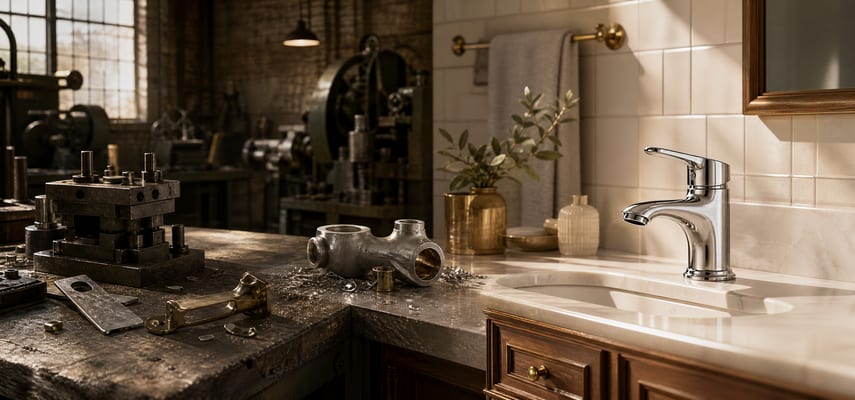
Masco was founded in Detroit, Michigan, on December 16, 1929, as Masco Screw Products Company by Alex Manoogian and two partners. Operating from a plant on Fort Street, the company began machining parts for automotive customers. Through the 1930s and into World War II, the firm expanded its metalworking capabilities, serving the automotive industry and later converting production to support the war effort.
Those early decades established Masco as a metalworking manufacturer rather than merely a marketer of others’ products. That manufacturing experience later helped the company move into finished consumer products instead of remaining an automotive-parts supplier.
Innovation in the bathroom: Delta and the single-handle faucet
In 1952, founder Alex Manoogian acquired rights to an existing single-handle washerless faucet produced by a small California company and began redesigning its flawed mechanism around a ball-valve principle. Masco began manufacturing and marketing the Delta faucet in 1954. Masco therefore did not originate the basic single-handle concept, but Manoogian developed and commercialized the successful Delta washerless ball-valve version.
That move brought new demands — marketing, warranty service and dealer relationships — and tied the company’s fortunes more directly to homebuilding and remodeling cycles.
Postwar expansion and brand building
Masco expanded its plumbing production and product range during the 1950s and 1960s. It built a faucet plant in Greensburg, Indiana, in 1958 and acquired Peerless Industries, a manufacturer of plumbing valves and fittings, in 1961, broadening the plumbing products it could offer customers.
The Delta business demonstrated that Masco could combine its manufacturing experience with product development and consumer branding, establishing a foundation for its later expansion into other branded home-improvement categories.
Key milestones
- 1929 — Masco Screw Products Company incorporated in Michigan and began machining automotive parts in Detroit
- 1930s–1940s — Expanded metalworking capabilities and converted production to support the World War II effort
- 1952–1954 — Acquired rights to an existing single-handle faucet, redesigned it and launched the Delta faucet
- 1958–1961 — Opened a faucet plant in Greensburg, Indiana, and acquired Peerless Industries
- 1970s–1990s — Growth largely through acquisitions across cabinetry, coatings and related categories
- 1990s–2000s — Restructuring and focus on higher-margin branded products
- Late 2006–2008 — Housing downturn prompted facility closures, workforce reductions and consolidation
- 2010s — Globalization of sourcing, technology investments and lean manufacturing
- 2015–2020 — Spun off installation services and exited cabinetry and window manufacturing
- 2020–2024 — Pandemic-related facility and supply disruptions, elevated repair-and-remodel demand and later cost and pricing pressures
Acquisitions and diversification: building a portfolio
From the 1970s through the 1990s, Masco pursued growth largely through acquisitions. The company bought manufacturers and brands that complemented its plumbing and hardware businesses, moving into cabinetry, coatings, and other home-improvement product lines. Acquisitions accelerated entry into categories that would have been slow or costly to develop in-house and provided established distribution and customer relationships.
Diversification introduced complexity. Managing disparate consumer brands and industrial operations tested Masco’s corporate center. Integration challenges — aligning procurement, consolidating plants, and rationalizing product lines — required repeated reorganization, producing a pattern of opportunistic expansion followed by corrective consolidation.
Restructuring and a focus on higher-margin products
By the 1990s and into the 2000s, Masco confronted the limits of unchecked diversification. Competition from lower-cost imports, the rise of big-box home centers, and changing consumer preferences required sharper focus. The company shed lower-return commodity operations and doubled down on branded, value-added lines with design differentiation and higher margins.
Practically, Masco closed or consolidated plants, invested selectively in product development and design for key brands, and reoriented sales toward national retailers and contractor networks that drove large-volume purchases. These moves aimed to emphasize design, brand strength and engineered performance.
The 2008 housing shock and recovery
The housing-market collapse of the late 2000s hit suppliers hard; Masco was no exception. From late 2006 through 2008, the company closed 17 manufacturing facilities, reduced its workforce by more than 23,000 employees and closed more than 80 installation locations. Its 2008 annual report also disclosed that two cabinet plants and one window plant had been idled as Masco pursued business consolidations, plant closures and other cost-saving measures.
Masco was already serving both repair-and-remodel and new-construction markets during the downturn. Its later portfolio strategy more explicitly sought to reduce cyclicality by increasing its exposure to repair-and-remodel products and reducing its dependence on new residential construction.
Globalization, technology and operational discipline
In the 2010s Masco internationalized manufacturing and sourcing while investing in product development and digital marketing. The company leveraged global supply chains and implemented lean manufacturing and information systems to tighten inventory turns and improve fulfillment for large retail partners.
Technology enabled both product differentiation — finishes, coatings and engineered tolerances — and tighter coordination with home centers and contractors through electronic ordering, logistics tracking and aftermarket parts management.
Portfolio pruning and sharper brand focus
Throughout the 2010s and into 2020, Masco exited major noncore businesses and concentrated on its Plumbing Products and Decorative Architectural Products segments. It spun off its installation and distribution operations as TopBuild in 2015, sold its UK Window Group and Milgard businesses in 2019, and completed the sale of Masco Cabinetry in 2020. Masco said these actions were intended to reduce exposure to new construction and focus the company on less-cyclical, repair-and-remodel-oriented products.
Pandemic era stresses and adjustments (2020–2024)
The COVID-19 pandemic caused temporary closures or reduced capacity at some Masco facilities and disrupted supplies of raw materials, components and services. At the same time, Masco reported strong consumer demand in 2020 as spending increased on its lower-ticket, repair-and-remodel-oriented products.
Masco initially focused on employee safety, business continuity and cost containment. By the third quarter of 2020, slowed facilities had largely resumed normal capacity and were working through production backlogs. In 2021 and 2022, the company reported supply-chain constraints and higher commodity and transportation costs while using productivity measures and higher selling prices to offset part of the pressure. Masco said higher net selling prices increased its 2022 sales by nine percent, although increased costs and lower volume weighed on profitability.
Leadership, capital allocation and shareholder returns
Masco remained under Manoogian-family leadership for most of its first eight decades, although the transfer of active control occurred in stages. Richard Manoogian was named president and chief operating officer in 1968 and led the company’s development program while founder Alex Manoogian remained chairman and chief executive officer. Richard formally became chairman and chief executive officer in 1985.
Timothy Wadhams succeeded Richard Manoogian as chief executive officer on July 1, 2007, while Richard moved into the role of executive chairman. Richard stepped down as chairman in 2012 and was later named chairman emeritus. Keith Allman succeeded Wadhams as president and chief executive officer on February 14, 2014. Jonathon Nudi succeeded Allman on July 7, 2025, and is Masco’s current president and chief executive officer.
Product mix and channel strategy in recent years
Masco sells its products through home-center and online retailers, wholesalers and distributors, mass merchandisers, hardware stores, direct-to-consumer channels and homebuilders. Its products are sold primarily for residential repair and remodeling activity and, to a lesser extent, new-home construction.
Its current portfolio includes faucets, shower and bath products, plumbing valves and fittings, architectural coatings, and builders’ hardware. Brand, design, finish, product performance and distribution are important points of competition across these categories.
Environmental and regulatory pressures
Regulation over water efficiency, chemical content in coatings and product safety has shaped Masco’s product priorities. The company invested in water-saving technologies for faucets and in reformulating coatings to meet VOC regulations. Such technical changes require engineering and sometimes capital expenditures, but they also benefit manufacturers with compliant processes and scale.
Where Masco stands now and why it matters
Masco today is a global supplier of branded plumbing and decorative architectural products, with sales concentrated primarily in repair-and-remodel markets. Its history is a sequence of capability shifts: from automotive-parts machine shop to branded fixture maker, from diversified acquirer to focused portfolio manager, and from a domestic manufacturer to a business with international manufacturing and sourcing operations.
Masco illustrates how legacy manufacturers can adapt amid globalization, retail consolidation and cyclical housing demand. It also highlights the risks of growth through acquisition and heavy exposure to housing cycles, underscoring the need for operational flexibility and durable revenue sources such as strong consumer brands.
Conclusion
Masco’s history is a study in adaptation. From an early Detroit machine shop supplying the automotive industry, the company evolved into a creator and marketer of household fixtures and finishes. Along the way it scaled products, bought and sold businesses, and reoriented its portfolio toward branded, higher-margin categories. It weathered the 2008 housing crash and the COVID-19 shock, refining its operating playbook each time.
Today, Masco’s future depends on the same elements that have driven its past: product innovation, disciplined capital allocation, and the ability to match manufacturing competence with evolving consumer tastes and regulatory standards.












