










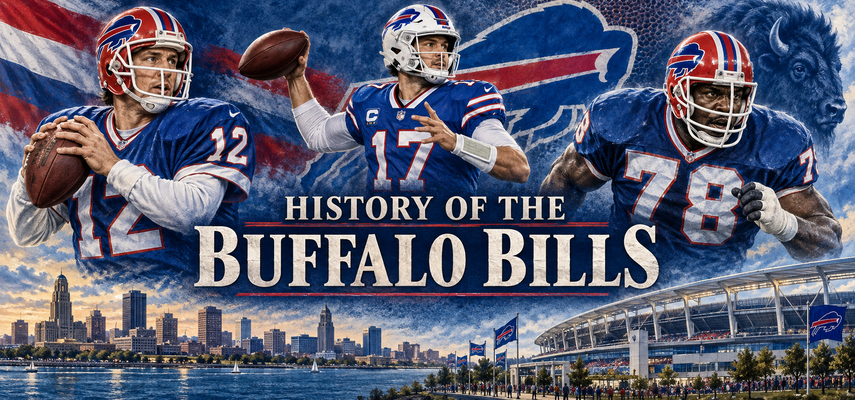

The Buffalo Bills connect the American Football League’s early years with one of professional football’s most devoted regional followings. Two AFL championships established an early standard, while the Jim Kelly–Marv Levy teams later reached four consecutive Super Bowls without winning one. That combination of achievement and disappointment became central to the franchise’s identity. A long playoff absence gave way to another contender led by Josh Allen and a new Orchard Park stadium. This history follows those changes while keeping the modern Bills distinct from Buffalo’s earlier AAFC team and separating AFL titles from Super Bowl results.
Franchise at a glance
| Field | Details |
|---|---|
| Founded | 1959; AFL franchise awarded to Ralph Wilson |
| First season | 1960, American Football League |
| Original city and name | Buffalo, New York — Buffalo Bills |
| Current city and name | Buffalo Bills; home games in Orchard Park, New York |
| Previous cities and names | None; the earlier AAFC Buffalo Bills were a separate franchise |
| League and conference/division | NFL — American Football Conference East; AFL through 1969 |
| Home venue | New Highmark Stadium, Orchard Park; opened in 2026 |
| League championships | 0 Super Bowl championships through the completed 2025 season |
| Other recognized championships | 2 AFL championships: 1964, 1965; 4 AFC championships: 1990–1993 |
| Historical coverage | 2025 NFL season, including playoffs completed in February 2026; later developments through October 16, 2026 |
Origins and early years
Ralph Wilson received an American Football League franchise for Buffalo on October 28, 1959. The new Bills began playing in 1960 at War Memorial Stadium, joining a league that was competing with the established NFL for players, attention and financial stability. The name revived a familiar local identity associated with the earlier Buffalo Bills of the All-America Football Conference.
That earlier organization played from 1946 through 1949, initially as the Bisons, and did not become the modern franchise. Reusing the Bills name did not transfer its records or create an uninterrupted team history. Wilson’s organization was a new AFL club, with its own roster, ownership and competitive record. Its first seasons were difficult, but the city supplied an audience and a distinctive setting for professional football. The club gradually assembled stronger players and benefited from Lou Saban’s arrival as head coach.
Defining eras
1960–1966: Building an AFL champion
The early Bills improved around quarterback Jack Kemp, running back Cookie Gilchrist and a defense that became one of the AFL’s strongest. Saban gave the team a clearer competitive direction, and Buffalo reached a divisional playoff in 1963 before losing to Boston. That disappointment preceded the franchise’s first championship rather than ending its development.
In 1964, the Bills defeated the San Diego Chargers 20–7 in the AFL Championship Game. The following season brought another title, this time through a 23–0 victory over the same opponent. These were full league championships in the AFL, earned before the first Super Bowl existed. Defensive strength and a balanced roster made the consecutive titles more substantial than a short offensive surge. Saban departed after the second championship, and Joe Collier took over. Buffalo returned to the AFL title game for the 1966 season but lost to Kansas City, missing the opportunity to represent the league in the first AFL–NFL World Championship Game.
1967–1985: Simpson, Knox and uneven progress
Buffalo struggled after its championship roster aged, then entered the NFL as part of the 1970 merger. O.J. Simpson became the central offensive player during the next revival. In 1973, he rushed for 2,003 yards in a fourteen-game regular season, the first 2,000-yard rushing season in NFL history. An offensive line known as the Electric Company helped make that achievement possible. The Bills also moved from War Memorial Stadium to their new Orchard Park home that year.
Individual excellence did not consistently produce postseason success. Buffalo reached the playoffs in 1974 but lost its opening game, and another period of decline followed. Chuck Knox brought renewed competitiveness after arriving as head coach in 1978. The 1980 team won the AFC East, while the 1981 Bills won a wild-card game before falling to Cincinnati. Those seasons showed that the franchise could rebuild around a different approach and generation. The improvement was not sustained, however, and difficult mid-1980s results left Buffalo searching again for a durable competitive foundation.
1986–1993: The Levy–Kelly team reaches four Super Bowls
Kelly joined Buffalo in 1986 after playing in the United States Football League, and Levy became head coach during that season. General manager Bill Polian helped construct a deep roster that included Bruce Smith, Thurman Thomas and Andre Reed. The no-huddle offense gave Kelly greater control of pace and defensive matchups, while Smith led a defense capable of changing games with pressure.
The Bills reached the AFC Championship Game after the 1988 season, then won the conference four consecutive times from 1990 through 1993. Their first Super Bowl ended when Scott Norwood’s late field-goal attempt went wide right, leaving the Giants with a 20–19 victory. Washington and Dallas won the next three championship games. Buffalo became the first team to reach four straight Super Bowls without winning one. The 1992 team also produced a famous wild-card comeback against Houston, rallying from 35–3 behind Frank Reich before winning in overtime. Buffalo had qualified as a wild card that season, demonstrating how the conference championship run extended beyond simply winning its division.
1994–1999: The championship core gives way
The Bills remained competitive after their fourth consecutive Super Bowl appearance, but the central roster gradually changed. Kelly retired after the 1996 season, and Levy stepped down after 1997. The organization had to replace more than familiar names: it needed another working relationship among quarterback, coaching staff and personnel leadership after a period of unusual continuity.
Strong defensive play helped preserve postseason opportunities. Doug Flutie and Rob Johnson became the focus of a contentious quarterback decision, reflecting the difficulty of establishing an offensive successor to Kelly. The 1999 team reached the playoffs with an excellent defense and faced Tennessee in a wild-card game played in January 2000. Buffalo took a late lead before the Titans scored on a kickoff return remembered as the Music City Miracle. The officials upheld the lateral used during the play, and Tennessee won 22–16. Buffalo would not return to the postseason for another seventeen seasons.
2000–2016: The long search for another contender
The playoff absence from 2000 through 2016 stretched across repeated changes in coaches, quarterbacks and personnel leadership. Some teams approached a winning record or briefly appeared capable of a breakthrough, but none earned an October-to-January run comparable with the earlier generation. Buffalo’s supporters continued to identify strongly with the club even as competitive continuity became difficult to maintain.
Wilson’s death in 2014 created a more fundamental transition. Terry and Kim Pegula purchased the franchise, keeping ownership tied to western New York at a moment when the team’s long-term future attracted considerable attention. The change did not immediately end the postseason drought. A winning 2014 season was followed by two years under Rex Ryan without a playoff berth. New leadership began another attempt in 2017.
2017–2025: McDermott, Allen and renewed contention
Sean McDermott became head coach and Brandon Beane took over as general manager in 2017. Buffalo ended its playoff absence that season, then selected Allen in the 2018 draft. His development from an inconsistent young passer into a leading quarterback changed the franchise’s competitive ceiling. A stronger roster and coaching continuity helped turn occasional improvement into recurring postseason appearances.
The Bills won five consecutive AFC East titles from 2020 through 2024. They reached the AFC Championship Game after the 2020 and 2024 seasons, losing to Kansas City both times. The Chiefs also won the dramatic divisional game after the 2021 season, when Buffalo’s late lead disappeared before an overtime defeat. Allen received the Associated Press NFL MVP for the 2024 season, an individual achievement that accompanied another deep team run. The 2025 Bills finished 12–5, qualified as a wild card and won at Jacksonville before losing 33–30 in overtime at Denver in the divisional round.
Recent history
The latest completed season is 2025, including the playoffs played in January 2026. Buffalo went 12–5 and reached the divisional round, where Denver won 33–30 in overtime. The club dismissed McDermott afterward and appointed Joe Brady as head coach in January 2026; Beane’s role expanded to president of football operations. Brady had already worked with Allen as quarterbacks coach and offensive coordinator. The Bills also opened the new Highmark Stadium in 2026, replacing the older Orchard Park venue across the street. These were completed changes by the October 16, 2026 research cutoff. The 2026 NFL season was still underway, so no final record, playoff berth or additional championship is assigned to it here. Buffalo’s completed honors remained two AFL championships, four AFC championships and no Super Bowl victory.
Greatest players and influential figures
Jim Kelly
Kelly gave Buffalo the quarterback around whom its greatest NFL team developed. His command of the no-huddle offense helped the Bills reach four consecutive Super Bowls. His entire NFL playing career was spent with Buffalo, although his earlier professional service came in the separate United States Football League.
Bruce Smith
Smith became the leading defensive player of Buffalo’s Super Bowl generation through exceptional pass rushing and sustained service. His career total of 200 sacks includes later Washington seasons, while most of that production came with the Bills. Buffalo retired his No. 78 in 2016 to recognize his franchise contribution.
Thurman Thomas
Thomas supplied rushing, receiving and pass protection within the no-huddle offense, giving Buffalo an unusually complete backfield centerpiece. His 1991 Associated Press NFL MVP accompanied another AFC championship. His long Bills tenure defined his career, while his final season with Miami remains separate from Buffalo’s own team record.
Andre Reed
Reed became Kelly’s leading long-term receiving partner and an important source of production across the middle of the field. His work helped sustain all four AFC championship teams. The 1992 wild-card comeback also showcased his impact, connecting a long career contribution with one of Buffalo’s most memorable playoff victories.
Jack Kemp
Kemp led the offense during Buffalo’s two AFL championship seasons and provided continuity as the young franchise became a contender. His contribution belongs to the AFL period rather than the later Super Bowl teams. His subsequent political career extended his public significance beyond the football achievements that established his Buffalo connection.
Josh Allen
Allen’s development after the 2018 draft transformed Buffalo’s modern offense through passing, rushing and an ability to extend plays. The 2024 Associated Press NFL MVP recognized his completed individual peak. His Bills achievements include division titles and conference-final appearances, while a Super Bowl victory remained unearned through the completed 2025 season.
Marv Levy
Levy guided the Bills through four consecutive AFC championships, managing an exceptional roster without reducing its identity to one player. His partnership with Kelly and a stable core helped Buffalo return after repeated Super Bowl defeats. Those conference titles remain substantial achievements even though none culminated in a Super Bowl championship.
Ralph Wilson
Wilson founded the modern Bills and sustained the franchise across its AFL beginnings, NFL transition and changing competitive generations. His ownership connected Buffalo with the wider development of the AFL. The two early league championships and the later Super Bowl appearances occurred within a long institutional commitment to the region.
Championships and postseason milestones
The table separates Buffalo’s two AFL championship victories from its four losing Super Bowl appearances. The AFL titles were earned before the first Super Bowl and remain valid honors in their own competition. The AFC championships of 1990–1993 qualified Buffalo for the four Super Bowls; they are not four additional overall championships. Other milestones include the 1992 wild-card comeback, the 2017 end of the playoff drought and the Allen-era returns to the conference final.
On smaller screens, scroll horizontally to see all columns.
| Season/year | Competition | Opponent | Result | Defining figure(s) |
|---|---|---|---|---|
| 1964 | AFL Championship | San Diego Chargers | Won 20–7 | Jack Kemp; Cookie Gilchrist; Lou Saban |
| 1965 | AFL Championship | San Diego Chargers | Won 23–0 | Jack Kemp; Billy Shaw; Lou Saban |
| 1990 | Super Bowl XXV | New York Giants | Lost 19–20 | Jim Kelly; Thurman Thomas; Marv Levy |
| 1991 | Super Bowl XXVI | Washington Redskins | Lost 24–37 | Jim Kelly; Bruce Smith; Marv Levy |
| 1992 | Super Bowl XXVII | Dallas Cowboys | Lost 17–52 | Jim Kelly; Andre Reed; Marv Levy |
| 1993 | Super Bowl XXVIII | Dallas Cowboys | Lost 13–30 | Thurman Thomas; Bruce Smith; Marv Levy |
Rivalries, venues and team identity
Rivalries
Miami became a defining divisional opponent through repeated games across the 1970s and the Kelly–Marino years. New England later supplied the standard Buffalo had to overcome in the AFC East. Kansas City became the most consequential recent postseason obstacle, with repeated meetings shaping how the Allen era is understood.
Home venues and traditions
War Memorial Stadium housed the AFL champions before the 1973 move to Orchard Park. The older stadium carried several sponsor names, including Rich Stadium, before a new Highmark Stadium opened nearby in 2026. Tailgating and Bills Mafia’s charitable activity connect the club with a regional identity extending into southern Ontario.
Retired numbers and team honors
Buffalo has formally retired Kelly’s 12, Thomas’ 34 and Smith’s 78. Its Wall of Fame recognizes a much broader range of contributors, including coaches, executives and players whose numbers remain available. An informally withheld jersey is not necessarily retired. These distinctions also keep individual honors separate from the franchise’s two AFL titles and later conference championships.
Legacy
Buffalo’s history cannot be reduced to the four Super Bowl defeats. The earlier AFL champions established a legitimate winning tradition, while Levy’s team achieved a continuity of conference success that remains exceptional. The long drought and the Allen revival then gave different generations their own experiences of waiting and renewed possibility. Throughout those changes, regional attachment supplied a durable connection between team and supporters. The new stadium and coaching transition belong to the next chapter, whose outcome remains open. The completed record already contains substantial achievement, persistent disappointment and an unusually strong sense of place.
Where to eat in Buffalo
Planning a visit? Explore our best restaurants in Buffalo guide.












