










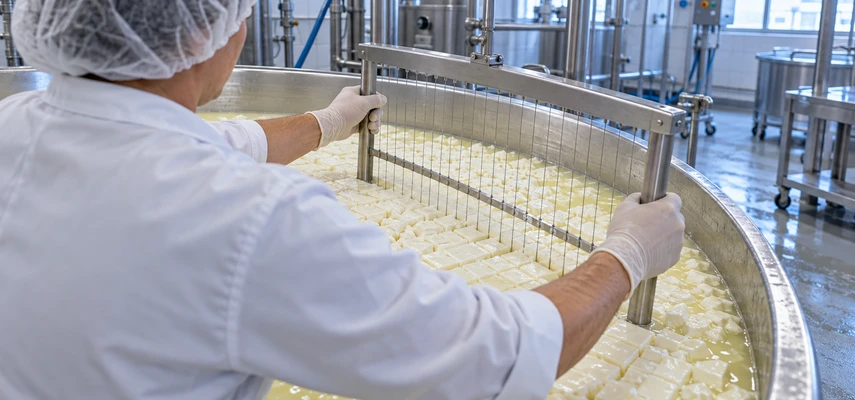
A vat of milk does not look much like a wheel of cheese. The transformation becomes easier to follow when you watch what happens to the water: first it is held inside a delicate curd, then some escapes as whey, and more may leave during draining and maturation. Along the way, the cheesemaker controls acidity, temperature, salt and time to build a particular food.
Learning how cheese is made means following those decisions from the dairy to the finished product. A soft fresh cheese and a firm aged wheel share some operations, but they take different routes through them. Neither is simply milk left to sit until it becomes solid.
For the broader introduction to the food itself, start with our beginner’s guide to what cheese is. This guide follows the main production stages, explains what each accomplishes and shows where familiar cheeses branch away from the general pattern. It is an explanation of professional practice, rather than a recipe with universal temperatures or timings.
1. Choose and prepare the milk
Production begins with milk suited to the intended cheese. The dairy checks incoming milk and may adjust the balance of fat and protein, a process called standardization. Removing some cream or blending milk components can help achieve a consistent starting point. The aim is not to make every cheese alike; it is to give a particular cheese the composition its recipe requires.
Many cheeses use pasteurized milk, while some established styles use raw milk. Pasteurization is a controlled heat treatment, distinct from the warming or cooking that may happen later in the vat. A raw-milk designation describes the starting treatment, rather than an entire cheesemaking method. The U.S. Dairy production overview describes milk testing and preparation as the opening stages of manufacture.
Consider Parmigiano Reggiano as a specific exception to any assumption that all cheese milk is pasteurized. Its producer consortium describes combining naturally skimmed evening milk with whole morning milk for its raw-milk production. That is a rule for this cheese, rather than a model for every dairy.
2. Add cultures and develop acidity
For many cheeses, selected starter bacteria begin converting lactose, milk’s natural sugar, into lactic acid. That acid development changes the conditions under which the curd will form and be handled. The cheesemaker follows its progress alongside temperature and time.
“Ripening the milk” can mean allowing a starter to become active before adding the coagulant. This early use of the word ripening is different from aging the finished cheese. Recipes vary in how much acid develops before the milk sets.
Cultures can also contribute to flavor development, and additional microorganisms may have particular jobs during maturation. The University of Guelph’s cultures reference distinguishes starter functions from the activities of other ripening organisms.
At this stage, think of the maker as preparing the conditions for a result. Adding a culture does not instantly supply the finished flavor of Cheddar or Brie. Its effects continue through subsequent operations, and different recipes require different patterns of activity.
3. Coagulate the milk into curd
Coagulation is the change from liquid milk to a gel or gathered mass of protein. In many familiar cheeses, the maker adds rennet, a preparation of milk-clotting enzymes. These enzymes act on casein proteins so that they can form a network holding fat and liquid.
Acid provides another route. Some cheeses rely primarily on acid development, while heat-and-acid methods are used for specialties such as paneer and ricotta-style products. Rennet is therefore common, but it is not a universal ingredient. The National Dairy Council of Ireland explains the broad distinction between acid-curd and rennet-curd production.
The setting stage matters because the curd must be ready for whatever comes next. An intact gel can look fairly uniform across a vat, but its condition determines how it responds to handling. The maker is managing a developing structure, rather than simply separating a solid that was already floating in the milk.
4. Cut, stir and sometimes cook the curd
Cutting divides a set curd into smaller pieces and opens routes for whey to escape. The tools may resemble wire frames or harps. This is one reason a dairy vat can look dramatically different a short time after coagulation: the continuous gel becomes particles surrounded by liquid.
The University of Guelph’s step-by-step manufacturing chapter describes how cutting, stirring and cooking help manage moisture release. Smaller pieces generally provide more surface through which whey can leave, although the finished moisture also depends on the rest of the process.
Stirring keeps the pieces moving, and heating can encourage further contraction and whey release. Here, “cooking” means controlled heating of curd and whey in the vat. It does not mean baking the finished cheese, and it is not interchangeable with pasteurization of the original milk.
The important question is what texture the maker is working toward. A drier cheese needs a different moisture-management strategy from a delicate cheese intended to retain more water. There is no single cut size or cooking schedule that produces every style.
5. Drain the whey and work the curd
Draining removes the surrounding whey while retaining the curd. Depending on the cheese, that can involve draining tables, cloth, baskets or forms. Whey remains a dairy material in its own right; separating it is part of concentrating the ingredients that will become cheese.
Guelph’s cheese-family guide shows how widely curd handling differs. Some recipes include washing the curd, replacing part of the whey with water to influence the remaining lactose and subsequent acid development. Washing curd inside the production process is different from washing the exterior rind during aging.
Other cheeses give the curd a distinctive mechanical treatment. These operations help explain why two cheeses can begin with similar milk and still emerge with quite different structures.
Cheddar: stack and turn
In traditional Cheddar production, drained curd mats into slabs that are cut, stacked and turned during cheddaring. The slabs are later milled into smaller pieces before salting and pressing. The Academy of Cheese’s Cheddar method documents this sequence.
Cheddaring is a particular production operation, rather than a general term for aging. It gives a name to work that happens before the familiar block or wheel reaches the maturation room.
Mozzarella: heat and stretch
Mozzarella takes a different path. Once the curd reaches suitable conditions, it is heated and worked into a smooth, stretchable mass, then shaped. The Mozzarella di Bufala Campana consortium describes the stretching and portioning used for its protected buffalo-milk cheese.
That brief comparison is enough to reveal a major difference: Cheddar curd is stacked and milled, while mozzarella curd is stretched. The cheese names refer to the results of specific processes, not just different lengths of storage.
6. Shape the cheese and press where appropriate
Forms, also called molds, collect curd into the intended shape. In this context, a mold is a container, not the fungus associated with a bloomy rind or blue veins. A form may create a wheel, a block or another familiar outline.
Some cheeses drain largely under their own weight; others are pressed. Pressing helps curd pieces join and supports further whey removal. It does not remove every drop of water. The finished cheese still needs the moisture level appropriate to its style.
The distinction is useful when looking at a cheese counter. A wheel does not necessarily reveal how much pressure was applied, and a soft cheese is not an unfinished hard one. Shape and texture reflect separate decisions that work together in the recipe.
7. Salt the curd or the formed cheese
Salt enters at different points. It may be mixed into curd pieces, applied to the outside of a formed cheese or absorbed from brine, a saltwater solution. Cheddar provides a familiar example of salting curd before pressing; other cheeses are brined after shaping.
Salt contributes more than a salty taste. It influences moisture, microbial activity and the conditions for ripening. The concentration and distribution matter, which is why a maker follows a salting procedure rather than seasoning a wheel casually at the end. Cargill’s technical overview of cheese salting describes dry salting and brining and their effects on the developing cheese.
This also explains why the production sequence cannot be reduced to a rigid checklist with exactly the same order for every variety. Salting, draining and shaping can overlap or change places according to the style.
8. Mature, inspect and package
Fresh cheeses may be prepared for sale without an intended aging period. Others enter rooms where temperature, humidity and handling are managed for maturation. Depending on the style, the maker may turn, brush, wash or otherwise care for the developing cheese.
During ripening, enzymes break down proteins and fats, contributing to changes in texture, flavor and aroma. Some cheeses become firmer as moisture is lost; certain surface-ripened cheeses soften. The University of Guelph’s ripening and packaging chapter explains why time and storage conditions have to suit the particular cheese.
Inspection is another part of the journey. For Parmigiano Reggiano, the consortium describes quality examination after a minimum of 12 months, including tapping wheels with a small hammer. Its production account connects the making, brining, maturation and inspection stages. Other cheeses follow their own standards and release schedules.
Packaging then protects the cheese for its intended route to market. A fresh product and a mature wheel require different handling; reaching a saleable stage does not make every cheese suitable for the same storage conditions.
Reading the finished cheese through its production
Knowing the main stages gives you better questions to ask. Was this cheese stretched? Was salt mixed into the curd or added through brining? Is the exterior a developed rind or a coating? Answers can connect what you see and taste with the work behind it.
For a simple comparison, examine a fresh mozzarella alongside a piece of Cheddar. Look at their surfaces and how each separates when cut. Treat those observations as clues to their different production paths, rather than a test of which cheese is better. When you are ready to serve a small selection, TFE’s Cheese Plate Essentials offers a related starting point.
The journey from milk to cheese is a sequence of controlled transformations: prepare the milk, develop acidity, form and handle curd, drain, shape, salt and, where intended, mature. The craft lies in adjusting those stages together. A finished wheel carries the results of decisions made long before it took its final shape.











