










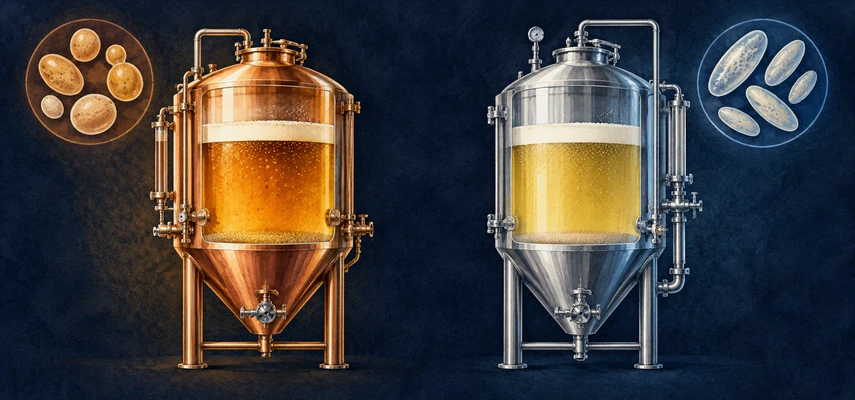
Two golden beers arrive at the table. One is an ale and the other a lager, yet neither their color nor their foam reveals which is which. The distinction begins inside the fermenter, where yeast and the brewer’s handling of fermentation help shape the finished drink.
Ale vs lager is primarily a question of fermentation family in common modern brewing usage. Ales generally use strains of Saccharomyces cerevisiae; lagers generally use Saccharomyces pastorianus. Traditional ale fermentation is usually warmer, while lager production commonly combines cooler fermentation with cold conditioning. Those are patterns, with meaningful exceptions.
Understanding the distinction helps you interpret a menu. It does not tell you that all ales are fruity, all lagers are pale, or one family is more carefully made. To choose confidently, connect the family with the style and the individual beer.
Ale vs lager starts with yeast
Yeast does more than make alcohol. The strain and its working conditions influence the fermentation products that contribute to aroma, flavor, and the impression of a clean or expressive finish. Brewers select and manage those characteristics deliberately.
Ale yeast belongs principally to S. cerevisiae, a species with many strains and diverse brewing applications. Lager yeast, S. pastorianus, has a hybrid ancestry involving S. cerevisiae and S. eubayanus, as described in genomic research on lager yeast. That biological distinction is more precise than judging the beer by appearance.
The BJCP yeast and fermentation study guide explains that fermentation performance depends on yeast strain and the conditions the brewer controls. For drinkers, the important consequence is variation within each family: the name alone is not a full flavor description.
If the scientific names feel like too much information, keep the practical version. Ale and lager usually identify different yeast and fermentation traditions. Ask about the specific style next, because that supplies the more useful expectation of what the glass may offer.
What top-fermenting and bottom-fermenting mean
You will often see ales called top-fermented and lagers bottom-fermented. These are traditional descriptions associated with yeast behavior and harvesting practices. They are not a claim that ale yeast works only at the liquid’s surface while lager yeast works only on the floor of a tank.
Fermentation occurs throughout the liquid. Modern vessel design and brewing practice also make a literal top-versus-bottom picture misleading. The shorthand remains common, but it is better treated as terminology than as a complete diagram of the process.
The BJCP introduction to beer styles adds another useful caution: the meanings of ale and lager have varied across brewing cultures. English-language menu categories are convenient, but they should not be projected unchanged onto every historical period or national tradition.
Temperature influences the result
Why ale fermentation is often warmer
Many familiar ale fermentations operate at warmer temperatures than traditional lager fermentations. With an appropriate yeast strain, the brewer can develop noticeable fruity or spicy fermentation character. The result depends on strain, temperature, pitch rate, wort composition, and other conditions together.
Warmer does not automatically mean rough, fruity, or rushed. A restrained pale ale and a strongly expressive Belgian ale can belong to the same broad family while offering very different impressions. Describing both simply as warm-fermented leaves most of their individual identity unexplained.
Why lager production often includes cold conditioning
Lager brewing is commonly associated with cooler fermentation and a period of cold maturation. Conditioning helps the brewer achieve the intended stability, clarity, and flavor profile. However, the relevant temperature program and timing depend on the brewery and beer.
Avoid universal claims that every lager takes an exact number of weeks or every ale is ready within days. Production involves more than a family label. A strong ale can require extended maturation, and a brewery may use fermentation methods that differ from the traditional outline.
For a drinker, there is little benefit in memorizing one supposed temperature boundary. If you are curious about a particular bottle, the producer’s own brewing description is a better source than an inflexible rule copied from a generic chart.
Color does not separate the families
A lager can be black, and an ale can be very pale. Color is strongly influenced by the grain recipe and processing decisions. It cannot reliably identify the yeast family or establish how much alcohol the beer contains.
German Pils and Schwarzbier make a useful comparison within lager brewing: one is pale, the other dark. The BJCP German Pils description and Schwarzbier description show how much sensory territory one family can cover.
Now imagine ordering by color alone. If you request a dark beer because you want sweetness, you might receive a dry, restrained example and be disappointed. Asking about sweetness, roast, body, and strength addresses your actual preferences more directly.
Neither family owns bitterness or strength
An ale can be gently hopped, while a lager can have a firm bitter finish. Hop selection and use, along with the rest of the recipe, influence the result. Fermentation family does not prescribe a single level of bitterness.
Likewise, both families contain relatively modest and stronger beers. Read the ABV rather than using the words ale, lager, pale, or dark as a shortcut. Consider serving size as well, particularly when tasting several beers.
Consider fermentation method, flavor, and the strength of the particular serving as three separate questions. Combining them into one assumption makes a menu harder to read. Keeping them separate gives you a more accurate description without much extra effort.
The existing beer styles guide can help you place individual styles within that wider landscape. Use it to generate questions, rather than to assume every example matches a single flavor template.
What you might taste—and what you cannot infer
Many drinkers associate lagers with a restrained fermentation profile that lets grain and hops stand clearly. Some ales foreground fruitlike or spicelike fermentation notes. Those are useful expectations when a style supports them, rather than universal sensory tests.
A citrus impression may come from hops, while a fruitlike note may arise from fermentation or an added ingredient. A single aroma cannot reliably identify the yeast species. Consult the brewer’s description when the production method matters to you.
As a comparison exercise, describe each glass before revealing its family. Write down the intensity and character of the aroma, the balance on the palate, and the finish. Then look at the label. This prevents the category from supplying observations you did not actually make.
Our guide to tasting wine introduces a related habit of structured observation. When applying that habit to beer, add particular attention to carbonation, foam, and the way bitterness develops after a sip.
Exceptions are part of the explanation
Kölsch and California Common demonstrate why strict formulas break down. Kölsch uses ale fermentation with subsequent cold conditioning; California Common is associated with lager yeast fermented at warmer temperatures than many conventional lagers.
The BJCP Kölsch guideline and California Common guideline are useful references for these combinations of yeast and technique. They do not erase the distinction between ale and lager; they show that brewers can combine practices in ways a simple two-column chart misses.
Mixed and spontaneous fermentations introduce further complexity. Some beers involve bacteria, nontraditional yeasts, or communities of microorganisms. Forcing every beer into an uncomplicated ale-or-lager answer can hide the very process that makes it interesting.
This is where asking a precise question helps. “Does this use lager yeast?” and “Was this cold-conditioned?” seek different information. A knowledgeable brewer may answer both clearly even when a broad marketing category seems ambiguous.
How to choose at a bar or shop
Begin with your desired experience. You might want a crisp finish, a soft grain character, floral aroma, restrained bitterness, or a stronger warming beer. Then ask which available beer fits those preferences.
If you liked one lager, do not assume the next lager will taste the same. Give the bartender the name or style of the beer you enjoyed and explain what appealed to you. The same applies when one ale was too bitter: that experience does not rule out an entire fermentation family.
For food, consider the intensity and flavor of the specific beer. Our beer and food pairing guide offers a companion framework. The word ale or lager alone cannot determine whether a pairing works.
A comparison you can learn from
For a focused tasting, choose two beers of similar strength and a broadly comparable flavor intensity, one identified by its producer as an ale and the other as a lager. Use small pours, matching clean glasses, and water between samples. This is an exploratory exercise, not a controlled test that isolates yeast from every other variable.
Record similarities as well as differences. Perhaps both are pale and dry, but one has a more expressive aroma. Perhaps their most obvious difference is hop intensity, which reminds you that recipe choices can dominate the comparison. Do not credit every contrast to yeast.
Repeat the exercise on another occasion with different examples. Your goal is to build a set of observations broad enough to resist a stereotype, rather than to prove that one family is always better.
The distinction worth remembering
Ale and lager are useful fermentation categories. They become misleading when used as substitutes for color, strength, bitterness, quality, or personal preference. Yeast and production provide the starting distinction; the style and individual beer complete the picture.
When choosing your next beer, use the family name to orient yourself, then ask what the beer actually offers. That one additional question turns a technical classification into knowledge you can use at the table.











