










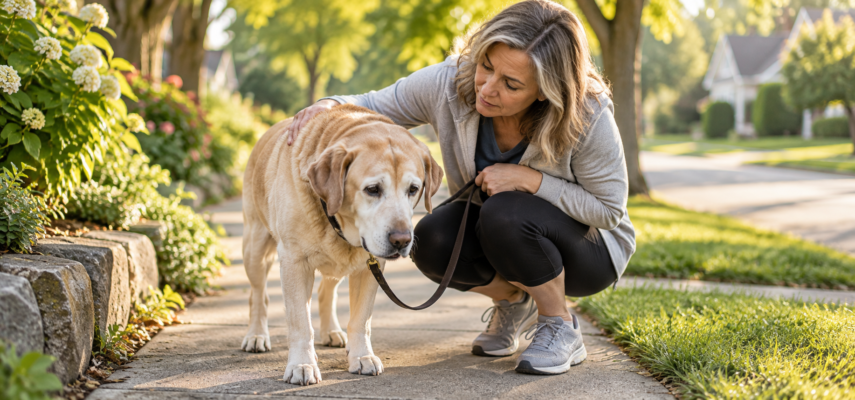
Last Saturday my neighbor’s ten year old lab, Rufus, quit halfway around the block. Just sat down on the sidewalk and looked at her. She panicked, carried him home, and spent the rest of the weekend googling worst case scenarios. By Monday her vet had a much simpler explanation, and a plan.
If your dog has started lagging on the route they used to sprint, you don’t need to spiral. You need two days, a notebook, and a few honest observations. That’s the whole routine. Do it this weekend and you’ll walk into your vet’s office with actual information instead of a vague feeling that something’s off.
One thing worth knowing up front: many owners in this situation start exploring options like CBD for Canine comfort and mobility support before they’ve even identified what changed. That’s backwards. Figure out the pattern first, then talk to your vet about what belongs in the plan. Here’s how to build that picture in 48 hours.
Why the Slowdown Shows Up on Walks First
Walks are the most demanding thing most dogs do all day. They involve distance, temperature, footing, other dogs, and a whole lot of decisions. So when something in your dog’s body starts to complain, the walk is usually where you notice it.
That’s not a diagnosis, and I’m not pretending it is. It’s a pattern. A dog who’s stiff getting off the couch but fine on grass is telling you something different than a dog who starts strong and fades at the halfway mark. Same symptom, two very different conversations with your vet.
Your job this weekend isn’t to name the problem. It’s to describe it well enough that a professional can.
Saturday Morning: Run the Baseline Walk
Take the normal route at the normal time. No changes. You’re collecting a control sample.
Bring your phone and note four things:
- Where exactly the slowdown happens. Distance from home matters.
- Whether they stop, slow, or refuse. Those aren’t the same behavior.
- What the surface was when it happened. Pavement, grass, gravel.
- How they move in the five minutes after you get home.
That last one is the one people forget. A dog who limps during the walk and a dog who limps an hour later are giving you different clues, and your vet will care about the difference.
One opinion from me: resist the urge to shorten the walk on day one. You need the real picture, not a flattering one. If your dog genuinely can’t finish, stop, but write down where.
Saturday Afternoon: The Three Minute Home Check
You don’t need to be a physical therapist to notice changes. You need to slow down and actually look.
Watch your dog rise from a lying position. Watch them go up and down stairs. Watch them jump onto the couch or the car. Then compare that to a year ago in your head.
The American Veterinary Medical Association notes that dogs age at very different rates depending on size, which is why a seven year old Great Dane and a seven year old Chihuahua aren’t in the same conversation. Big dogs hit their senior years earlier. If your large breed dog is slowing down at seven, that’s not nothing, but it’s also not a surprise.
Write down what you saw. Three sentences is plenty.
Sunday: Test One Variable at a Time
This is where most owners go wrong. They change five things at once, which means they learn nothing.
Pick one variable and change only that.
- Time of day. Walk at sunrise instead of midday. Heat changes everything for older dogs.
- Surface. Trade pavement for a flat grass field. See if the slowdown moves.
- Distance. Cut the route in half and see if energy holds steady to the end.
Do one. Note the result. That’s your Sunday.
If a cooler, shorter, softer walk removes the problem entirely, you’ve learned something useful and low stakes. If the slowdown shows up no matter what you change, that’s a stronger signal that it’s time to call the vet rather than adjust your route again.
What to Actually Bring to the Vet
Vets are working with limited time, and a scattershot description wastes it. A short written log gets you further than a long anxious monologue.
Your one pager should cover:
- When you first noticed the change and whether it came on suddenly or gradually.
- The exact moments it shows up, ranked by how often.
- Anything else that shifted, including appetite, sleep, or mood.
- Every supplement, treat, or food you’ve added in the last three months.
That last bullet matters more than people think. The U.S. Food and Drug Administration regulates animal drugs and animal food differently, and supplements don’t go through the same approval path as medications. So bring labels, not guesses. If your vet knows exactly what’s going in, they can spot interactions or cut things that aren’t helping.
The Comfort Question, Handled Honestly
At some point in this process, you’ll wonder about comfort support options, and that’s a reasonable thing to wonder about. It’s also a question with a real answer, just not a universal one.
The American Animal Hospital Association publishes preventive care guidelines built around the idea that senior pets need more frequent checkups, not fewer, because early changes are easier to work with than late ones. Use that as your frame. Bring up comfort support at your appointment, ask what’s appropriate for your dog’s specific situation and current medications, and let a professional who has actually examined your dog weigh in.
What you shouldn’t do is order something at 11pm based on a forum thread and start guessing at amounts. I’d rather you show up with a notebook and a question than a bottle and a hunch.
Build the Routine You’ll Actually Keep
Here’s the thing about a weekend protocol. It only helps if it turns into something you repeat.
So make it light. Once a month, take the same baseline walk and note the same four things. Two minutes of writing. Keep the notes in one place, whether that’s a phone note or the back of a grocery list.
Over six months you’ll have a real record of how your dog is trending. That record is worth more to your vet than any single visit, because it shows direction instead of a snapshot.
And honestly, it changes how you walk with your dog. You start paying attention to the details instead of just covering distance. My neighbor noticed Rufus had been avoiding the shaded side of the street for weeks before she ever noticed him slowing down.
Where This Leaves You Sunday Night
You started the weekend with a worry and you’re ending it with data. That’s a better position.
If your notes show a clear pattern, call your vet Monday and say so in plain language. If they show nothing, keep the log going and check again next month. Either way, you did the useful thing instead of the panicked thing.
So which is it for your dog, a one off bad day or a trend you’ve been explaining away? Your notebook will tell you. That’s the whole point of writing it down.












