










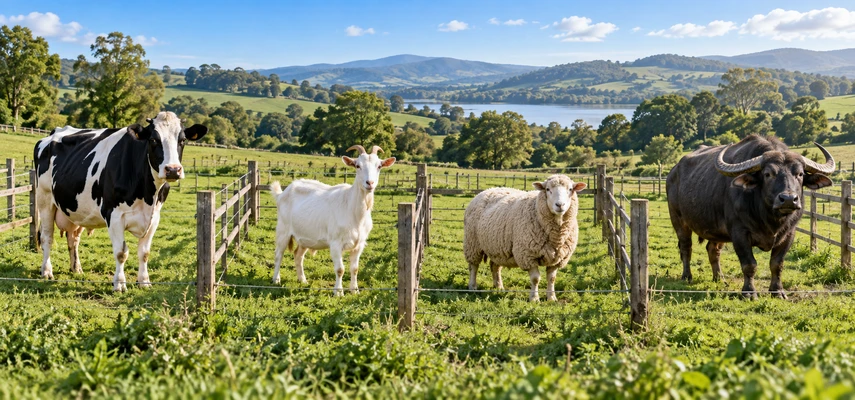
A cheese label can tell you the animal that supplied the milk without telling you whether the cheese will spread, crumble or slice. Goat’s milk can become a fresh log or an aged wheel. Cow’s milk can produce a delicate bloomy rind or a firm cheese for grating. The species matters, but it is only the beginning of the description.
Comparing cow, goat, sheep and buffalo milk cheese becomes more useful when you separate the starting ingredient from the cheesemaker’s decisions. Milk composition, curd handling and maturation work together. A difference you notice between two cheeses may come from several of those factors at once.
This guide explains what the four milk sources contribute and how to explore them fairly. For the broader framework, our guide to the different types of cheese explains why texture, rind and production categories overlap.
What milk source actually tells you
Milk supplies water, proteins, fat, sugar and minerals. Their balance varies among species and within a species. The FAO’s milk-composition reference identifies breed, diet, season and stage of lactation among the influences on that starting material.
The same source notes that sheep’s milk generally contains more fat and protein than cow’s or goat’s milk, while buffalo milk is notably rich in fat. These are broad compositional tendencies, not a promise about the richness of every finished cheese. A maker can adjust milk composition, and draining changes how much water remains.
A useful question is therefore, “What was done with this milk?” Our explanation of how cheese is made follows the stages that turn a starting ingredient into a particular texture.
Cow’s-milk cheese: start with the breadth
Cow’s milk supports a broad range of familiar cheeses. Think of Cheddar, Brie-style cheeses, many Goudas and Parmigiano Reggiano. That range is a practical warning against describing cow’s-milk cheese as one flavor or consistency.
If you already eat several of those cheeses, you have experienced how much variation can exist without changing the animal. Use that knowledge when you encounter an unfamiliar milk source. The important comparison is not necessarily “cow versus goat.” It may be “fresh versus aged” or “washed rind versus firm interior.”
For a first experiment, choose a cow’s-milk cheese you know well and write down its full description: name, approximate age if supplied, texture and rind style. Keep it as an anchor for later comparisons. Familiarity gives you a reference point without making it the standard every other cheese must imitate.
Avoid assuming that the most familiar option is the simplest. A well-described familiar cheese is useful precisely because you can notice the effects of changing one feature at a time.
Goat’s-milk cheese: more than the fresh white log
The word chèvre means goat in French and often appears on fresh goat-cheese labels. In everyday shopping, that association can make goat cheese sound like a single soft, tangy style. It is a much wider category.
The University of Guelph’s milk-quality chapter discusses differences in milk proteins and their implications for cheesemaking. Those differences help explain why species can matter to production, even though they do not predict every sensory detail of the finished product.
When buying goat’s-milk cheese, ask whether the example is fresh, surface-ripened or firm and aged. Those extra words make a more informative description than “goaty,” a term people use in different ways and with different expectations.
If a fresh goat cheese was not to your taste, that is a reason to record what you disliked, not necessarily to dismiss every goat’s-milk cheese. Was the difficulty acidity, texture, aroma or an accompaniment? A different production style may be a more useful next comparison than another nearly identical fresh log.
Sheep’s-milk cheese: composition meets tradition
Sheep’s-milk cheeses include firm, blue and brined examples. Roquefort is a particularly clear demonstration that milk source and cheese family describe different aspects of the same food. Its official producer organization identifies it as a raw sheep’s-milk cheese; its blue character provides another part of its identity.
Feta offers a different example. The European Commission’s protected Feta guide describes sheep and goat milk and maturation involving brine. That protected cheese cannot be understood simply by calling it white, moist or sheep-based.
For exploration, compare sheep’s-milk cheeses across two different families. You are not conducting a controlled test of species, but you will quickly see why the animal alone is insufficient to describe a cheese.
Ask the seller to identify the exact milk blend when it matters to you. A description associated with sheep dairying does not mean every version on every shelf uses sheep’s milk exclusively. The product’s own label and specifications are the useful evidence.
Buffalo milk: an animal, not another word for mozzarella
In this context, buffalo milk refers to water buffalo milk. It does not mean bison milk, and the term is not interchangeable with the cheese name mozzarella.
The Mozzarella di Bufala Campana consortium identifies a specific protected buffalo-milk cheese and describes its production. Mozzarella also exists in other milk versions. Reading the full name helps you distinguish a particular product from the broader stretched-curd family.
For a practical comparison, ask for fresh cow’s-milk mozzarella and fresh buffalo-milk mozzarella of comparable condition. Choose a small amount of each and taste them with the same plain accompaniment. Note differences without assuming every difference comes from species: producer, formulation, handling and time since production may also matter.
This is a good example of matching the question to the purchase. If you want to learn about milk source, compare similar styles. If you want a cheese for a particular dish, discuss the intended use first and milk source second.
Why comparisons can mislead
A fresh goat cheese and an aged cow’s-milk wheel differ in much more than the animal. They may have different moisture, salt, cultures, handling and maturation. Calling the result a test of goat versus cow would overlook most of the variables.
Instead, decide what you are trying to learn. For a milk comparison, ask a knowledgeable seller whether similar styles made from different milks are available. For a texture comparison, keep the milk source consistent if convenient and compare two families.
Perfectly matched examples are not always available, and enjoyment does not require a laboratory experiment. Simply acknowledge the limits of the comparison. “I preferred this aged sheep’s-milk cheese to that fresh goat cheese” is an accurate observation. “Sheep cheese is always better than goat cheese” is a conclusion the tasting cannot support.
This habit also improves recommendations. Tell the seller the cheese you liked and why, rather than asking for the best cheese from a particular animal. A concrete preference gives the conversation somewhere to go.
Mixed milks deserve their own description
Some cheeses combine milk sources. Treat the blend as information rather than an obstacle to classification. Ask which milks are involved and whether the label gives their proportions. If the answer is not available, do not infer a formula from appearance.
A mixed-milk cheese can still be described through texture, age and rind. “A firm aged cheese made from mixed milks” gives you more usable information than either the animal list or the texture alone.
Keep a photograph of the original label if you expect to buy the cheese again. A similar-looking piece with a different blend or producer is not necessarily the product you enjoyed before. The exact name matters when you are building a useful record of your preferences.
Milk source is not a dietary shortcut
Do not use the animal name as a substitute for checking a dietary requirement. Milk allergy and lactose intolerance are different concerns, and neither can be settled by a cheese’s appearance.
The FDA’s allergen-labeling guidance includes milk from ruminants other than cows in its interpretation of milk as a major food allergen. A goat or sheep label is therefore not a general promise of suitability for someone with a milk allergy.
For lactose questions, the NIDDK’s dietary guidance discusses how tolerance can vary and how some dairy choices differ in lactose content. Use product information and individual medical advice when necessary; this comparison is about cheese education, not prescribing a dairy substitute.
A simple four-source exploration
Begin with two sources, rather than feeling obliged to buy four cheeses at once. Ask for a modest amount of each and write down the name, milk source and style. Choose an occasion when you can taste without rushing.
Try each cheese alone before adding condiments. Use the same plain bread or cracker if you want an accompaniment. Describe texture separately from aroma and taste: smooth, crumbly, firm, salty or tangy are perfectly useful words.
Keep the label and your notes together. On a later visit, change one variable deliberately. Try the same milk source in another style, or a similar style from another milk. Each small comparison will teach you more than an oversized assortment with no clear question.
Cow, goat, sheep and buffalo milk offer different starting materials, but cheese takes shape through the whole production process. Read the animal name, then keep asking: which cheese, made how, and at what stage? That fuller description is the most reliable route from a label to a purchase you understand.











