










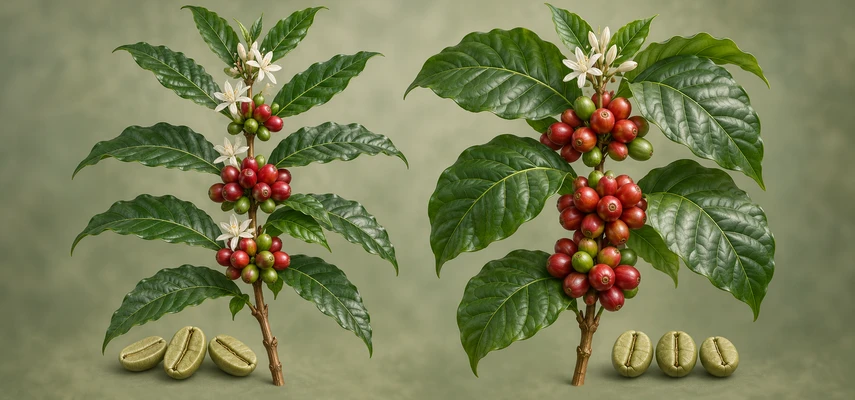

“100% Arabica” sounds reassuring on a coffee bag. It has the confidence of a medal, even when you aren’t entirely sure what competition it won. Meanwhile, Robusta often appears in much smaller print, as though it arrived without an invitation.
The two names do tell you something useful. They point to different coffee plants, with differences in growing conditions, caffeine, and the kinds of flavors you might find in your cup. What they can’t do is taste the coffee for you. A species name is a helpful introduction, not a final verdict.
Here’s how to read those labels with a little more confidence, and a little less deference to the largest type on the package.
First, these are different plants
Arabica is Coffea arabica. Robusta is the name commonly used in the coffee trade for Coffea canephora. Both produce fruits whose seeds can be processed, roasted, and brewed into coffee, but they aren’t simply dark and light versions of the same bean.
Within each species, there are more specific varieties and cultivated selections. World Coffee Research’s catalog covers both species and their many forms. A name such as Bourbon belongs to a different level of the family tree from Arabica. Likewise, a country name tells you where a coffee grew, rather than which species it is.
This clears up several common mix-ups. Arabica doesn’t mean Colombian. Robusta doesn’t mean instant. And espresso can be made with Arabica, Robusta, or a blend of the two. The plant and the way you prepare its seeds are separate decisions.
What difference might you taste?
Arabica is often associated with a broad aromatic range: fruit, flowers, caramel, nuts, and chocolate can all appear in descriptions. It can also have noticeable acidity, the lively brightness that makes a coffee feel fresh rather than flat. That doesn’t mean every Arabica is delicate or tastes like berries.
Robusta tends toward lower perceived acidity, more bitterness, and a fuller impression in the mouth. Depending on the coffee, you might encounter nutty, earthy, or cocoa-like associations. Research on Robusta’s potential also emphasizes how careful production and processing can improve its cup quality. A rough, poorly handled sample doesn’t represent the entire species.
Think of these descriptions as useful expectations when opening a bag. They’re less useful as rules about what you must taste. A dark-roasted Arabica can be firmly bitter. A carefully produced Robusta can be much more enjoyable than its reputation suggests. Roasting and preparation can make the broad species differences easier or harder to notice.
Brightness isn’t the same as a bad sour cup
When someone praises a coffee’s acidity, they usually mean a pleasant liveliness, perhaps reminiscent of fruit. That’s different from saying the cup tastes unpleasantly sour. The distinction is easier to recognize through tasting than through a definition.
If you like a gentler, rounder impression, an Arabica with chocolate or nut descriptors may suit you better than one described as intensely citrusy. Preferring that doesn’t mean you missed the point of specialty coffee. You found out something useful about your own preferences.
Where they like to grow
Arabica has deep roots in the forests of Ethiopia and is widely associated with cooler tropical growing conditions, often at higher elevations. Its growing needs help explain why mountains appear so often in coffee photography. Arabica’s history also helps explain how particular cultivated lines spread far beyond their original home.
Robusta’s native range reaches across parts of central and western sub-Saharan Africa. It is commonly grown in warmer conditions and can succeed in places that don’t suit Arabica. Its commercial geography includes Vietnam, Brazil, Uganda, Indonesia, and India, among other producing countries.
Elevation is a clue, though, rather than a universal dividing line. Temperature changes with latitude and local conditions, and plants differ within each species. A farm’s suitability depends on more than whether someone can describe it as “high altitude.”
For a drinker, the useful takeaway is that these are agricultural choices before they’re marketing choices. A grower needs plants that work on the land available, with the rainfall, disease pressures, labor, and market opportunities that come with it.
Is Robusta really more robust?
There is a reason for the name. Some Robusta plants have useful resistance to important pests and diseases, and the species can offer farmers productive options under conditions unsuitable for Arabica. But “robust” should never be translated as “nothing can hurt it.”
Coffee plants still need suitable water, temperatures, nutrition, and care. Robusta can suffer from disease and environmental stress, too. Efforts to improve Robusta planting material reflect how much room remains for agricultural research and breeding.
This matters when you hear that Robusta will simply replace Arabica as the climate changes. Farmers don’t get a magic reset button. Changing plants can involve money, time, new processing needs, and a different market for the crop. Both species deserve serious attention rather than a story with one doomed plant and one invincible replacement.
Robusta usually brings more caffeine
If caffeine is what brought you to this comparison, here’s the short answer: Robusta generally contains more of it than Arabica. The basic species comparison makes that distinction, although the exact difference varies among coffees.
That still doesn’t tell you the dose in your mug. Serving size, the amount of ground coffee used, and the brewing method all matter. A modest serving of one coffee and an enormous serving of another aren’t a controlled comparison, even if the labels look satisfyingly decisive.
Also, intensity of taste isn’t a caffeine meter. Bitter flavor, dark roast color, and the word “strong” on a bag don’t provide an exact caffeine measurement. If you need to manage your intake, seek serving-specific information where it’s available rather than relying on how forceful the drink tastes.
You can enjoy exploring the species without turning caffeine into a competition. More isn’t automatically better; it’s simply another characteristic to consider.
Why are they blended together?
A blend gives a roaster more ingredients to work with. Arabica and Robusta can be combined to pursue a particular balance of aroma, body, bitterness, and cost. That blend may be designed for espresso, for drinking with milk, or for another specific use.
You can see this in actual products: Arabica–Robusta blends are a deliberate part of established roasters’ ranges. Their existence doesn’t prove a blend is superior, but it does show that using both species isn’t automatically an accident or a secret compromise.
When you try one, ask what the coffee is trying to accomplish. A full, assertive blend might be exactly what you want in a milk drink. On another morning, you might prefer an Arabica whose subtler aromas are easier to notice without milk. Those are different pleasures, and you’re allowed to enjoy both.
Does “100% Arabica” mean better coffee?
It tells you what species is in the bag, assuming the label is accurate. It doesn’t tell you how ripe the fruit was at harvest, how carefully it dried, how it was stored, or how well it was roasted. Those details don’t disappear just because the bag contains a familiar plant name.
The same caution applies in reverse. Robusta has often been sold into markets emphasizing volume and price, which has helped shape its reputation. Yet coffee quality organizations have also recognized fine Robusta evaluation, making room to assess better examples on their own terms.
“Fine” should still prompt a question about who evaluated the coffee and how. It isn’t a spell that makes every product carrying the word delicious. What you want is a seller who can explain the coffee beyond a species slogan: its origin, its intended style, and why they chose it.
Price offers no shortcut to your personal favorite, either. You can pay more for a cup you enjoy less. Your taste buds don’t receive a copy of the invoice.
How to compare them without making it homework
If you’re curious, start with small quantities or individual cafe servings rather than buying more coffee than you can comfortably use. Ask whether a shop has an Arabica and a Robusta, or an Arabica–Robusta blend, that it can describe clearly. You don’t need a laboratory-grade experiment to learn something.
For the fairest practical comparison, keep preparation as similar as you can. Comparing a lightly roasted filter coffee with a dark espresso covered in milk tells you about several differences at once. That’s enjoyable drinking, but it won’t isolate the species very well.
Taste a little of each without additions if that suits you, then prepare them the way you’d normally drink them. Notice aroma, bitterness, brightness, and texture. Write a few ordinary words: “nutty,” “too sharp for me,” “good with milk.” Leave the impressive vocabulary to someone who needs it.
Be honest about the limits. One Arabica and one Robusta are two examples, not representatives elected by their entire species. If you don’t enjoy one, you’ve learned about that coffee, in that preparation, on that occasion. You haven’t closed the case forever.
Choose the coffee, not the team
Arabica often rewards people looking for aromatic variety and brightness. Robusta can offer a fuller, firmer cup and usually more caffeine. Both leave plenty of room for the farmer, processor, roaster, and person making the drink to influence what happens.
Read the species name, then keep reading. Better still, ask a question and taste the result. The point of understanding Arabica and Robusta is to find more coffees you enjoy, not to make your morning cup pass a loyalty test.











