










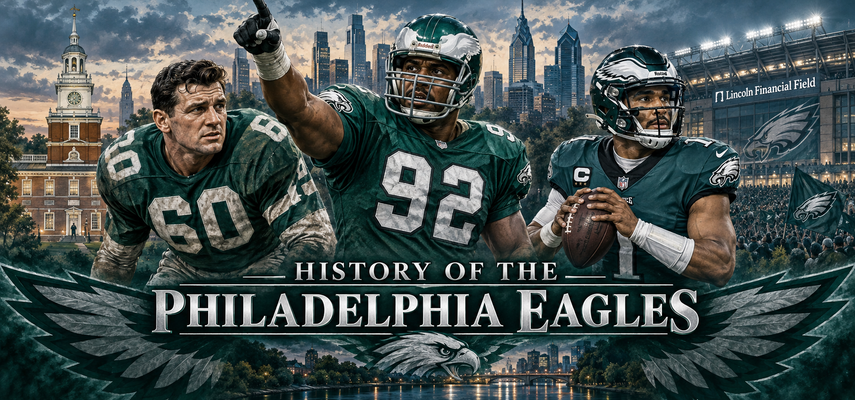

The Philadelphia Eagles built their identity through championship peaks separated by long periods of waiting. Early titles belonged to the running power of Steve Van Buren and the two-way era of Chuck Bednarik; later teams reached a larger national stage before finally winning the Super Bowl. Two modern championships now sit alongside three earlier NFL titles in one continuous franchise record. The city’s attachment to the team connects those generations without erasing their differences. This history follows Philadelphia from its 1933 beginning through the completed 2025 season, with subsequent developments distinguished from the unfinished results of the ongoing campaign.
Franchise at a glance
| Field | Details |
|---|---|
| Founded | 1933; NFL franchise awarded July 8 |
| First season | 1933, National Football League |
| Original city and name | Philadelphia, Pennsylvania — Philadelphia Eagles |
| Current city and name | Philadelphia Eagles; Philadelphia, Pennsylvania |
| Previous cities and names | Phil-Pitt / “Steagles” combined wartime team in 1943; no permanent relocation |
| League and conference/division | NFL — National Football Conference East |
| Home venue | Lincoln Financial Field; opened in 2003 |
| League championships | 2 Super Bowl titles: 2017, 2024 |
| Other recognized championships | 3 pre-Super Bowl NFL titles: 1948, 1949, 1960; 5 NFC titles |
| Historical coverage | 2025 NFL season, including playoffs completed in February 2026; later developments through October 16, 2026 |
Origins and early years
Bert Bell and Lud Wray established the Eagles in 1933, restoring NFL football to Philadelphia after the collapse of the Frankford Yellow Jackets. The new club adopted the eagle associated with the National Recovery Administration’s emblem. Although the founders acquired the former organization’s territorial rights and assets, the Eagles’ recognized championship record begins with their own franchise. Frankford’s 1926 NFL title is not an Eagles championship.
The early team played at the Baker Bowl and struggled to become competitive. Bell combined ownership with coaching responsibilities during part of that period, reflecting the practical limitations of a young organization. World War II then created a different challenge as military service reduced available personnel. In 1943 Philadelphia temporarily combined with Pittsburgh to field the Phil-Pitt team, commonly called the Steagles. The arrangement lasted one season. It did not permanently merge the Eagles and Steelers into a single franchise or transfer their later championships between them.
Defining eras
1933–1949: From survival to consecutive championships
The Eagles’ early losses gave way to a stronger organization under coach Earle “Greasy” Neale. The temporary wartime partnership with Pittsburgh helped the team continue playing, and the postwar roster developed around a powerful running attack. Steve Van Buren became its central offensive figure, supported by players such as tackle Al Wistert. A loss to the Chicago Cardinals in the 1947 NFL Championship Game brought Philadelphia close to its first title.
The following season produced a rematch in heavy snow at Shibe Park. Van Buren scored the only touchdown as the Eagles won 7–0. Philadelphia repeated in 1949, defeating the Los Angeles Rams 14–0 in difficult weather at the Los Angeles Coliseum. The consecutive championship shutouts reflected the team’s strength beyond one runner. Rookie Chuck Bednarik joined the second title roster, providing a link between that championship generation and the next one a decade later.
1950–1960: Another champion in a changing league
The Eagles did not immediately extend the late-1940s success into another championship run. Coaching changes and the decline of the earlier core required a different team to emerge. The franchise moved to Franklin Field in 1958, and quarterback Norm Van Brocklin’s arrival supplied an experienced leader. Buck Shaw’s coaching helped develop the roster around Van Brocklin, receiver Tommy McDonald and Bednarik’s exceptional two-way contribution.
The 1960 Eagles finished 10–2 and faced Vince Lombardi’s Green Bay Packers in the NFL Championship Game. Philadelphia won 17–13, with Ted Dean’s touchdown run supplying the decisive lead and Bednarik making the final tackle on Jim Taylor as time expired. The victory was the franchise’s third NFL championship. Van Brocklin and Shaw departed afterward, while Bednarik continued playing. The title belonged to a particular combination of veteran leadership and timely development, not to an uninterrupted dynasty extending from 1949.
1961–1985: Vermeil restores a contender
The years after the 1960 title brought a prolonged search for competitive direction. The move to Veterans Stadium in 1971 changed the setting before it changed the results. Dick Vermeil became head coach in 1976 and gradually assembled a more disciplined contender around quarterback Ron Jaworski, running back Wilbert Montgomery and a defense led by players such as Bill Bergey.
Philadelphia returned to the playoffs and then won the NFC championship after the 1980 season. Montgomery’s early touchdown run helped defeat Dallas 20–7 at Veterans Stadium, earning the Eagles their first Super Bowl appearance. Oakland won Super Bowl XV, 27–10, leaving the conference championship as the season’s completed honor. Vermeil later stepped away from coaching, and the organization again had to find continuity. That run established an important modern benchmark even though it did not end the wait for another overall league title.
1986–1998: Defensive identity and changing leadership
Buddy Ryan’s arrival in 1986 gave the Eagles a forceful defensive personality. Reggie White, Jerome Brown, Clyde Simmons and Seth Joyner formed part of an exceptional group, while Randall Cunningham’s athletic quarterback play supplied a different offensive possibility. Regular-season success did not translate into a Super Bowl appearance, and the team’s postseason frustrations remained part of the same era.
Rich Kotite succeeded Ryan, while White’s departure in free agency and Brown’s death in 1992 changed the defense’s foundation. Jeffrey Lurie purchased the franchise in 1994, beginning a new ownership period. Ray Rhodes later coached playoff teams, and players such as Brian Dawkins entered the organization. The period therefore connected memorable individual performances with significant institutional transitions. Its legacy cannot be reduced either to the defense’s talent or to the absence of a championship; both shaped the expectations inherited by the next coaching regime.
1999–2016: Reid, McNabb and sustained contention
Andy Reid became head coach in 1999, and Philadelphia selected Donovan McNabb in the draft. Their partnership developed into a sustained period of playoff contention. Dawkins led an aggressive defense, while offensive contributors changed across the seasons. The Eagles reached four consecutive NFC Championship Games from the 2001 through 2004 seasons, winning the last of those to return to the Super Bowl.
New England won Super Bowl XXXIX, 24–21, leaving Philadelphia with another conference title rather than an overall championship. Lincoln Financial Field had opened in 2003, placing the later part of the run in a new stadium. Reid’s tenure continued through 2012 and included another conference-final appearance. Chip Kelly then introduced a different offensive approach, but his period did not produce a playoff victory. Doug Pederson’s appointment in 2016 began another transition, with Carson Wentz arriving through the draft and a different championship roster taking shape.
2017–2025: Two Super Bowl-winning generations
The 2017 Eagles won despite losing Wentz to injury late in the regular season. Nick Foles took over and delivered an exceptional postseason, ending with a 41–33 victory over New England in Super Bowl LII. Foles earned MVP honors, while the fourth-down touchdown pass to him remembered as the Philly Special became a signature moment. The championship belonged to the wider roster and Pederson’s coaching as well as its replacement quarterback.
Nick Sirianni became head coach in 2021, and Jalen Hurts developed into the next central quarterback. Philadelphia lost Super Bowl LVII to Kansas City after the 2022 season, then defeated the same opponent 40–22 in Super Bowl LIX after the 2024 season. Hurts earned the latter game’s MVP, with Saquon Barkley’s running and a powerful defense central to the wider title season. The 2025 Eagles won the division at 11–6 but lost their wild-card game to San Francisco.
Recent history
The latest completed season is 2025. Philadelphia finished 11–6, won the NFC East and lost 23–19 to San Francisco in the wild-card round on January 11, 2026. That result ended the attempt to repeat as Super Bowl champion. It did not erase the 2024 title, but it also did not add a sixth overall championship to the franchise’s recognized record.
As of October 16, 2026, Nick Sirianni remained head coach and the following NFL season was underway. No final 2026 record, playoff outcome or additional championship is assigned here. Lincoln Financial Field remained the home venue. Philadelphia’s completed honors stood at three pre-Super Bowl NFL titles, two Super Bowl victories and five NFC championships, with the conference honors distinguished from the overall titles. The current era’s achievements are substantial, while its next postseason outcome remains separate from the historical record.
Greatest players and influential figures
Steve Van Buren
Van Buren supplied the running power behind Philadelphia’s consecutive NFL championships in 1948 and 1949. He scored the only touchdown in the first title game and remained central to the second championship offense. His entire NFL playing career belonged to the Eagles, making his contribution foundational to the club’s earliest success.
Chuck Bednarik
Bednarik connected the 1949 and 1960 championship teams through exceptional work at center and linebacker. His final tackle secured the 1960 title, while his broader career represents the demands of two-way football. He spent his entire NFL playing career with Philadelphia and became one of the franchise’s defining historical figures.
Reggie White
White made the Eagles’ late-1980s and early-1990s defense one of the league’s most formidable units. His pass rushing earned major individual recognition and changed how opponents prepared for Philadelphia. His later Super Bowl victory came with Green Bay, so that title belongs to his wider career rather than the Eagles’ championship count.
Brian Dawkins
Dawkins supplied leadership and versatile safety play across Philadelphia’s late-1990s transition and the Reid-era contender. He helped the Eagles reach Super Bowl XXXIX and multiple conference finals. His final NFL seasons in Denver remain separate from the long Philadelphia contribution recognized by the retirement of his No. 20.
Nick Foles
Foles took over an injured team’s offense and directed Philadelphia to its first Super Bowl victory. His Super Bowl LII MVP performance included both passing touchdowns and the famous touchdown reception. His broader career included several other teams, but the championship breakthrough remains a specific and enduring Eagles achievement.
Jalen Hurts
Hurts led Philadelphia to two Super Bowl appearances within three seasons and earned Super Bowl LIX MVP honors in the victory over Kansas City. His passing and rushing supplied complementary parts of the offense. Those completed achievements establish his place in the franchise’s history without predicting the outcome of later seasons.
Earle “Greasy” Neale
Neale coached the Eagles through wartime disruption and into their first championship generation. His teams won consecutive NFL titles in 1948 and 1949 through strong defense and a powerful running game. His contribution established a competitive standard before the Super Bowl existed, and those titles retain their distinct historical identity.
Andy Reid
Reid built a sustained Philadelphia contender around McNabb and a succession of strong defenses. His Eagles reached five NFC Championship Games and one Super Bowl, but did not win the overall title. His later Kansas City championships are separate coaching achievements and must not be counted as Eagles honors.
Championships and postseason milestones
Philadelphia has five overall league titles through the completed 2025 season: three pre-Super Bowl NFL championships and two Super Bowl victories. Its five NFC championships include the Super Bowl-losing seasons of 1980, 2004 and 2022. Conference titles are not additional overall championships. The table lists championship victories chronologically and uses season years for Super Bowls, which were played in the following calendar year. Frankford’s separate 1926 title is excluded.
On smaller screens, scroll horizontally to see all columns.
| Season/year | Competition | Opponent | Result | Defining figure(s) |
|---|---|---|---|---|
| 1948 | NFL Championship Game | Chicago Cardinals | Won 7–0 | Steve Van Buren; Al Wistert; Greasy Neale |
| 1949 | NFL Championship Game | Los Angeles Rams | Won 14–0 | Steve Van Buren; Chuck Bednarik; Greasy Neale |
| 1960 | NFL Championship Game | Green Bay Packers | Won 17–13 | Norm Van Brocklin; Chuck Bednarik; Buck Shaw |
| 2017 | Super Bowl LII | New England Patriots | Won 41–33 | Nick Foles; Brandon Graham; Doug Pederson |
| 2024 | Super Bowl LIX | Kansas City Chiefs | Won 40–22 | Jalen Hurts; Saquon Barkley; Nick Sirianni |
Rivalries, venues and team identity
Rivalries
Dallas and the Giants supply recurring divisional rivalries with important postseason chapters. The 1980 NFC Championship Game against Dallas is one of the franchise’s defining victories, while meetings with New York include dramatic regular-season finishes and playoff contests. Washington adds another long-running NFC East relationship, including the conference final after the 2024 season.
Home venues and traditions
Philadelphia moved from its early grounds to Shibe Park, Franklin Field, Veterans Stadium and Lincoln Financial Field. The modern venue opened in 2003, while the team’s geographic identity stayed rooted in the city. The fight song, distinctive green uniforms and intense home support connect different generations without making their football experiences identical.
Retired numbers and team honors
The Eagles formally retire numbers and maintain a separate team Hall of Fame. Their retired numbers include Steve Van Buren’s 15, Brian Dawkins’s 20, Chuck Bednarik’s 60, Reggie White’s 92 and Jerome Brown’s 99. A number that remains unused informally should not be described as formally retired without an official announcement.
Legacy
Philadelphia’s history combines persistence with repeated reinvention. The earliest champions depended on running power and defensive control; the later Super Bowl winners used different quarterbacks and coaching structures to end and then renew a long-awaited success. Between those peaks, memorable contenders helped establish a demanding local standard without adding an overall championship. The five completed league titles now span very different forms of professional football. Their shared significance lies in the franchise’s ability to build another successful generation after disappointment, while the gaps between them show how difficult that achievement remains.
Where to eat in Philadelphia
Planning a visit? Explore our best restaurants in Philadelphia guide.











