









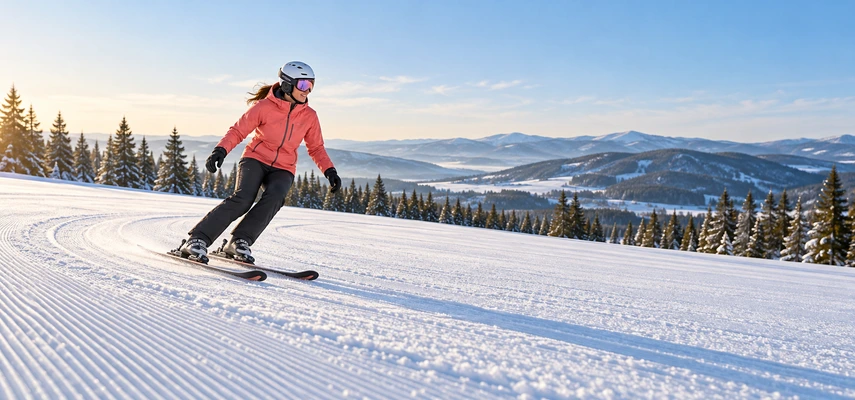

Walking downhill becomes more awkward when the ground is slippery. Skiing takes that problem, attaches a long slippery object to each foot, and makes an entire sport out of it. The surprising part isn’t that people slide. It’s that they learn to choose where the slide goes.
A skier can drift across a gentle slope, trace a rounded turn, and come to a deliberate stop. With practice, those movements become connected enough to feel like drawing on the mountain. Gravity supplies the motion; the skier helps shape it.
That combination explains much of skiing’s appeal. You’re outside in a winter landscape, learning a physical skill whose smallest improvements are immediately noticeable. You don’t need to race, jump, or visit a famous mountain to experience it. A short, comfortable glide on a learning slope can be quite enough to make the idea click.
What counts as skiing?
Skiing means traveling over snow on skis: long platforms attached to boots that support the skier and allow controlled sliding. It can be recreation, competition, exercise, or a way of getting from one place to another.
The version many beginners picture is alpine skiing, usually called downhill skiing. At a resort, a lift carries you uphill and you ski down designated terrain. Your boot is secured at both the toe and heel by an alpine binding, the mechanism connecting boot and ski.
But skiing doesn’t require a chairlift or even a big mountain. Cross-country skiers propel themselves across rolling landscapes, while other forms emphasize climbing, free-heel turns, tricks, or jumps. These activities share sliding on snow, but their equipment and skills differ. Snowboarding is a related snow sport using one board rather than a pair of skis.
For this introduction, we’ll mostly use lift-served alpine skiing as the reference point. It’s a useful doorway into the wider sport, rather than the definition of everything skiing can be.
Why skis slide instead of simply sinking
Put a boot into soft snow and it may punch through. A ski spreads the skier’s weight over a larger area, helping provide support. It doesn’t make the skier weightless, and deep snow can still swallow a ski, but that longer platform changes the interaction considerably.
On a slope, part of gravity pulls you downhill. Snow pushes back against the skis, and friction and air resistance oppose motion. If the downhill pull wins, you accelerate. On flat ground, you generally need a push, a skating movement, or another source of propulsion.
The slippery part is more complicated than snow being frozen water. Ski bases meet individual snow grains; temperature, surface texture, speed, and moisture all affect the contact. A ski can feel quick on one snow surface and surprisingly reluctant on another. Researchers at Switzerland’s WSL Institute for Snow and Avalanche Research measure this friction under controlled conditions because the details matter.
You’ll often hear that skis glide on a thin water film. That’s a useful starting idea, but not a universal explanation for every snow condition. Research into frictional meltwater beneath sliding skis examines a more complicated contact than a miniature swimming pool. For a beginner, the practical lesson is simpler: the snow helps determine how your skis behave, so yesterday’s easy glide doesn’t guarantee identical conditions today.
How a skier persuades the slide to turn
Skis aren’t just straight planks with attractive paint. Many alpine skis have a narrower waist between a wider tip and tail, creating curved sides called sidecut. They also bend under load and have metal edges along their sides.
When a skier tips a ski onto its edge, the edge can engage the snow. Ski shape, bending, steering movements, pressure, and the snow’s resistance work together to change direction. The precise result depends on the movement and conditions. There isn’t one secret angle that makes every turn happen.
Some turns leave narrow, clean tracks, known as carving. Others brush the skis sideways through the snow, known as skidding. A controlled skid is a useful part of skiing, not evidence that someone has failed to discover carving. The PSIA-AASI Eastern teaching framework includes both skidded and carved turns. Different situations call for different tools.
Turning also helps manage speed. A rounded turn carries you across the hill and can finish toward the uphill direction, changing how gravity affects your motion. Skidding dissipates energy as the skis work against the snow. Pointing straight down a slope and hoping to discover the brakes later is a poor learning plan.
Beginners may learn a wedge, with ski tips closer together and tails farther apart, to help manage direction and speed on gentle terrain. Others may encounter different teaching progressions. An instructor chooses movements and terrain that fit the learner. These explanations describe the idea; learning to stop reliably requires supervised practice before moving onto busier or steeper slopes.
One sport, several different experiences
Alpine skiing centers on descending slopes with the heel held down. It includes relaxed recreational turns as well as specialized racing events. You can enjoy the recreational version without wanting anything to do with a stopwatch.
Cross-country skiing uses equipment that allows the heel to lift. Classic technique often follows parallel tracks, while skate skiing uses outward, skating-like pushes. Here, creating forward motion is a major part of the activity, rather than something a lift handles for you.
Telemark skiing also leaves the heel free and is associated with a distinctive turn in which one ski leads the other and the skier lowers into a staggered stance. Freestyle skiing includes disciplines built around features such as moguls, jumps, and halfpipes. Those are specialized skills, not beginner requirements.
Ski touring combines uphill travel with descending. Removable climbing skins under the skis provide grip for the ascent, and suitable equipment permits uphill movement. Touring can enter backcountry terrain, where avalanche hazards, navigation, rescue preparation, and decision-making demand education and experience beyond a resort lesson. A slope doesn’t become managed resort terrain merely because a lift is visible nearby.
How a ski resort works
A resort connects uphill transport with downhill terrain and supporting services. Depending on the area, lifts might include moving carpets, surface lifts, chairlifts, and enclosed gondolas. Beginner areas commonly use short, gentle terrain where learning doesn’t require negotiating the main mountain.
A run, trail, or piste is a route used for skiing. Groomed runs have their snow surface prepared by machinery; ungroomed terrain retains more irregular features. Grooming can make a surface more consistent, but it doesn’t remove every hazard or guarantee easy conditions.
In the United States, you’ll commonly see green circles for the easiest trails, blue squares for more difficult trails, black diamonds for most difficult terrain, and double black diamonds for expert terrain. Those labels compare trails within a resort. The National Ski Areas Association’s trail-signage guidance stresses that relative scale. A blue run elsewhere may feel very different, and countries use different systems.
Conditions matter too. A familiar slope can become harder when firm snow, poor visibility, or heavy traffic changes the task. Ask the ski school which terrain suits your actual stopping and turning ability. Completing a few runs doesn’t automatically qualify you for the next color.
The equipment, without the shopping spiral
For an introductory alpine lesson, the core equipment is skis, compatible bindings, and properly fitted ski boots. The boots transmit your movements to the skis; an uncomfortable or poorly matched fit can make learning unnecessarily difficult. Rental equipment is a practical way to begin without buying a complete setup.
Alpine bindings are designed to retain the boot during skiing and release under certain loads. They cannot guarantee release in every fall or prevent every injury. Have qualified rental or shop technicians select, adjust, and test the setup; Vermont Ski Safety’s equipment guidance explains why inspection and testing matter. Don’t guess safety-critical settings yourself.
A properly fitted snow-sport helmet, goggles, gloves or mittens, and weather-appropriate layers belong in the plan. Helmets provide useful protection, but they don’t eliminate concussion or other serious injury risk; the Canadian Ski Council explains their limits. Poles can help with balance and movement as skills develop, although an instructor may leave them aside during early learning.
You don’t need to understand every ski specification before taking a lesson. You do need equipment that fits, clothing that helps keep you comfortable, and a clear idea of what your rental and lesson booking includes.
Why the beginning can feel so strange
Everyday walking relies on your feet gripping the ground. Skiing asks you to balance on feet that can keep moving. Stiff boots change ankle movement, long skis occupy more space than shoes, and a gentle slope can suddenly feel surprisingly persuasive.
The understandable reaction is to become rigid or retreat backward. Unfortunately, defensive movements can make control harder. Learning means gradually replacing that reaction with movements suited to sliding, on terrain gentle enough to practice without being overwhelmed.
Progress isn’t a contest to reach the highest lift. An instructor can observe what you’re doing, offer feedback you can actually use, and choose a manageable next step. Aspen Snowmass’s lesson guide illustrates this progression by separating first-time sliding and stopping from later linked turns. The useful measure is control, not how impressive the trail sounds afterward.
From getting through winter to enjoying it
Skiing existed long before lift passes. People used skis to travel across snowy country, and recreation and organized competition developed over time. The International Ski and Snowboard Federation’s history places its own founding in Chamonix in 1924 within that much longer story.
As skiing developed, specialized equipment and uphill transport helped turn descending into something people could practice repeatedly. Alpine racing joined the Winter Olympics in 1936, as the Australian Olympic Committee records. Competition became one highly visible branch of a much broader activity.
The modern recreational skier inherits all of that development without needing to race. A lift, comfortable equipment, and accessible instruction make it possible to spend a morning learning something earlier generations developed for very different reasons.
Your first goal: a controlled glide
Begin with a first-time lesson at an established ski area, arrange correctly fitted rentals, and confirm the meeting place and beginner access before arrival. Tell the instructor you’re new. Ask how to stop, where to practice, and how to get help. Treat fatigue and discomfort as reasons to pause rather than push onto harder terrain.
Read the NSAA’s Your Responsibility Code. Its essentials include staying in control, avoiding people downhill, looking uphill before entering a trail, obeying closures, and stopping where you’re visible without obstructing others. Learn lift procedures before boarding. Stay on open terrain appropriate to your ability; backcountry travel requires separate preparation, including avalanche education, forecasts, rescue equipment, and knowledgeable partners. Avalanche.org’s education resources are a starting point for understanding those additional responsibilities, not a substitute for training.
The pleasure often arrives in a small moment: the skis begin to move, you make a deliberate turn, and they go where you intended. The mountain hasn’t changed. Your relationship with it has. That’s plenty of reason to want another run.










