










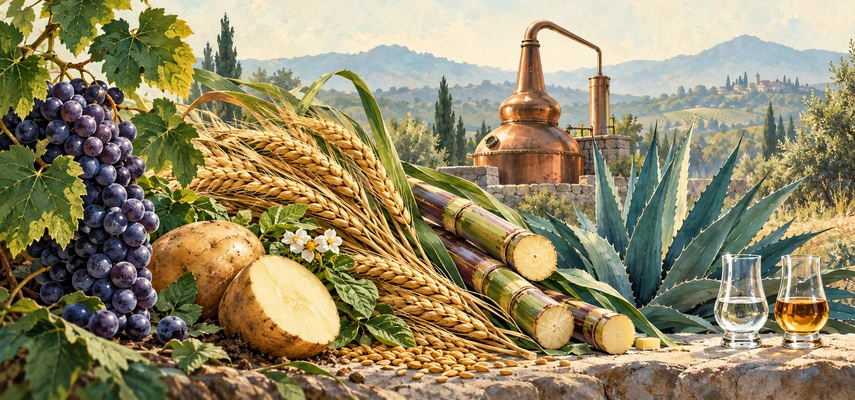

Put a potato beside a bunch of grapes. Add a stalk of sugarcane and the spiky leaves of an agave. It looks like someone has misunderstood the shopping list. Yet each can supply the starting material for a distilled spirit.
The stranger part comes later. Two finished spirits might look as clear as water while smelling completely different. Another might turn amber after spending time in wood. One producer wants the raw ingredient’s character to survive; another works hard to make a relatively neutral canvas.
What connects them? Fermentation creates alcohol, and distillation concentrates it. What separates them is the extraordinary number of choices surrounding those two steps. Understanding that relationship makes a spirits shelf much less mysterious, even if some of the price tags remain ambitious.
What makes a spirit a spirit?
A distilled spirit is an alcoholic beverage made using distillation: a process that separates components of a liquid mixture through evaporation and condensation. Gin, vodka, rum, tequila, mezcal and brandy belong to this broad world. Whiskey does too, although this guide mainly explores the other families.
The word alcohol usually means ethanol when we’re discussing drinks. Spirits contain ethanol and water, along with other compounds that contribute aroma and flavor. They’re not simply agricultural ingredients squeezed into a stronger form. There are biological and physical transformations along the way.
Beer and wine get their alcohol through fermentation. Spirits also depend on fermentation, then use distillation to increase alcohol concentration. A wine and a grape brandy can therefore share an agricultural beginning while becoming very different drinks. Adding sweetness, flavorings or other ingredients after distillation can create further products, including liqueurs.
Everyday language is a little untidy. Liquor commonly means spirits in American English; liqueur generally means a sweetened, flavored alcoholic product. Legal categories are more precise. The U.S. standards of identity define particular classes and types, while other jurisdictions have their own requirements. Don’t expect every country to draw exactly the same boundaries.
First, something living makes the alcohol
Distillation doesn’t manufacture ethanol from a potato. Yeast does the essential biological work first, converting fermentable sugars into ethanol and carbon dioxide.
Grapes supply readily available sugars. Sugarcane can supply juice or products such as molasses. Grain and potatoes contain substantial starch, which must first be broken down into sugars yeast can use. Preparing the ingredient matters because yeast can’t treat every carbohydrate as an equally convenient lunch.
Agave has its own carbohydrate chemistry and processing traditions. For an introductory understanding, the important point is that the plant must be prepared so its carbohydrates can contribute fermentable sugars. Different crops demand different routes to a fermentable liquid; they don’t all go straight into the same recipe.
Fermentation also produces substances beyond ethanol. Those smaller ingredients help explain why the eventual spirit may suggest fruit, flowers or other aromas even when nothing resembling a fruit salad was added to the bottle. The American Chemical Society’s overview of spirits chemistry identifies raw materials, fermentation, distillation and aging as contributors to their varied volatile profiles.
This is the first useful surprise: a distiller inherits flavor from an earlier stage involving living organisms. The still gets considerable attention, but it doesn’t work alone.
Then the still concentrates and selects
Imagine heating that fermented liquid and collecting some of the vapor, then cooling it back into liquid. Under the conditions used for spirit distillation, the vapor can contain a higher proportion of ethanol than the liquid it came from. Condense that vapor, and you’ve collected a stronger liquid.
It’s tempting to picture alcohol politely leaving the pot while all the water waits behind. Real mixtures aren’t that orderly. Both water and ethanol enter the vapor, along with other volatile substances. Distillation changes their proportions rather than providing a perfectly neat escape hatch for one ingredient.
The Wine & Spirit Education Trust’s distillation explanation describes this concentration principle. Equipment and operating choices influence both strength and the compounds carried into the collected spirit.
Stronger doesn’t automatically mean more flavorful
A distiller making a relatively neutral base may seek extensive separation, reducing much of the starting material’s aromatic character. Another producer may want more character to travel through. Neither goal makes sense without knowing what the finished spirit is intended to be.
Think of distillation as an editor with physical equipment. It can emphasize some parts of the fermented liquid and reduce others. That’s an analogy, of course: molecules follow chemistry rather than editorial instructions. But it explains why concentrating alcohol and preserving flavor aren’t identical objectives.
Water is commonly added later to reach bottling strength. The number on the bottle therefore doesn’t tell you the strength at which the spirit originally left the equipment. The American Institute of Chemical Engineers’ introduction to spirits production places distillation within a larger sequence of processing operations, rather than treating it as the entire story.
Meet a few of the main families
You don’t need to memorize a taxonomy before understanding a bottle. Start with two questions: what provided the fermentable material, and what happened after fermentation?
Vodka and gin: a canvas and a botanical direction
Vodka can begin with several agricultural ingredients, including grain and potatoes. Its production generally aims for a comparatively neutral character, although neutral doesn’t mean every vodka must have an identical texture or aroma.
Gin takes a different direction. Juniper provides its defining aromatic identity, often accompanied by other botanicals. The ethanol in a gin needn’t originate in juniper berries; the botanical character and the raw material supplying the alcohol are separate questions. That distinction makes an apparently simple clear liquid considerably more interesting.
Rum and agave spirits: different agricultural roots
Rum belongs to the sugarcane world. Depending on the style, its starting material can include molasses or fresh cane juice. Fermentation, distillation and subsequent treatment help explain the range within the family.
Tequila and mezcal belong to Mexican agave traditions. Their names carry specific production and geographical requirements; they aren’t interchangeable labels for any spirit made from an agave plant. Nor should you assume every mezcal tastes strongly smoky. A category name gives useful orientation, but it doesn’t replace information about the producer and process.
Brandy and Cognac: fruit, followed by a more specific address
Brandy is associated with distilled fruit, including grapes and other fruits. Cognac is a particular protected French grape spirit within that broader landscape, rather than a separate agricultural species of alcohol.
The Cognac interprofessional organization describes a chain running from vines and winemaking through distillation, maturation and blending. That connection to a place and its production rules helps explain why a familiar family name can contain much narrower identities.
These are signposts, not full profiles. Each family contains distinctions worth exploring separately, and a single adjective rarely does justice to all its members.
Why clear and brown don’t tell the whole story
Fresh distillate is generally clear. Many familiar amber or brown spirits gain color during maturation in wooden containers. Wood also changes aroma and flavor; it isn’t merely a natural paint tin.
Clear spirits can nevertheless have forceful aromas. Gin makes the point neatly: a transparent liquid can carry an unmistakable botanical character. Conversely, a dark appearance doesn’t establish how old a spirit is or how intense it will taste. Some products permit coloring, and some matured spirits are filtered to reduce color.
The practical lesson is to read the description instead of asking your eyes to do every job. A bottle’s appearance is one clue among several. It can’t reveal the complete production history, and it certainly can’t rank quality by itself.
Flavor can reflect the crop, fermentation, separation, botanical treatment, maturation and blending. Changing one stage can change the result, even when the liquid begins with the same agricultural ingredient.
ABV, proof and the size of the pour
Alcohol by volume, usually abbreviated ABV in conversation, expresses alcohol concentration by volume. A spirit at 40% ABV contains the equivalent of 40 milliliters of ethanol per 100 milliliters of finished liquid under the measurement conditions.
In the current U.S. system, proof is twice ABV: 40% ABV is 80 proof, and 50% ABV is 100 proof. That’s a U.S. convention; historical proof systems elsewhere weren’t identical. The TTB’s label guide explains the required alcohol-content statement on U.S. spirits labels and the optional proof statement.
Concentration and serving size must be considered together. The CDC defines a U.S. standard drink as 14 grams of pure alcohol, approximately the amount in 1.5 U.S. fluid ounces of a 40% ABV spirit. Its comparison servings are 12 ounces of 5% beer or 5 ounces of 12% wine.
A larger pour or stronger spirit contains more alcohol. Adding water changes concentration but doesn’t remove ethanol already poured into the glass. A standard drink is a measuring unit, not a promise of safety.
A small vocabulary that earns its place
Distillate means the liquid collected through distillation. Botanicals are plant ingredients used for flavoring. Maturation means a period of development under specified storage conditions, often involving wood. Blending combines components to achieve an intended result; it isn’t automatically a shortcut or a mark of inferior quality.
These words describe different parts of production. Separating them helps you ask better questions. Was an aroma created during fermentation, carried through the still, introduced through botanicals or developed during maturation? A beginner doesn’t need the laboratory answer to every question. Recognizing that several answers are possible is already progress.
There’s a human history in the equipment
Spirits connect agriculture to trade, work, regulation and social custom. Cognac offers a concrete example: its interprofessional organization describes Dutch involvement in distilling Charente wines for shipment and the later development of double distillation. A regional wine economy became linked to another kind of product and expertise.
That example isn’t a universal origin story. Different spirit traditions require their own histories, including the people who grew the crops and supplied the labor. Cultural importance also doesn’t cancel health risks. The World Health Organization identifies ethanol as toxic and dependence-producing and links alcohol consumption to injuries, disease and cancer.
There’s no health requirement to drink spirits to appreciate their history or production. If you drink, less alcohol means less exposure; don’t drive afterward. Avoid alcohol during pregnancy and when medications or medical conditions make it unsafe. Expensive, traditional and artisanal aren’t synonyms for harmless.
The useful starting point is curiosity. Ask what grew in the field, what fermentation changed, what the still selected and what happened afterward. A clear liquid can then tell a surprisingly complicated story—and you don’t need a complicated vocabulary to follow it.










