










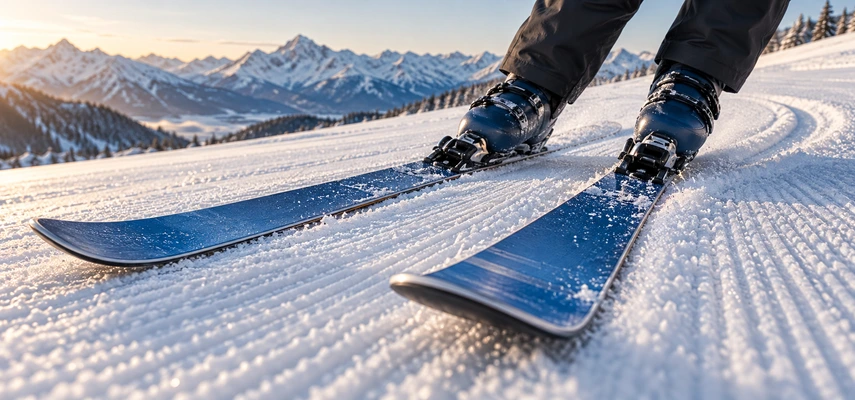

A ski has no engine, steering wheel, or brake pedal. Yet a skier can leave the same spot on a slope and choose several quite different journeys: a slow sequence of rounded turns, a smooth traverse across the hill, or a deliberate stop. The equipment hasn’t changed. The way it meets the snow has.
That’s the useful secret behind skiing. You aren’t commanding an unresponsive plank by force of personality. You’re adjusting direction, balance, edge angle, and pressure so the snow can push the skis along the path you want. Gravity contributes plenty of enthusiasm already.
Understanding that relationship won’t replace a lesson. It can, however, make the lesson more intelligible. Instead of collecting disconnected instructions about knees and feet, you can recognize what each movement is trying to accomplish.
First, gravity provides a downhill invitation
Imagine placing a ball on a flat tabletop, then gently tilting the table. The ball now has a preferred direction. A skier on a slope experiences a similar downhill tendency, although skis also slide, grip, bend, and interact with an uneven surface.
Gravity acts downward. The slope supports you, and part of gravity’s effect tends to move you down the incline. A steeper slope generally increases that downhill component. Friction with the snow and resistance from the air oppose motion, so actual speed depends on more than steepness alone.
The fall line is the direction straight down the slope at your location. Pointing your skis closer to it typically encourages acceleration. Traveling more across the slope changes the situation, because your direction of movement no longer lines up with the steepest descent.
The comparison isn’t a promise that any sideways path will be slow or safe. Starting speed, snow, gradient, available space, and other people all matter. It explains why direction is one of a skier’s most important tools for managing speed.
The snow isn’t merely something to slide over
A ski’s base supports gliding, while its edges and shape help it resist sideways movement. Snow provides the forces that make those changes possible. Without that interaction, leaning into a turn would accomplish much less than a skier hopes.
Snow is also an inconsistent partner. Hard, smooth snow behaves differently from soft, broken snow. A surface that felt forgiving in the morning may become scraped or bumpy later. Temperature and moisture change how the base moves over the crystals.
Researchers at Switzerland’s snow and avalanche institute measure ski-material friction on snow and ice rather than treating every frozen surface as equivalent. For a learner, the implication is practical: if the skis suddenly behave differently, conditions may be part of the explanation.
That matters when copying another skier. Their speed, skis, movement, and patch of snow may all differ from yours. A visible pose is only one part of the event, not a complete set of instructions.
Balance means staying available to move
On skis, balance isn’t a rigid position you achieve once and preserve all morning. Your feet move beneath you, the slope changes, and the support from the snow changes through a turn. Balance involves ongoing adjustments that let you respond.
A useful starting stance has comfortable flexion through the ankles, knees, and hips, with the body supported over the feet. Hands remain where they can help rather than pulling the body backward. The exact appearance varies with body proportions, equipment, terrain, and task.
Think of standing on a slowly moving bus. Locked knees and a stiff body make each change feel abrupt. Some flexibility gives you options. Skiing adds two long sliding platforms, so those options become especially useful.
Boots influence the sensation. Alpine boots limit ankle movement compared with shoes and transmit movement to the skis. They don’t mean your ankles stop contributing. If a boot fit or cuff makes a comfortable stance difficult, ask the instructor and rental technician for help rather than inventing a more strenuous posture.
Turning combines several controls
You can steer the skis by turning your legs and feet, adjust how much they tip onto their edges, and change how force is distributed along and between them. Those controls work together. Trying to isolate one as the entire secret produces some very unhelpful skiing advice.
Consider moving a flat tray across sand, then tipping one side downward. Its interaction with the surface changes. A ski edge similarly changes how the ski engages snow, although a ski is flexible and shaped, and the comparison isn’t a literal model of a turn.
Modern alpine skis commonly have curved sides, with a waist narrower than the tip and tail. When edged and loaded, the combination of that shape, bending, and snow contact can help guide a curved path. Steering movements also matter, especially when the skis are brushing sideways rather than leaving clean tracks.
An instructor may ask for a movement at the feet, a gentler release of an edge, or a change in support from one ski to the other. Those aren’t competing explanations. They’re ways of adjusting different parts of a coordinated system.
A skid can be useful, and a carve isn’t compulsory
In a carved turn, the ski tail follows close to the path made by its tip, leaving a relatively narrow track. In a skidded turn, the ski also moves sideways relative to its length, brushing a wider path through the snow.
The difference matters because sideways brushing can help dissipate energy and manage speed. A controlled skid is a technique, not a failure to ski elegantly. Carving offers a different sensation and can preserve speed effectively, which isn’t always what a beginner needs.
The PSIA-AASI Eastern assessment framework explicitly describes skidded basic parallel turns and edged, bent-ski arcs as different tasks. The goal is the ski performance appropriate to the situation, not one preferred track everywhere.
This is why a photograph can be misleading as instruction. A deep lean and a clean arc may be suitable for an experienced skier on open terrain. Trying to recreate the outline before learning basic steering and stopping reverses the learning process.
Speed control begins before the stop
Beginners often imagine skiing as alternating between going and braking. A more useful picture is choosing a path that keeps the speed manageable throughout the run.
A rounded turn can guide you from a more downhill direction toward a path across the slope. Continue it appropriately and the skis may head somewhat uphill. That changes the relationship between motion and gravity. Skidding can contribute additional resistance along the way.
Simply drawing a quick zigzag with the tips may not achieve the same result. If the skis repeatedly point down the hill and the turns never develop enough shape, speed can keep building. Turning and controlling speed are related, but the mere appearance of turning isn’t enough.
The Canadian Ski Council’s slope-safety guidance emphasizes matching speed to ability and conditions. Useful questions are whether you can choose your route, maintain space, and stop where intended. Looking stylish comes considerably later in the queue.
How stopping fits into the picture
A common beginner stopping method is the wedge, also called a snowplow: the ski tips are closer together than the tails, and the skis engage the snow on their inside edges. On suitable gentle terrain, steering and edge engagement create resistance that can reduce speed and bring the skier to rest.
The shape alone isn’t magic. A very large wedge, stiff legs, or an unsuitable slope can make the task exhausting without producing reliable control. An instructor helps match the movement to the learner and the terrain, then checks whether it works consistently.
As skills develop, skiers learn other ways to slow and stop, including bringing parallel skis across the direction of travel in a controlled skid. Those methods require coordination and practice. They aren’t emergency tricks to try for the first time when already moving too quickly.
Falling intentionally isn’t a routine braking system. Nor should a learner rely on a friend to catch them or on an uphill-looking patch to fix an uncontrolled descent. Learn stopping in a designated beginner setting before committing to a lift or slope whose demands exceed that skill.
Why trying harder can make control worse
When sliding feels alarming, it is natural to stiffen, pull back, stare at the ski tips, or twist the shoulders toward the desired direction. The intention is sensible: regain control. The result may remove the flexible, balanced movements that make control possible.
More effort isn’t always more effective pressure. Pressing hard on the wrong part of a ski, or holding an edge when it needs to release, can obstruct the turn. A smaller movement made at a better moment may work more smoothly than a larger one.
This is where feedback matters. Tell an instructor what you feel: one ski catching, acceleration at the same place in each turn, or difficulty stopping in one direction. Specific observations help them distinguish a movement issue from terrain, fatigue, or an equipment problem.
Don’t experiment with greater speed to force the skis into cooperating. Return to easier terrain and a movement you can control. Understanding the mechanism gives you better questions to ask; it doesn’t remove the consequences of an unsuitable practice setting.
A sensible way to learn the connection
Start with professional instruction on terrain selected for first-time learning. Establish that you can stand, move short distances, and stop predictably before adding more complicated demands. Progress means repeating a controlled result, not merely surviving a longer run.
The NSAA’s responsibility code requires skiers to remain able to stop or avoid people and objects. It also gives downhill users priority and calls for looking uphill before entering a trail. Those rules describe the space your movements must respect.
After a successful turn, the useful question isn’t only whether you stayed upright. Notice what changed: the direction of the skis, their contact with the snow, and the speed you carried into the next movement. Discuss those observations with your instructor.
Eventually, the separate ideas begin to feel connected. You guide the skis, the snow responds, and the path becomes intentional. The missing steering wheel was never a design oversight. The controls were under your feet all along.











