










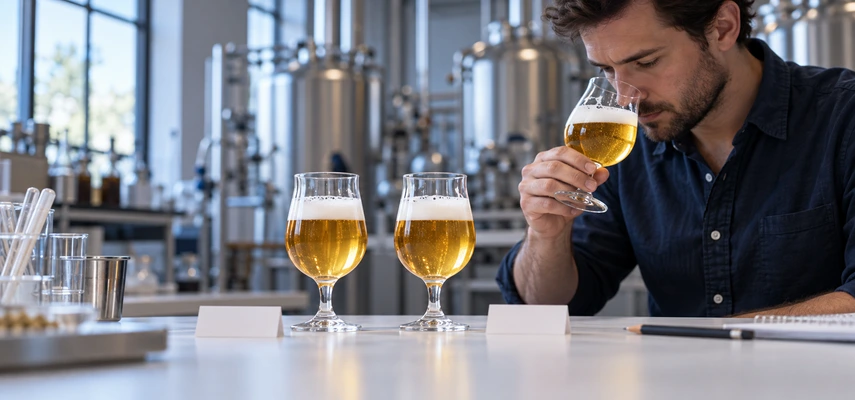

Two pale gold beers sit side by side. Same color, similar foam, apparently the same drink. Then one smells of bread crust and flowers while the other suggests banana and clove. If you want to evaluate beer, this is a useful puzzle: what happened before either glass reached the table?
The answer lies in relationships. Ingredients offer possibilities; brewing decisions select and reshape them. Fermentation adds another layer, and storage can preserve the result or undo it. Learning those connections turns a long list of beer styles into something you can reason through.
This opening lesson in The TFE Guide to WSET Level 2 Beer establishes that habit. You don’t need to complete Level 1 first. TFE’s series is an independent study resource, with no affiliation with or endorsement by WSET. Use it alongside your provider’s current course materials.
What Level 2 asks you to understand
The official qualification page organizes the subject around ingredients, production, styles, and storage and service. These are connected subjects. A question about a dark lager may require you to link malt processing to color, lager fermentation to aroma, and serving conditions to what reaches your nose.
Level 2 therefore rewards more than recognizing a familiar label. For each important characteristic, ask what can cause it, what can change it, and what other evidence you would need. A citrus aroma might come from hops or an addition; the aroma alone does not prove which.
The same reasoning keeps comparisons useful. A German pilsner and Munich helles can share a pale appearance while differing in hop emphasis and perceived balance. A style gives you a set of expectations. Your task is to understand why those expectations exist and describe the actual beer without forcing it to fit.
Follow the beer from ingredients to glass
Start with malted grain. Malting prepares grain for brewing; mashing uses enzymes to turn accessible starch into smaller carbohydrates, including fermentable sugars. Malt also contributes color and flavor. Different processing choices can suggest fresh bread, toast or roast, rather than one universal malty taste.
Hops contribute bitterness and aromatic possibilities. How they are processed, stored and used matters alongside variety. A brewer seeking pronounced fresh hop aroma will make different addition decisions from one mainly seeking kettle-derived bitterness. The later hop lessons explain the chemistry; for now, remember that an ingredient name is only part of the story.
Yeast consumes fermentable sugars and produces alcohol and carbon dioxide, along with aroma compounds and heat. Different strains and conditions can produce noticeably different results. Water composition also affects the brewing environment and beer character. Some styles use additional grains, sugars, flavorings or bacteria deliberately. The four familiar ingredients are a foundation, not a ban on everything else.
This chain is your study tool: ingredient choice, production choice, sensory result. When reviewing a lesson, try completing that chain in ordinary language. If a technical term doesn’t help you explain a change in the beer, check whether you understand the term or merely recognize its spelling.
Evaluate beer before naming its style
A systematic approach reduces the chance that one striking feature will dominate your judgment. The Cicerone discussion of evaluation methods distinguishes observing a beer’s parts from starting with expectations about the whole. Both have uses; recording observations before checking a label makes your evidence easier to examine.
Use a clean, odor-free glass and a neutral setting. Strong room fragrances, food smells and dirty glassware compete with the sample. Keep conditions reasonably consistent when comparing beers. Differences in temperature, pour and time in the glass can otherwise masquerade as differences between recipes.
You don’t need a sprawling tasting note. A few accurate observations beat a paragraph of ambitious guesses. Record what you notice, distinguish intensity from identity, and leave uncertain details uncertain. Revisit a sample after a short interval if an aroma initially seems difficult to place.
Appearance: useful clues with clear limits
Describe color and clarity separately. A gold beer can be brilliantly clear or hazy. A dark beer can look almost black in a full glass yet reveal brown or ruby highlights at its edge. Use a pale background and consistent lighting so the surroundings don’t choose the color for you.
Notice foam amount, color and persistence too. These observations are evidence, not a complete diagnosis. Foam behavior can reflect beer composition, carbonation, the pour and glass condition. A disappointing head does not identify one brewing mistake all by itself.
Most importantly, darkness does not tell you alcohol strength. A relatively light-bodied dark beer and a strong pale beer are entirely possible. Appearance starts the investigation; it cannot finish it. Treat each further observation as an opportunity to test your first impression.
Aroma and flavor: describe first, explain second
Smell before taking a sip. Ask how intense the aroma is, then choose a small number of recognizable descriptions. Broad groups such as bread, citrus or spice are perfectly useful. You can become more specific as your confidence grows; there is no prize for naming the least familiar orchard fruit.
Flavor involves aroma as well as basic tastes. Aromas reaching the nose from the mouth help explain why a sip offers more than sweetness or bitterness. WSET’s tasting guidance provides practical context for developing those sensory connections.
A descriptor is a comparison, not an ingredient declaration. Banana-like aroma in weissbier does not require bananas in the recipe. Likewise, toasted or coffee-like impressions can arise from grain processing. Keep the sensory observation and your proposed production explanation separate in your notes until the evidence supports joining them.
The palate: six observations worth separating
Bitterness is not the same as acidity. The lingering bitter impression of a strongly hopped beer differs from the sourness of a deliberately acidic beer. Learn to name each independently, even when both occur together. Don’t use sharp as a substitute for deciding what you mean.
Sweetness also differs from sweet-smelling aroma. Caramel-like aroma can suggest sweetness before you assess the actual taste. A beer can smell richly malty yet finish relatively dry. Body describes its perceived weight or fullness in the mouth; sweetness may influence the experience but does not define body.
Carbonation contributes bubbles, liveliness and tactile bite. A highly carbonated beer can feel brisk even when its flavor is rich. Notice texture and any alcohol-related warmth separately. These sensations help explain why two equally aromatic beers can feel very different to drink.
Finally, consider the finish: what remains after the sip, and for how long? The persistence of clean hop bitterness differs from a coarse, drying sensation. A long finish is not automatically a good one. Describe its character as well as its duration, then decide whether it supports the beer.
Balance and quality need reasons
Balance means the components work together in context. It does not require equal sweetness, bitterness and acidity. A hop-driven beer may be deliberately bitter; a sour style may be deliberately acidic. Ask whether those features leave the rest of the beer coherent rather than judging every sample against a mild pale lager.
Quality and preference are related but different questions. You can recognize a well-made style you rarely choose to drink. Conversely, enjoying a beer does not erase a storage fault. Support an evaluation with observations about balance, clarity of expression, integration and the character of its finish.
The official tasting framework is your vocabulary reference. This lesson explains how to think with that framework; it does not replace or reproduce the official tasting sheet. Detailed comparisons and fault judgments return later, after you have more production and style knowledge.
A comparison exercise you can do without drinking
Take two published tasting descriptions of pale beers, or use notes supplied by your educator. Hide the style names. Separate each description into appearance, aroma, taste and texture. Then identify which differences could come from malt, hops, fermentation or service, marking each explanation as a possibility rather than a proven fact.
If you choose to taste and are legally eligible, compare modest samples under similar conditions. Participation is optional. Smelling ordinary food references, reading technical descriptions and explaining production relationships aloud can all support theory study. Drinking alcohol is not required to prepare for the examination.
Turn the examination format into a study plan
The Issue 1, 2024 specification sets a closed-book examination of 50 multiple-choice questions in 60 minutes. Each correct answer earns one mark; incorrect answers do not lose marks. There is no separately graded practical tasting examination.
The weighting is 14 ingredient questions, 14 production questions, 16 style questions and six storage-and-service questions. The published bands are Pass at 55–69%, Merit at 70–84%, and Distinction at 85% or above. On a 50-question paper, the minimum totals are respectively 28, 35 and 43 correct answers.
Use short retrieval sessions instead of repeatedly rereading comfortable material. Explain a mechanism from memory, compare two easily confused styles, then check the explanation against your sources. Keep a mistake log organized by cause: missing fact, confused term or faulty reasoning. Spend the next study session fixing the cause rather than simply memorizing the answer letter.
One-page revision summary
Evaluate beer by separating observation, explanation and judgment. Color does not prove strength; aroma does not prove an ingredient; intensity does not prove quality. Distinguish bitterness, acidity, sweetness, body, carbonation and finish, then connect them to plausible brewing choices.
Build your Level 2 knowledge around ingredients, production, styles, and storage and service. Practice comparisons and causal explanations before timed questions. The aim is to see a glass of beer as the result of understandable decisions, with enough evidence to explain what you notice and enough restraint to admit what you cannot yet know.
Continue your beer studies
Explore the related lessons on malt explained alongside hops explained alongside beer yeast to extend the ingredient, process or sensory reasoning in this article.
Knowledge check: 12 original practice questions
Independent TFE questions, not official WSET examination items. Choose one answer per question; explanations follow separately.
1. Two pale beers have different aromas. Which is the most useful first conclusion?
- Their alcohol levels must differ
- Their ingredient or production choices may differ
- One must have a fault
- They must belong to the same style
2. What does a banana-like aroma establish by itself?
- Fruit was added before fermentation
- The beer is definitely a lager
- The brewer used malted wheat
- The aroma resembles banana
3. Which pair should be recorded as separate observations?
- Color and clarity
- Aroma and smell as two different senses
- Body and its identical measure of sweetness
- Bitterness and its identical measure of acidity
4. A full-bodied beer must necessarily be which of the following?
- Sweet
- High in alcohol
- Perceived as having substantial mouthfeel
- Dark in color
5. Which result is associated with alcoholic fermentation?
- Starch is milled into grist
- Yeast forms alcohol and carbon dioxide from sugar
- Hops are separated in a lauter tun
- Malt is dried during steeping
6. What is the best reason to compare beers under similar serving conditions?
- It guarantees identical flavors
- It removes all personal differences
- It proves their recipes are identical
- It reduces temperature and pouring differences as competing explanations
7. Which statement about balance is most accurate?
- It depends on how components work together in context
- It means bitterness equals acidity
- It requires low hop aroma
- It requires moderate sweetness in every style
8. How is WSET Level 2 Beer formally assessed?
- A practical tasting examination only
- A 30-question, 45-minute paper
- A 50-question, 60-minute closed-book theory examination
- A production demonstration and an oral interview
9. Which learning outcome has the largest official question allocation?
- Ingredients with 14
- Storage and service with 16
- Production with 16
- Styles with 16
10. What is the minimum passing score on the 50-question examination?
- 27 correct
- 28 correct
- 35 correct
- 43 correct
11. How should an uncertain citrus aroma be recorded?
- As proof that citrus fruit was added
- As proof of a particular hop variety
- As a citrus-like observation with its cause left open
- As an automatic quality fault
12. Which study activity is useful for a learner who does not consume alcohol?
- Explaining ingredient-to-process-to-character relationships from verified notes
- Skipping all production lessons
- Replacing the official exam with a practical demonstration
- Learning only the appearance of packaging
Answers and explanations
1. B — Their ingredient or production choices may differ. Similar color does not fix aroma, strength or style. Ingredient and process differences are plausible explanations requiring further evidence. Mapping: LO1/LO2 introductory relationship.
2. D — The aroma resembles banana. An aroma comparison describes perception. Some yeast can produce banana-like aromas without fruit additions, so recipe identity needs other evidence. Mapping: LO1 fermentation influence.
3. A — Color and clarity. Color and clarity are independent visual properties. A gold beer may be clear or hazy; neither observation replaces the other. Mapping: LO3 introductory sensory description.
4. C — Perceived as having substantial mouthfeel. Body describes perceived weight or fullness. It is not a direct measure of sweetness, strength or color, although these can influence an experience. Mapping: LO3 introductory comparison.
5. B — Yeast forms alcohol and carbon dioxide from sugar. Yeast uses fermentable sugars and produces alcohol, carbon dioxide, aroma compounds and heat. Milling and malting are separate operations. Mapping: LO2 AC1.
6. D — It reduces temperature and pouring differences as competing explanations. Consistent conditions improve interpretation of a comparison. They cannot remove individual sensory differences or establish identical recipes. Mapping: LO4 AC2 introductory service.
7. A — It depends on how components work together in context. Balance is contextual integration, not equal numerical intensity. Deliberately bitter or acidic styles can be coherent and well balanced. Mapping: LO3 introductory evaluation.
8. C — A 50-question, 60-minute closed-book theory examination. The specification prescribes 50 multiple-choice theory questions in 60 minutes. Tasting education does not create a separately graded practical examination. Mapping: Exam guidance.
9. D — Styles with 16. Styles receive 16 questions; ingredients and production receive 14 each, and storage and service six. These allocations sum to 50. Mapping: Exam guidance.
10. B — 28 correct. The published minimum is 55%, specified as 28 marks out of 50. Merit begins at 35 and distinction at 43 correct answers. Mapping: Exam regulations.
11. C — As a citrus-like observation with its cause left open. The description can be sound while the causal explanation remains uncertain. Hops and additions are among possible sources of citrus character. Mapping: LO1/LO3 introductory application.
12. A — Explaining ingredient-to-process-to-character relationships from verified notes. Theory knowledge can be developed through descriptions, comparisons and causal explanations. Alcohol consumption is not a requirement for successful qualification. Mapping: Qualification access and integrated revision.












