










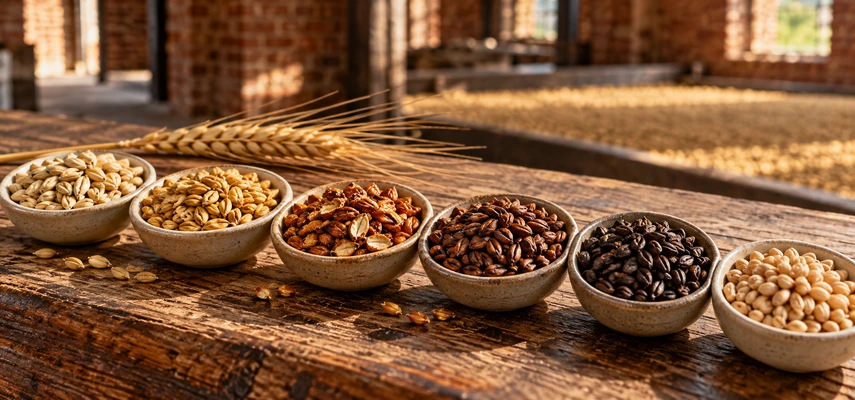

A handful of pale grain can help make a gold lager. A much smaller handful of almost black grain can transform a whole batch’s appearance. With malt explained as a set of processing choices, that difference becomes less mysterious: the maltster is controlling both what the grain can do and what it tastes like.
That double role is the key to Level 2. Malt supplies material for fermentation, but it also supplies a vocabulary of bread, biscuit, caramel, smoke and roast. You cannot predict the finished beer simply by asking whether it contains barley. You need to ask what happened to that barley and how much of each ingredient the brewer used.
Barley anatomy: the seed has another plan
A barley kernel is a small plant’s starting kit. The embryo is the living part that can grow; the endosperm holds a food reserve rich in starch. The outer husk protects the grain and later helps form a permeable bed when the brewer separates liquid wort from spent grain.
The starch is not conveniently packaged as a tank of sugar. It sits within structures containing proteins and cell-wall material. Malting prepares that reserve for brewing by initiating changes that make its contents accessible. The Maltsters’ Association of Great Britain describes how controlled germination modifies the endosperm while preserving valuable material for the brewer.
Enzymes are catalysts: they help particular reactions happen without being the fuel for those reactions. Grain enzymes help break down structural material and, during mashing, starch. Proteins matter too. Their breakdown products include nutrients useful to yeast, while other protein fractions can influence foam, haze and mouthfeel. More protein is not automatically better or worse; its form and the brewing context matter.
Steeping: wake the grain without drowning it
Steeping supplies the moisture needed to begin growth. Maltsters typically alternate wet periods with air rests, managing water uptake and allowing the living grain to breathe. Temperature, grain condition and the desired malt influence the schedule. Think of it as preparing a batch of seeds to grow evenly rather than merely washing a sack of cereal.
Uniformity matters because the next operations affect every kernel in the batch. A mixture of grains at very different stages of development is harder to manage. The maltster wants a predictable raw material with reliable conversion potential, not a competition to see which seed grows fastest.
At this point, the distinction between grain and malt becomes clear. Ordinary raw barley has not undergone the controlled germination and drying that define malting. It may still be used in brewing, but its treatment and contribution are a different question, covered with adjuncts in the next lesson.
Germination: open the food store, then stop
During germination the grain develops and activates enzymes and begins breaking down barriers around its starch reserve. Maltsters call these preparatory changes modification. They regulate airflow, moisture and temperature, and turn or otherwise manage the grain bed so growth remains reasonably even.
The growing plant would happily use the food reserve for itself. The brewer would prefer to keep it. Controlled malting therefore stops growth after the required preparation, before too much extract potential disappears into roots, shoots and respiration. Green malt is the germinated, still-moist intermediate, not a separate green-colored beer ingredient.
Malting and mashing are related but distinct. Malting prepares the grain and its enzyme system. Mashing later brings crushed grain together with water under conditions that allow enzymes to produce soluble carbohydrates, including fermentable sugars. Saying that malting converts all the starch to sugar collapses two stages and loses the reason for having a mash at all.
Kilning: preserve function, develop character
Kilning dries the germinated grain, halts growth and helps make it suitable for storage. It also develops color and flavor. The maltster must consider moisture, temperature and time together: heat applied to wet grain has different consequences from heat applied after much of that moisture has gone.
Pale base malt is dried and cured to retain useful enzyme activity while creating a relatively light flavor profile. More intense treatments can build stronger character while reducing that activity. Briess’s malting and roasting overview explains this functional difference between enzyme-active and more heavily processed malts.
This is a trade-off, not a rule that every specialty malt contains zero usable enzymes. Some highly kilned malts retain enough activity for important brewing roles. Roasted and crystal malts are generally chosen mainly for their sensory contributions, with the rest of the grain bill supplying conversion capacity where needed.
Two browning pathways, different starting conditions
The Maillard reaction involves reducing sugars and amino compounds. It produces many compounds associated with browned foods, including malty, bready and toasted impressions. Different time, temperature and moisture conditions change the mixture of products. The familiar comparison with bread crust helps explain an aroma; it does not mean the maltster has baked bread inside the kernel.
Caramelization is heat-driven transformation of sugars and does not require amino compounds in the same way. Caramel-like impressions can involve complex processing chemistry, so a tasting note alone cannot tell you exactly which reaction produced it. Both pathways matter in understanding malt character; they are not interchangeable technical names for making anything brown.
Roast adds another level of heat treatment and sensory change. Chocolate-like, coffee-like and burnt impressions differ from the sweeter associations of lighter caramel malt. A darker color can accompany several different flavor routes. That is why two brown beers can smell quite unlike each other.
Base malts: the bulk of the working recipe
Pilsner, or lager, base malt is generally lightly colored, with delicate grain, cracker or fresh-bread impressions. It can support a pale appearance while providing starch and enzymes for the mash. The name does not mean it can only be used in pilsner; brewers use it across a range of styles.
Pale ale base malt generally receives a somewhat more developed kilning treatment, often bringing a deeper golden contribution and a fuller bready or biscuit-like impression. Exact characteristics depend on the maltster and product. Neither name specifies the entire recipe, the final alcohol level or the yeast that will ferment it.
Base refers to function and usual role in the grain bill. A base malt commonly contributes a substantial share of the recipe’s extract potential and conversion ability. It is not merely a neutral filler carrying the more exciting ingredients. In a restrained beer, the base malt’s character may be especially exposed.
Specialty malts: several ways to change the result
Highly kilned specialty malts develop richer bread-crust, toast or nutty impressions and greater color through their heat treatment. Vienna and Munich malts illustrate the broad territory, although their brewing roles and enzyme activity depend on the particular product. Use them to understand a direction of change rather than memorize one rigid flavor per name.
Dark roasted malts use more intense heat to create deep color and roast character. Chocolate malt and black malt can provide different strengths and kinds of roasted impression. A stout’s coffee-like note need not mean actual coffee was added. Likewise, roast barley is not automatically malt: unmalted roasted barley exists and belongs to a different ingredient category.
Caramel or crystal malts undergo conditions that allow starch conversion within moist kernels before further heating and drying. Their glassy interiors and caramel-toffee-to-dried-fruit possibilities distinguish them from simply toasted pale malt. Product methods vary, and the names do not promise one universal finished sweetness or body.
Smoked malts take up smoke-derived compounds during production, typically when smoke contacts moist grain during drying. Wood type and processing affect the result, which can range from gentle smokiness to a much more assertive impression. Smoke and black color are separate choices: smoked malt can contribute smoke without turning the beer nearly black.
Malted wheat and the grain bill
Malted wheat is wheat that has undergone malting, not another name for malted barley. It can contribute bready grain character, protein and fermentable material. Wheat lacks the same attached husk structure that makes barley so convenient as a filter bed, so substantial wheat use can affect mash separation as well as sensory character.
Wheat also does not produce a German wheat beer’s banana-and-clove signature by itself. That distinction requires the relevant fermentation choices. An American wheat ale and a weissbier can both contain wheat yet have very different yeast expression. WSET’s malt overview places grain choice within this wider production picture.
The grain bill is the recipe’s combination and proportions of grains and malts. Imagine mostly pale base malt with a modest dark roasted addition, versus a large share of richly kilned malt with little roast. Both recipes may deepen color, but one can emphasize roast while the other emphasizes bread crust. Dose, extract yield and process all influence the outcome.
Reading a recipe as a prediction
Before tasting, write three predictions: likely color direction, likely malt aroma, and the ingredients supplying most of the mash’s enzymatic work. Then ask what you still cannot know. Final sweetness also depends on wort composition and fermentation; aroma depends on hops and yeast too. A malt list is evidence, not the whole production record.
For alcohol-free study, compare supplier descriptions and examine food-grade grain samples without needing to taste beer. Explain why the processing should change the result. Your explanation should separate ingredient identity, heat treatment and proportion. That simple discipline prevents most of the common malt misconceptions from taking hold.
One-page revision summary
Barley supplies an embryo, a starch-rich endosperm and a protective husk. Steeping hydrates it, germination modifies it, and kilning stops growth while developing a chosen balance of function and flavor. Mashing later uses enzymes to access its brewing potential.
Base malt supplies much of the recipe’s working material. Highly kilned, dark roasted, caramel/crystal and smoked malts change beer through different treatments. Malted wheat adds another grain option. Always connect the malt’s processing and its share of the grain bill to the expected beer, and resist treating darkness, strength, sweetness or smoke as the same thing.
Continue your beer studies
Explore the related lessons on evaluate beer alongside brewing adjuncts alongside milling and mashing to extend the ingredient, process or sensory reasoning in this article.
Knowledge check: 10 original practice questions
Independent TFE questions, not official WSET examination items. Choose one answer per question; explanations follow separately.
1. Which part of barley primarily stores starch for the growing plant?
- Husk
- Endosperm
- Rootlet
- Outer filter bed
2. What is the principal purpose of steeping?
- Roast the kernel
- Convert wort into alcohol
- Separate beer from yeast
- Hydrate grain to initiate controlled growth
3. Why does a maltster stop germination?
- To retain useful brewing material after adequate modification
- To remove every enzyme
- To increase the beer alcohol directly
- To turn the grain into hops
4. Which statement distinguishes Maillard reactions from caramelization?
- Neither involves sugars
- Both require yeast
- Maillard reactions involve amino compounds as well as reducing sugars
- Caramelization requires hop alpha acids
5. Which malt is generally chosen for delicate pale grain character and conversion ability?
- Black malt
- Pilsner base malt
- Dark crystal malt
- Intensely roasted malt
6. Which feature helps distinguish crystal malt processing from simple dry toasting?
- Starch conversion within moist kernels before further heating
- No exposure to heat
- Fermentation before malting
- Mandatory addition of refined caramel syrup
7. A beer smells smoky but is pale. What is the best explanation?
- The description must be wrong
- All smoke requires black roasted grain
- The beer cannot contain malt
- Smoke exposure and dark roasting are different processing choices
8. What can malted wheat contribute without determining the entire style?
- A guaranteed banana aroma
- A mandatory sour taste
- Grain character, protein and brewing extract
- The same attached husk as barley
9. What does the grain bill specify?
- The combination and proportions of recipe grains and malts
- Only the color of finished beer
- The serving temperature
- The number of fermentation tanks
10. Which conclusion about a dark beer is justified from color alone?
- It is high in alcohol
- It has a dark appearance under the observation conditions
- It contains only black malt
- It must be sweeter than a pale beer
Answers and explanations
1. B — Endosperm. The endosperm contains the main starch reserve. The embryo is the growing plant and the husk forms a protective outer structure. Mapping: LO1 AC1.
2. D — Hydrate grain to initiate controlled growth. Steeping raises grain moisture and begins the conditions needed for germination. Air rests help manage the needs of living grain. Mapping: LO1 AC1.
3. A — To retain useful brewing material after adequate modification. The aim is sufficient preparation without letting the developing plant consume too much of the reserve valuable to the brewer. Mapping: LO1 AC1.
4. C — Maillard reactions involve amino compounds as well as reducing sugars. Maillard chemistry involves reducing sugars and amino compounds. Caramelization is heat-driven sugar transformation without that same requirement. Mapping: LO1 AC1.
5. B — Pilsner base malt. Pilsner base malt is lightly colored and retains useful enzymes. The darker choices are mainly selected for more intense sensory effects. Mapping: LO1 AC1.
6. A — Starch conversion within moist kernels before further heating. Crystal/caramel production uses moist-kernel conditions that enable internal conversion before further heat treatment develops color and flavor. Mapping: LO1 AC1.
7. D — Smoke exposure and dark roasting are different processing choices. Smoked malt can carry smoke-derived compounds without intense dark roasting. Smoke character and deep color are not inseparable. Mapping: LO1 AC1.
8. C — Grain character, protein and brewing extract. Malted wheat contributes grain-derived material and character. Banana-like aromas require relevant fermentation choices rather than wheat alone. Mapping: LO1 AC1.
9. A — The combination and proportions of recipe grains and malts. The grain bill identifies the grain ingredients and their proportions. It does not independently determine the entire finished sensory profile. Mapping: LO1 AC1.
10. B — It has a dark appearance under the observation conditions. Dark appearance is the direct observation. Alcohol, sweetness and the exact malt combination need further recipe or sensory evidence. Mapping: LO1 AC1 application.












