










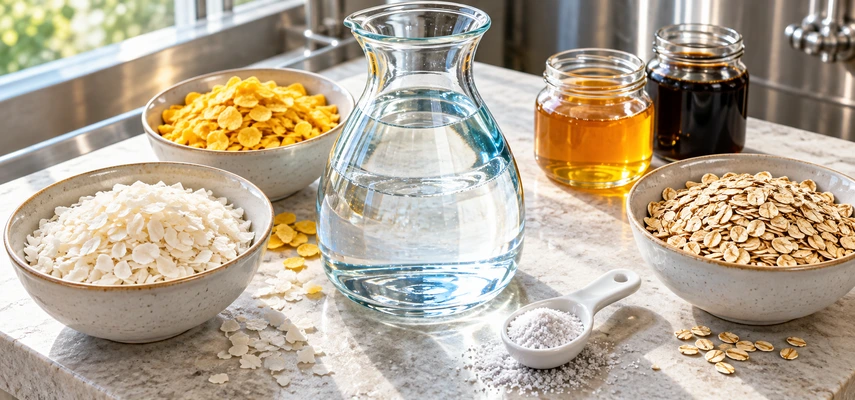

Add sugar to a beer recipe and the finished beer can become less sweet. Add oats and the result need not become sugary at all. Brewing adjuncts make more sense when you stop judging ingredients by how they taste in the kitchen and start asking what survives the brewery.
Water creates a similar trap. It looks like the least interesting ingredient until dissolved minerals change the mash or the impression of bitterness. This lesson follows two questions: what material does an addition contribute, and what does the process do with it? Those questions explain far more than the flattering or unflattering reputation of the word adjunct.
Brewing adjuncts are a role, not a quality verdict
In this context, adjuncts include cereal ingredients, sugars and other sources of brewing carbohydrate used alongside the main malt supply. Usage of the term varies across brewing traditions. Calling an ingredient an adjunct does not tell you whether the beer is carefully made, inexpensive, historically traditional or adventurous.
Judge the ingredient by its purpose. It may supply fermentable material, change texture, lighten or deepen flavor, influence color, or help create a particular style. Some additions do several jobs. Honey can be a fermentable ingredient and an aromatic one; which role dominates depends on the honey, amount and process.
The official WSET specification requires you to understand these effects. It does not require treating every non-barley ingredient as a shortcut. A well-made beer can use adjuncts because they are precisely what its intended character calls for.
Cereal adjuncts: starch needs preparation
Unmalted cereals such as maize, rice, wheat, barley, oats and rye can contribute brewing material. Starch must become accessible to enzymes before it can be efficiently converted. Depending on grain and preparation, that may involve cooking before or during processing rather than simply tipping raw grain into any mash and hoping for the best.
Flaking often includes heat treatment that gelatinizes starch, making it more accessible. Briess describes its brewing flakes as pregelatinized so they can be mashed with malt without a separate cereal cooker. This is a statement about that prepared product, not proof that every raw cereal behaves the same way.
Unmalted grain does not bring the same developed enzyme supply as a suitable base malt. Brewers therefore consider the grain bill’s overall conversion ability. Accessibility and enzyme availability are different requirements: preparing starch does not itself guarantee that enough enzyme is present to convert it.
Rice and maize can help create lighter grain expression and a relatively lean result, especially when they replace part of the malt contribution. Oats and wheat can influence protein, texture and haze. Proportion, preparation and fermentation still matter. It is more useful to predict a direction of change than claim that one handful guarantees a particular mouthfeel.
Sugar: the kitchen association can mislead
Fermentable sugar provides material yeast can turn into alcohol and carbon dioxide. When yeast consumes it, that sugar is no longer present as sweetness. That is the simple answer to the apparent paradox at the beginning of this lesson.
Compare replacing part of a malt-derived extract contribution with a highly fermentable sugar against merely adding sugar on top of an unchanged recipe. Replacement can reduce the proportion of less-fermentable malt-derived material and create a drier, lighter impression. Addition can increase starting extract and potential alcohol. These are different comparisons, so they should not share one automatic prediction.
Yeast strain, nutrition, fermentation conditions and total recipe all influence the result. More fermentable sugar does not guarantee healthy, complete fermentation under any conditions. The Level 2 principle is that ingredient fermentability connects to final character through the microorganism and process, not that sugar magically fixes a recipe.
Sugar syrups: composition matters more than thickness
Sugar syrups are solutions containing carbohydrates whose proportions and processing vary. A syrup can be highly fermentable, less fermentable, relatively neutral or strongly flavored. Its appearance in a jug does not reveal its entire brewing function. Supplier information is more useful than assuming all syrups are interchangeable.
A light, neutral syrup used for extract differs from a darker syrup selected for caramel or dried-fruit associations. Color and aromatic compounds can persist even as much of the fermentable sugar disappears. This helps explain how a beer can retain a rich flavor impression without becoming as sweet as the original ingredient.
The same distinction applies to brewing sugars sold under familiar regional names. Learn what the product contains and what the brewer wants it to do. Do not infer a single mandatory syrup formulation from a broad style label or from a romantic account of brewing tradition.
Honey, maple syrup and black treacle
Honey contributes fermentable sugars and potentially delicate floral, herbal or other aromas that depend on its source. Fermentation and heat can change or reduce those aromas. Honey beer therefore does not automatically mean sweet beer, nor does a honey-like tasting note prove honey was added.
Maple syrup likewise supplies fermentable sugar alongside characteristic flavor compounds. The recognizable maple impression in the finished beer depends on the syrup and how it is used. A generous ingredient aroma before brewing is not a guarantee of equally strong aroma after fermentation.
Black treacle and molasses bring darker, more assertive flavors as well as fermentable material. They can contribute burnt-sugar, mineral or licorice-like impressions, depending on product and recipe. These terms refer to related sugar-processing products, not a promise that every commercial treacle or molasses has identical composition.
For all three, distinguish the ingredient’s aromatic identity from its residual sweetness. Ask which components yeast can consume, which compounds remain perceptible and which additions replace other recipe material. That reasoning makes sense of both a dry honey beer and a richly flavored dark ale.
Unfermentable sugars and sweeteners
Unfermentable is always a relationship between a substance and the organisms or conditions involved. Lactose is a useful example: ordinary brewing strains of Saccharomyces do not generally ferment it, so it can remain and contribute sweetness and body. It is not correct to extend that statement to every possible microorganism or mixed fermentation.
Other sweeteners may contribute sweetness without supplying the same fermentable extract as ordinary brewing sugar. Different products have different intensity, stability and flavor effects. Dextrin-rich carbohydrate products may influence texture more than sweetness. Do not make unfermentable synonymous with intensely sweet.
The BJCP malt and adjunct discussion offers ingredient context. For study, concentrate on the contrast: a fermentable addition may disappear as sugar while a less-fermentable addition can remain. Neither label alone tells you the complete sensory result.
Water composition: the invisible part of the recipe
Water carries dissolved ions that can affect brewing reactions and sensory perception. Hardness, alkalinity and pH describe different properties. Hardness mainly reflects calcium and magnesium; alkalinity concerns resistance to added acid. A pH reading describes the current acid-base condition, not by itself how strongly water will resist change.
That distinction matters in a mash. Malt contributes acidic and buffering substances, so mash behavior depends on the interaction between grist and water. Two waters with similar starting pH can behave differently when mixed with the same grain bill. Starting water pH is therefore an incomplete guide to brewing suitability.
You need not memorize advanced water calculations for this lesson. Learn the causal connections. Water affects the environment in which enzymes work, the handling of grain-derived compounds, and the final flavor impression. A mineral profile is a production choice with consequences, rather than a decorative detail on a brewery tour.
Carbonates, bicarbonates and sulfate do different jobs
Carbonates and bicarbonates contribute alkalinity. They can resist the acidifying effect of a mash, and excessive alkalinity can make achieving appropriate mash conditions more difficult. Darker grists often bring a different acid contribution from pale grists, which helps explain why water and historical style developed relationships in particular places.
That does not mean every dark beer needs highly alkaline water, or every pale beer needs completely mineral-free water. Brewers can treat water, alter recipes and adjust their process. Bru’n Water’s technical guidance emphasizes this interaction and the risks of treating one water number as the whole answer.
Sulfate can accentuate a dry impression and the expression of hop bitterness. It does not substitute for adding hops or create hop-derived bitterness by itself. More is not automatically better: excessive mineralization can seem harsh, and the rest of the beer affects how the result is perceived.
The BJCP water overview supplies further context. Think of sulfate as shaping emphasis and carbonate-related alkalinity as influencing acid balance in the brewing environment. Keeping those roles separate prevents the common mistake of treating all mineral-rich water as one category.
Practice predicting changes, not praising ingredients
Consider three hypothetical recipe changes. Replacing some malt extract with a readily fermentable sugar may lean the result toward dryness. Adding pregelatinized oats may change texture and processing behavior. Changing water alkalinity may alter mash conditions even if the water looks identical. Each prediction names a mechanism rather than a fashionable ingredient.
For an alcohol-free exercise, make a comparison chart with ingredient, primary contribution, processing requirement and likely sensory effect. Add a final column for uncertainty. Honey retention, cereal texture and sulfate emphasis all belong there because dose and context change their results. The uncertainty column is part of understanding, not an admission that the lesson failed.
One-page revision summary
Cereal adjuncts supply starch that needs appropriate accessibility and enzymes. Fermentable sugars can increase alcohol potential or help create a drier balance; they do not necessarily leave sweetness. Honey, maple syrup and black treacle/molasses combine fermentable material with possible flavor. Unfermentable sugars and sweeteners behave differently.
Water composition changes both process and perception. Carbonates and bicarbonates contribute alkalinity; sulfate can emphasize dryness and hop bitterness. Predict the effect in a specific grain bill and fermentation rather than searching for one perfect water or one universally superior ingredient.
Continue your beer studies
Explore the related lessons on malt explained alongside milling and mashing alongside beer fermentation to extend the ingredient, process or sensory reasoning in this article.
Knowledge check: 10 original practice questions
Independent TFE questions, not official WSET examination items. Choose one answer per question; explanations follow separately.
1. Why can replacing some malt-derived extract with fermentable sugar create a drier beer?
- Sugar always destroys hop flavor
- Yeast can consume the sugar, while the recipe contains proportionally less less-fermentable malt material
- Sugar prevents alcoholic fermentation
- All sugar remains sweet
2. What does pregelatinization primarily help with?
- Creating alcohol before mashing
- Producing hop oils
- Making cereal starch accessible for enzyme action
- Removing the need for any enzymes
3. Which statement about honey is most accurate?
- It can supply fermentable sugar and aroma, with retention depending on process
- It always leaves intense sweetness
- It cannot ferment
- Its aroma proves the finished beer contains honey
4. What do carbonates and bicarbonates primarily contribute in brewing water?
- Hop aroma
- Alcohol
- Fermentable extract
- Alkalinity
5. Which effect is associated with sulfate in an appropriate brewing context?
- Guaranteed sweetness
- Accentuated dryness and hop bitterness perception
- Automatic starch conversion
- Removal of all acidity
6. Why does starting water pH alone not predict mash behavior?
- Water has no effect on mash
- All malts have identical acidity
- Alkalinity and grist interactions also affect the result
- Fermentation occurs before the mash
7. How is lactose typically treated by ordinary brewing Saccharomyces strains?
- It generally remains unfermented
- It is always fully fermented
- It becomes hop bitterness
- It eliminates all beer protein
8. Which comparison is most useful for understanding sugar syrup?
- Thicker always means sweeter finished beer
- Darker always means more alcohol
- All syrup is a single brewing product
- Compare its carbohydrate composition, flavor and intended use
9. Which ingredient is commonly used to influence texture in an oatmeal stout?
- Sulfate as a cereal
- Oats
- Only refined table sugar
- Only neutral rice syrup
10. Which conclusion about historical brewing water is justified?
- A historical city profile is mandatory for every modern example
- Dark beer always requires the highest alkalinity
- Local water influenced styles, but modern brewers can adjust water and process
- All mineral-free water is ideal for every recipe
Answers and explanations
1. B — Yeast can consume the sugar, while the recipe contains proportionally less less-fermentable malt material. The outcome depends on replacement and fermentation. Readily consumed sugar need not remain as sweetness, unlike some malt-derived carbohydrates. Mapping: LO1 AC1.
2. C — Making cereal starch accessible for enzyme action. Pregelatinized flakes have accessible starch. Conversion still requires appropriate enzymes; preparation alone is not the same as starch conversion. Mapping: LO1 AC1.
3. A — It can supply fermentable sugar and aroma, with retention depending on process. Honey supplies fermentable material and variable aromas. Fermentation and heat affect the final expression, so neither sweetness nor aroma is guaranteed. Mapping: LO1 AC1.
4. D — Alkalinity. Carbonate-related alkalinity resists acidification. It affects the water-grist interaction rather than directly supplying alcohol or hop aroma. Mapping: LO1 AC2.
5. B — Accentuated dryness and hop bitterness perception. Sulfate can emphasize a dry and bitter impression. Excessive amounts may be harsh, and sulfate does not replace the source of hop bitterness. Mapping: LO1 AC2.
6. C — Alkalinity and grist interactions also affect the result. pH describes a current condition, while alkalinity reflects resistance to acidification. The grain bill contributes acids and buffering substances too. Mapping: LO1 AC2.
7. A — It generally remains unfermented. Ordinary brewing Saccharomyces generally cannot ferment lactose, allowing residual contribution. Other microorganisms can change the situation. Mapping: LO1 AC1.
8. D — Compare its carbohydrate composition, flavor and intended use. Syrups vary in fermentability and sensory contribution. Physical thickness or darkness alone does not determine the finished beer. Mapping: LO1 AC1.
9. B — Oats. Oats are a cereal adjunct that can affect texture and processing. Their role differs from readily fermentable sugar or dissolved mineral ions. Mapping: LO1 AC1.
10. C — Local water influenced styles, but modern brewers can adjust water and process. Water helped shape brewing traditions, but treatment and recipe choices prevent that history from becoming one universal modern prescription. Mapping: LO1 AC2.











