










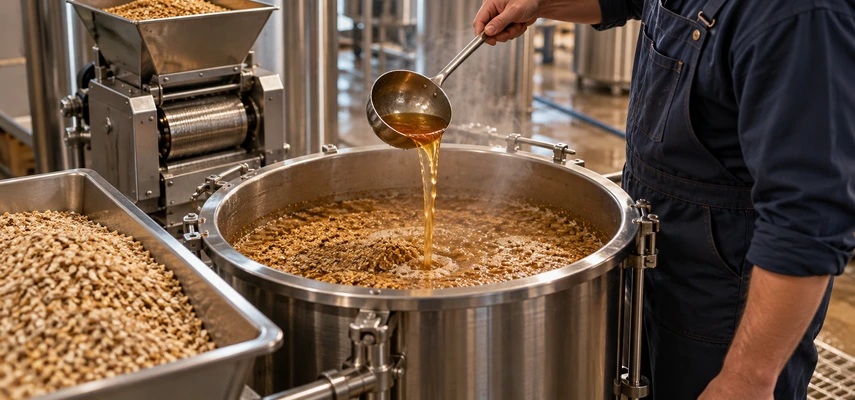

Grinding barley more finely seems like an obvious way to get more out of it. Then the liquid refuses to drain. Milling and mashing involve that kind of practical bargain: the brewer wants access to the grain’s contents, but also needs a workable way to separate the resulting liquid from the solids.
The liquid is wort, the brewing material yeast will later ferment. Getting it right means preparing the grain, creating suitable conditions for enzymes, and recovering soluble material without treating extraction as a contest to obtain every last trace at any cost. This lesson follows those operations in sequence, with the equipment attached to the job it actually does.
Malting prepares the material before the brew day
Malting uses controlled steeping, germination and kilning to prepare grain for brewing. Water initiates growth, germination develops or activates useful enzymes and modifies the endosperm, and drying stops growth while shaping flavor. The brewer receives a material whose performance depends partly on those earlier decisions.
The Maltsters’ Association’s production explanation shows why the process stops before the growing plant consumes too much valuable reserve. Malt is not simply grain with a toasted flavor. It has been biologically prepared, with important consequences for the mash.
Article #2 covers malt classes and browning in detail. Here, keep the operational distinction clear: malting prepares the grain; milling opens it physically; mashing uses water and controlled conditions to extract and transform its material. Confusing those stages makes later equipment questions much harder than they need to be.
Milling: open the kernel, preserve a route for runoff
A mill crushes malt into grist. The aim is to expose the endosperm so water and enzymes can reach its contents. An intact hard kernel resists that access. At the other extreme, indiscriminate pulverizing can create fine material that complicates separation in a grain-bed system.
Barley husk is useful because it can help form a permeable filter bed. In a lauter-tun process, preserving an appropriate husk structure while breaking up the endosperm helps reconcile extraction with drainage. That is why a brewer cares about the mix of coarse particles, fine particles and husk, not just whether the grain looks crushed.
Murphy’s milling guidance explicitly ties the suitable particle distribution to the separation system. A mash filter can handle a different grist from a traditional lauter tun. The useful rule is to match the crush to the process, not memorize one universal roller gap.
Mashing: put the prepared grain to work
In the mashing vessel, grist is mixed with brewing water to create the mash. The brewer manages temperature, time and chemistry so grain components become accessible and enzymes can act. This is a reaction environment with solids suspended in liquid, not yet the clear wort heading to the kettle.
Starch consists of large carbohydrate molecules that ordinary brewing yeast cannot simply treat as table sugar. Amylase enzymes break susceptible starch structures into smaller molecules. The resulting mix contains fermentable sugars and less-fermentable carbohydrates, with the proportions influenced by ingredients and the mash regime.
Water has to reach the material, and starch needs appropriate accessibility. Prepared cereal adjuncts may enter the mash differently from raw cereals requiring cooking. Enzyme supply also matters. A grain bill rich in ingredients with little useful enzyme activity requires the brewer to consider where conversion capacity will come from.
Temperature changes both reaction and enzyme survival
Enzymes work within suitable conditions, but they are not indestructible. Temperature influences reaction rates and stability, while pH and the mash environment also affect performance. Making the mash hotter indefinitely does not keep accelerating useful conversion; sufficient heat eventually denatures the relevant enzymes.
Different mash schedules can change the balance of smaller fermentable sugars and larger carbohydrates. Broadly, a regime favoring greater fermentability can support a drier finished beer, while a different regime may leave more material that the chosen yeast cannot consume. The final outcome still depends on strain and fermentation performance.
Briess’s malt-analysis discussion connects malt measurements to extract and enzyme performance. For Level 2, understand the direction of the relationships rather than treating one temperature as a guaranteed body setting for every malt, mash duration and yeast combination.
Time, water and mixing influence access
Conversion needs sufficient contact under appropriate conditions. Poor mixing can leave dry pockets where water has not properly reached the grist. Too little useful time can leave conversion incomplete, but simply waiting longer cannot restore enzymes already destroyed or compensate for every ingredient-preparation problem.
Mash thickness and water composition influence the environment too. A brewer considers the grain bill together with brewing water, rather than judging the water’s starting pH in isolation. Article #3 explains why alkalinity and grist acidity matter to the conditions reached after mixing.
These variables interact, which is why causal explanations should name the comparison being made. If someone changes temperature, time, grain composition and yeast together, you cannot confidently assign the finished difference to temperature alone. A controlled comparison is more informative than a story built around the most memorable variable.
Mash separation: recover the liquid wort
Once the required mash work is complete, mash separation divides the liquid wort from spent grain. In a lauter tun, the grain bed sits above a supporting false bottom, allowing liquid to pass while retaining much of the solid material. The equipment’s job differs from the mash vessel’s primary conversion role, although some systems combine functions.
Initial wort may be recirculated to establish a satisfactory runoff and retain loose particles. Flow matters: a bed pulled too hard can compact and drain poorly. More force is not automatically more efficient when the material itself forms part of the separation system.
Lautering therefore links back to milling. A crush that created too many fines, or a grain bill with challenging physical properties, can affect bed permeability. The operations are a chain. An apparently slow separation step may have part of its explanation in decisions made before the mash even began.
Sparging: rinsing is not a second fermentation
Sparging rinses the grain bed with brewing water to recover soluble extract left with the solids. It adds water while helping move remaining dissolved material into the collected wort. It does not create alcohol, and it is not the same operation as enzyme conversion.
There are limits to useful extraction. Water quality, temperature, runoff conditions and the amount collected affect what comes through. The brewer balances yield against appropriate wort composition and quality, rather than assuming the last possible rinse is always desirable.
The BJCP wort-production guide provides broader brewing context. Its process sequence is the important reference here: conversion and liquid recovery precede the kettle operations. Fermentation has not yet happened merely because the wort tastes sweet.
Original extract: how much dissolved material is there?
Extract refers to dissolved material recovered into wort. Original extract describes the concentration before fermentation, commonly expressed on a mass-based scale such as degrees Plato. It includes fermentable and less-fermentable material; it is not a count of only the sugar the selected yeast will eventually consume.
Imagine dissolving the same recovered extract into two different volumes. The smaller volume is more concentrated. This is why ingredient mass alone does not determine original extract: yield and water volume also matter. Likewise, obtaining more total extract is different from increasing its concentration.
The distinction helps explain brewing adjustments. A brewer can alter grain quantity, recovery or dilution to change starting concentration. Those decisions can affect both alcohol potential and flavor intensity, but they are not direct measurements of the alcohol that will eventually be present.
Original gravity: related information, a different measurement
Original gravity is the wort’s specific gravity before fermentation: its density relative to water under specified measurement conditions. Dissolved extract makes wort denser than plain water. Higher starting extract therefore generally corresponds to higher original gravity, but the two terms do not name identical units.
If two worts start at different original gravities, the more concentrated one often offers greater alcohol potential. Whether that potential is realized depends on fermentability, strain and fermentation. A high original gravity cannot guarantee a dry result, strong alcohol or successful fermentation without the rest of the process.
During fermentation, sugar consumption and alcohol production change density. Comparing starting and finishing measurements is useful for understanding attenuation and estimating alcohol, but that belongs to the next fermentation lesson. Keep the stages straight: original describes the starting state, not the final serving strength.
Practice the equipment sequence
Without looking at your notes, assign a job to each item: mill, mashing vessel and lauter tun. Then explain what sparging adds to the sequence and what original extract or original gravity tells you about the collected wort. If the answer only lists vessels in order, add the physical or biochemical change that happens in each.
For an alcohol-free exercise, draw a simple flow on paper and identify where solids and liquid move. The grain does not disappear during conversion, and the fermenter does not need the entire grain bed. This picture makes several common examination distractors immediately less convincing.
One-page revision summary
Malting prepares grain; milling produces accessible grist; mashing uses enzymes and controlled water conditions to generate a chosen wort composition. Mash separation recovers liquid, and sparging rinses remaining soluble material from the bed. Equipment choices influence the suitable grist and process.
Original extract measures starting dissolved material concentration, while original gravity describes relative density before fermentation. Both help explain alcohol potential, but neither alone predicts the finished beer. Follow the material, the mechanism and the measurement, and the brewing sequence becomes a connected explanation.
Continue your beer studies
Explore the related lessons on wort boiling to extend the ingredient, process or sensory reasoning in this article.
Knowledge check: 10 original practice questions
Independent TFE questions, not official WSET examination items. Choose one answer per question; explanations follow separately.
1. What is the main purpose of milling malt?
- Convert alcohol to acid
- Expose the grain interior for brewing while producing suitable grist
- Boil away hop aroma
- Separate yeast from finished beer
2. Why can preserving appropriate husk structure help a lauter-tun process?
- Husk supplies all fermentable sugar
- Husk turns into yeast
- It helps form a permeable grain bed
- It eliminates the need for water
3. Which operation principally allows grain enzymes to transform starch in brewing water?
- Mashing
- Packaging
- Bottle opening
- Cold storage
4. Why does increasing mash temperature indefinitely not keep improving conversion?
- Temperature cannot affect enzymes
- Starch becomes a hop resin
- Yeast starts lagering immediately
- Sufficient heat denatures the enzymes
5. What is sparging?
- Rinsing the grain bed to recover soluble extract
- Adding lager yeast
- Boiling hops
- Removing alcohol from finished beer
6. Which vessel is associated with grain-bed wort separation?
- Bottle filler
- Lauter tun
- Yeast propagator only
- Serving keg
7. What does original gravity describe?
- Final alcohol percentage directly
- The grain bill mass alone
- Wort density relative to water before fermentation
- Only the color of malt
8. Why is original extract not identical to fermentable sugar?
- Wort contains no sugar
- Extract exists only after fermentation
- All extract becomes carbon dioxide
- It includes dissolved material that the chosen yeast may not ferment
9. Which comparison correctly separates concentration from total extract?
- The same extract in less water is more concentrated
- More water always raises original gravity
- Concentration cannot change with dilution
- Original extract depends only on grain weight
10. Why should mill settings be matched to the downstream process?
- All separation systems require identical flour
- Different separation systems handle particle structures differently
- Milling fixes final alcohol independently
- The lauter tun is the same as a bottle filler
Answers and explanations
1. B — Expose the grain interior for brewing while producing suitable grist. Milling opens the kernel physically. The ideal grist also depends on how the brewery will separate wort from solids later. Mapping: LO2 AC2.
2. C — It helps form a permeable grain bed. The husk contributes structure to a grain-bed separation system. Pulverizing all material can compromise drainage despite exposing starch. Mapping: LO2 AC2.
3. A — Mashing. Mashing creates controlled conditions for extraction and enzyme activity. Packaging and storage occur after these wort-production operations. Mapping: LO2 AC2.
4. D — Sufficient heat denatures the enzymes. Enzymes have limits of stability as well as temperature-dependent activity. Excessive heat can remove the catalytic function needed for conversion. Mapping: LO2 AC3.
5. A — Rinsing the grain bed to recover soluble extract. Sparging uses brewing water to rinse dissolved material remaining with the spent grain. It is a recovery operation, not fermentation. Mapping: LO2 AC2.
6. B — Lauter tun. A lauter tun supports separation through a grain bed and false bottom. It recovers wort after the mash has performed its conversion role. Mapping: LO2 AC2.
7. C — Wort density relative to water before fermentation. Original gravity is pre-fermentation relative density under specified measurement conditions. It reflects dissolved material rather than directly measuring final alcohol. Mapping: LO2 AC3.
8. D — It includes dissolved material that the chosen yeast may not ferment. Original extract includes fermentable and less-fermentable components. Yeast capabilities and wort composition determine how much can be used. Mapping: LO2 AC3.
9. A — The same extract in less water is more concentrated. Concentration depends on dissolved material relative to liquid amount. Dilution and extraction yield matter alongside the initial grain quantity. Mapping: LO2 AC3.
10. B — Different separation systems handle particle structures differently. A grain-bed lauter tun and a mash filter have different grist requirements. Suitable preparation reflects the actual equipment and recovery process. Mapping: LO2 AC2.












