










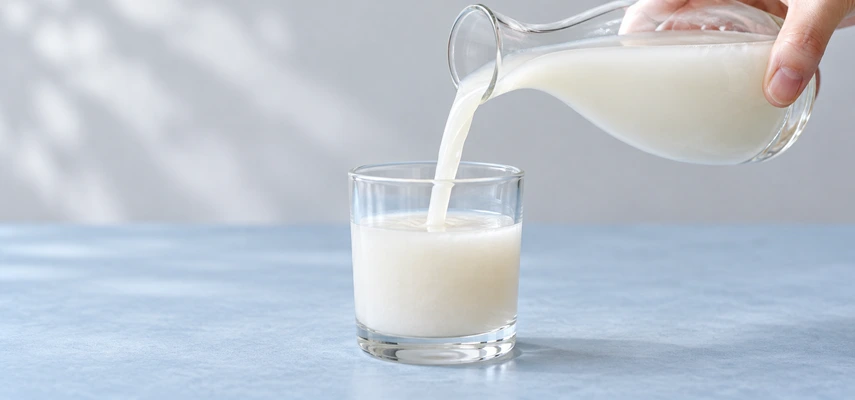

Cloudiness usually invites suspicion in a drink expected to be clear. With nigori sake, it can be exactly the intended result. Fine particles remain in suspension because the brewer uses a separation method that lets more of them enter the collected liquid. The appearance is a production choice, not an automatic sign that something has gone wrong.
Nigori is one of the specialty styles prescribed at Level 2. Its most useful explanation connects filter openings, retained material, appearance and mouthfeel. Once that chain is clear, it becomes much easier to avoid the mistaken claims that every nigori is sweet, unpasteurised or a separate premium grade.
Nigori sake uses a deliberately coarser separation
The fermented mash contains liquid, rice material and yeast. Clearer sake results when separation and later clarification remove much of the suspended material. For nigori, filters with large openings allow more fine mash particles through. The resulting liquid looks cloudy because those particles scatter light.
The NRIB explanation describes the coarse mesh or cloth used for nigori. It is therefore misleading to say that no filtration or separation occurs at all. Coarse-filtered is a more informative description than an unqualified unfiltered, which can suggest the entire mash has simply been bottled unchanged.
The distinction also separates nigori from muroka. Within the Level 2 finishing context, muroka concerns omission of charcoal fining. A muroka sake can be clear. Nigori concerns retained suspended material following its coarse separation. One word does not establish the condition described by the other.
The particles explain the white appearance
Suspended material gives nigori its characteristic whitish or milky look. Milky describes appearance here, not an ingredient statement. Standard nigori production does not require adding milk to a rice-based sake. The analogy helps the reader picture the liquid while remaining separate from what went into it.
The degree of cloudiness varies. A lightly cloudy example may have a more translucent appearance than a densely white one. Filter choice and the amount of retained material influence that difference. The broad term therefore covers a range of visual intensities rather than one exact shade and opacity.
Gekkeikan’s own nigori description directly connects its product’s cloudiness with rice sediment retained through a coarse-mesh filter. This is a useful real producer example of the mechanism. It should not be turned into a claim that every nigori uses identical equipment or has the same tasting profile.
Texture is part of the style, not just a photograph
Particles can contribute to a fuller, creamy or more textured mouthfeel. A relatively dense nigori can feel more substantial than a lightly cloudy one. But texture needs to be observed in the actual sample. The term does not prescribe one viscosity or make every example thick.
Separate physical feel from flavor. Creamy mouthfeel is not the same as a cream aroma, and neither necessarily means dairy was used. A grain-like flavor is another observation again. Keeping these on different lines makes a tasting note more precise without making it longer for its own sake.
The JSS sensory guide links degrees of filtration with clarity and texture. Its broader sensory framework is useful here: appearance tells you retained material is plausible, while the palate tells you how that material and the rest of the drink actually feel together.
Cloudiness does not establish sweetness
Many familiar commercial nigori examples are sweet, but sweetness is not the defining requirement. Sugar remaining in the liquid and the balance of acidity, umami and alcohol influence the impression. Retained particles can affect texture without proving a particular sugar concentration.
Imagine a cloudy sake with a fairly dry palate and another with pronounced sweetness. Both can fit the nigori mechanism if the appropriate suspended material remains. Their different sweetness levels need an explanation involving fermentation and composition, rather than assuming one must have been mislabeled because it is less sweet.
This is especially important when recommending a bottle. Someone asking for a sweet sake has expressed a palate preference, not merely a preference for white appearance. Use the producer’s description or a tasted sample to answer that request. Cloudy is not a reliable substitute for sweet.
Nigori can overlap premium grades and other styles
Nigori is a specialty description rather than a ninth premium grade. A sake can be junmai and nigori, for example, because the two words describe different production facts. One concerns added brewing alcohol; the other concerns physical separation and retained material.
Likewise, nigori does not establish pasteurisation history. A cloudy sake can be heat-treated, while a nama nigori combines cloudiness with no pasteurisation. Sparkling nigori adds another possible dimension. Read all the words on a specific product rather than asking nigori to supply the missing information.
The official specification treats specialty styles and premium grades as connected but distinct subjects. This lets a label carry more than one meaningful statement without contradiction. Think of several questions being answered, not several names competing to win the same category.
Settling changes the bottle’s appearance over time
Particles can settle while a bottle stands. The upper liquid may look clearer and the bottom more concentrated with sediment. That physical redistribution does not necessarily mean the product has deteriorated. It may simply show gravity acting on the material that defines the style.
Follow the producer’s handling directions when redistributing sediment. Gentle movement may be appropriate for some products, but vigorous shaking is a poor blanket instruction, especially if carbonation is present. The bottle’s other style features matter to how it should be opened and poured.
For a tasting comparison, try to keep sample handling consistent. If the first pour is clear upper liquid and the second contains most of the settled material, the glasses may differ for a very practical reason. Record what was poured before assigning the difference to grade or quality.
Describe intentional cloudiness without ignoring faults
Knowing that nigori is meant to be cloudy doesn’t mean every unusual change is desirable. Storage condition, aroma and the producer’s intended style still matter. The white appearance alone cannot diagnose microbial spoilage, and it cannot prove that a badly stored bottle remains in good condition.
Use a complete observation. Is the appearance consistent with the declared style? What does the aroma suggest? How do sweetness, acidity, umami, texture and finish fit together? A single visual feature should not overrule the rest of the evidence, whether the observer is inclined toward suspicion or enthusiasm.
This also keeps quality assessment fair. Judge a nigori against what the style is trying to achieve. Penalizing it simply for lacking the clarity of a clear sake would miss the production brief. Equally, a dense mouthfeel does not automatically establish balance or complexity.
For revision, explain the style without using the word cloudy: large filter openings retain more fine material, which changes appearance and can change mouthfeel. That complete chain is more useful than a one-word translation.
One-page revision summary
Nigori uses coarse filtering with large openings to retain fine suspended material. Those particles create cloudiness and can affect texture. The style is not necessarily sweet, and it does not independently establish a premium grade, alcohol level or pasteurisation history. Distinguish it from muroka, handle settling according to producer directions, and evaluate the whole drink rather than diagnosing quality from cloudiness alone.
Knowledge check: 10 original practice questions
Independent TFE questions, not official WSET examination items. Choose one answer per question; explanations follow separately.
1. Which process creates the characteristic nigori effect?
- Distilling the sake
- Using coarse filters that retain more fine particles
- Removing all particles with charcoal
- Adding milk as a requirement
2. Why is unfiltered an incomplete description?
- Nigori uses no rice
- Nigori is always transparent
- Coarse filtration or separation still occurs
- All nigori is distilled
3. What chiefly explains the cloudy appearance?
- Suspended fine material scatters light
- A mandatory dairy ingredient
- Bottle glass color only
- All alcohol has frozen
4. Must nigori be sweet?
- Yes, always
- Only if junmai
- Only if cold
- No, sweetness is a separate property
5. Which observation concerns texture?
- White color
- Creamy mouthfeel
- Pear aroma
- A printed grade
6. Can a nigori also be junmai?
- No, the words conflict
- Only after distillation
- Yes, they describe different production features
- Only if no water was used
7. Does nigori alone establish no pasteurisation?
- No, heat-treatment history needs separate information
- Yes, always
- Only in small bottles
- Only if sediment settles
8. What can happen while a nigori bottle stands?
- All rice becomes alcohol immediately
- The grade necessarily changes
- The bottle becomes sterile
- Particles can settle
9. Why avoid a blanket instruction to shake vigorously?
- Rice cannot move
- Some products may also contain carbonation
- All cloudy sake is faulty
- All bottles have the same handling needs
10. How does nigori differ from muroka?
- They are identical
- Muroka always means milk
- Nigori concerns particles; muroka here concerns omission of charcoal fining
- Nigori is a premium grade
Answers and explanations
1. B — Using coarse filters that retain more fine particles. Large openings let more suspended mash material pass into the collected sake. Mapping: LO2.
2. C — Coarse filtration or separation still occurs. The defining distinction is coarse separation, rather than necessarily no separation at all. Mapping: LO2.
3. A — Suspended fine material scatters light. Retained material affects visibility through the liquid and creates a whitish appearance. Mapping: LO2.
4. D — No, sweetness is a separate property. Cloudiness and texture do not establish a required residual-sugar level or sweet taste. Mapping: LO2.
5. B — Creamy mouthfeel. Creaminess as mouthfeel describes physical sensation, not necessarily flavor or ingredients. Mapping: LO2.
6. C — Yes, they describe different production features. Junmai concerns added brewing alcohol, while nigori concerns retained suspended material. Mapping: LO2.
7. A — No, heat-treatment history needs separate information. A nigori can be pasteurised or combine with a nama description. Mapping: LO2.
8. D — Particles can settle. Gravity can redistribute the retained material without necessarily indicating deterioration. Mapping: LO2.
9. B — Some products may also contain carbonation. Other style features affect safe opening and pouring, so producer directions should guide handling. Mapping: LO2.
10. C — Nigori concerns particles; muroka here concerns omission of charcoal fining. The terms identify different finishing choices and neither completely predicts the other. Mapping: LO2.
Continue studying sake
Article #1: How to Understand and Evaluate Sake: The WSET Level 2 Framework · Article #9: Sake Filtration and Alcohol Addition Explained: Pressing, Clarity, and Style · Article #11: Sake Categories Explained: Futsū-shu, Premium Sake, and Classification Rules · Article #17: Nama Sake Explained: Unpasteurised, Nama-chozō, and Nama-zume Styles












