










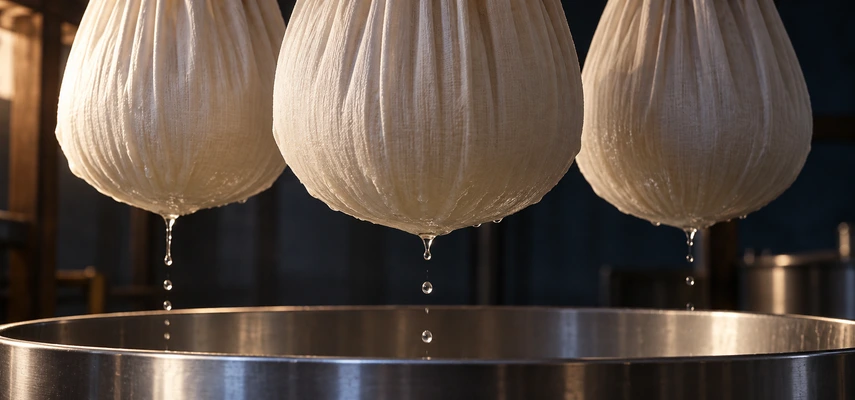

Fermentation has created alcohol, but it hasn’t created a clear bottle-ready liquid by itself. The mash still contains rice material and yeast. Sake filtration and alcohol addition are decisions at this transition: the brewer can adjust the liquid’s balance and aroma expression, then separate it from the material that helped produce it.
These operations are easy to collapse into one vague word, finishing. Keeping them distinct is more useful. Adding jōzō alcohol changes composition. Pressing separates liquid from solids. Sedimentation lets particles settle. Charcoal fining changes colour and sensory components in another way, and belongs to the next lesson.
Sake filtration and alcohol addition serve different aims
Alcoholic fermentation has already produced the base drink. Optional brewing-alcohol addition does not explain all the alcohol in sake. Junmai styles are made without that addition, while other eligible styles may use it. The distinction concerns an ingredient decision layered onto a fermented beverage.
Jōzō alcohol is distilled brewing alcohol. In an eligible production plan, it is commonly added near the end of the main fermentation and before pressing. This timing matters because the addition interacts with the mash, including the transfer of aroma components into the liquid that will be collected.
The official Level 2 specification includes reasons and timing of additions as well as named separation methods. Learn the purpose before the equipment name. Otherwise a list of Japanese terms can conceal that several quite different production problems are being solved.
Why add alcohol to a fermented drink?
Brewing alcohol can help bring aromatic components into the collected liquid and alter the finished balance. In suitable production it can support a lighter impression while allowing fragrance to show clearly. It also changes alcohol concentration at the point of addition. Later water dilution is a separate decision that can change the final strength.
The NRIB sake questions explain the purposes of jōzō alcohol. The important correction is that a small, deliberate addition in a premium-style plan is not automatically an attempt to disguise poor fermentation. Assess the role and the rules rather than assuming every addition has the same motivation.
Nor does added alcohol guarantee harshness. The sensory result depends on quantity, the base sake, later dilution and the overall balance. Conversely, no-added-alcohol does not guarantee softness. Fermentation itself can create a high alcohol level. Production facts and sensory judgments need to remain connected without becoming synonyms.
For a hypothetical aromatic sake, the brewer might use eligible alcohol addition to help express aroma before separating the liquid. The same decision would be inappropriate for a junmai classification because that family excludes the addition. A production tool can be useful yet unavailable within a particular ingredient brief.
Futsū-shu allows a broader set of additions
The syllabus also lists glucose, acids and amino acids as optional additions for basic sake, or futsū-shu. These can adjust aspects of composition and taste. Glucose can affect sweetness; acids can affect acid balance; amino acids can influence savory character and the broader flavor profile.
Permitted does not mean universally used. A bottle in the basic category does not prove that all three were added. Equally, a premium designation involves additional restrictions and cannot simply be inferred from an attractive taste. Ingredient statements and production information answer questions that tasting alone cannot settle.
Keep the reason for each addition specific. Glucose is not added to remove solid rice particles. Acid isn’t a substitute for pressing. Amino acids do not turn the drink into a distilled spirit. The category permits a broader formulation toolkit, while the brewer chooses what to use within the applicable rules.
These finishing-related additions should also be distinguished from lactic acid used in starter preparation. The same broad chemical family can appear in discussions of different stages for different purposes. Always ask when and why a component enters the process rather than treating its name as a complete explanation.
Pressing separates the liquid from the mash
The fermented mash is a mixture of liquid and solids. Pressing or mash filtration collects sake while leaving a substantial residue called sake kasu, or lees. Pressure and filter material influence how liquid is recovered. This is a physical separation process, not another form of alcoholic fermentation.
Separation does not necessarily make the liquid perfectly brilliant, and it does not automatically remove every viable organism or every enzyme. Further clarification and stability steps may follow. Remembering this prevents a common chain of mistakes in which clear is assumed to mean sterile, pasteurised and ready for indefinite storage.
The JSS professional process guide describes mechanical filtration, pressing cloth bags and collecting gravity-dripped liquid. All separate mash components, but they use different arrangements and forces. Those differences matter to recovery, scale and style possibilities.
Yabuta: a mechanical filter-press approach
Yabuta refers to a familiar mechanical filter-press system used for separating sake mash. The mash passes into filter chambers, and pressure helps separate liquid from solids through the filtering surfaces. The equipment can handle substantial volumes and produce a relatively dry residual cake.
For Level 2, distinguish this chamber-based mechanical approach from loose bags stacked in a traditional press or hung to drip. You don’t need to memorize the internal engineering of every model to explain the production principle. A recognizable equipment name should lead to an explanation of what happens to the mash.
Mechanical does not mean low quality. A controlled press can be an appropriate part of a carefully designed sake. The useful question is how the brewery manages the separation and which liquid it chooses to retain. Equipment type alone is a poor substitute for assessing the result.
Fune: bags arranged in a press
A fune is a trough-like pressing arrangement in which mash-filled cloth bags are laid in the vessel and liquid is collected as pressure is applied. The image differs from the filter chambers of a Yabuta system. Here the bags and their arrangement are central to the separation method.
The applied pressure can change over the course of pressing, and liquid collected at different stages may differ. A producer can blend or select portions according to its aims. That introduces another reason not to assume one press name produces a single fixed flavor. Handling and selection remain important.
Compare squeezing a wet cloth gently with applying greater force. The analogy illustrates changing recovery without claiming that sake pressing is a household laundry exercise. The brewery controls a food-production process with equipment and materials selected for that purpose. More recovery is not automatically the same goal as a particular sensory result.
Fukuro and shizuku: collecting the drip
Fukuro refers to bags, while shizuku refers to drops in this context. The terms are associated with collecting liquid that drips from suspended mash-filled bags, with little or no external pressing force. You may see related names such as fukuro-zuri and shizuku-dori in producer descriptions.
The liquid separates under gravity rather than being recovered through the same forced-pressure approach as a mechanical press. This can produce a delicate expression and involves a different practical yield and labor pattern. It doesn’t prove every drip-collected sake is better than every pressed one.
It is also worth keeping the material visible in the explanation: the mash still passes through cloth. Calling drip sake completely unfiltered can obscure that separation. The absence of strong pressing force is not the absence of all physical filtering.
Sedimentation removes particles by settling
After initial separation, fine particles can remain suspended. During sedimentation, the liquid is allowed to stand so that particles settle, after which clearer liquid can be separated from the deposit. The mechanism is gravity acting over time rather than a new pressing operation.
Sedimentation and filtration can work together in a production plan. Neither word means charcoal fining. Charcoal can adsorb selected components and influence colour and flavor, while settling mainly addresses suspended material. The next article examines those later adjustments alongside pasteurisation, storage and dilution.
An everyday comparison is a glass of water containing fine sediment. Given time, some material may settle to the bottom without anyone pushing it through a filter. The brewery applies that physical principle under controlled conditions to sake rather than treating appearance as an accidental outcome.
Choose the explanation that matches the observation
A clearer appearance after settling suggests fewer suspended particles; it does not establish that alcohol was added. A more fragrant expression after a carefully managed addition does not establish which press was used. When a production question gives an intended effect, identify the operation that can cause it directly. This discipline is useful in both tasting discussions and multiple-choice questions because neighboring stages can sound plausible while solving a different problem.
One-page revision summary
Jōzō alcohol is an optional eligible addition, commonly before pressing, with aroma and balance roles. Futsū-shu can permit glucose, acids and amino acids without requiring every producer to use them. Yabuta uses a mechanical filter-press approach; fune uses bags in a press; fukuro or shizuku methods collect gravity-dripped liquid. Sedimentation lets fine particles settle. Physical clarity, charcoal treatment and microbial stability remain separate questions.
Knowledge check: 10 original practice questions
Independent TFE questions, not official WSET examination items. Choose one answer per question; explanations follow separately.
1. When is jōzō alcohol commonly added in the process described?
- Before rice is grown
- Only after restaurant service
- Near the end of fermentation before pressing
- Instead of all fermentation
2. Which is a legitimate reason for an eligible alcohol addition?
- Help aroma expression and adjust balance
- Replace rice polishing completely
- Make every sake junmai
- Remove all enzymes automatically
3. Which group contains optional futsū-shu additions in the syllabus?
- Only grapes and hops
- Only charcoal and cork
- Only rice husks
- Glucose, acids and amino acids
4. Which method uses a mechanical filter-press system?
- Shizuku only
- Yabuta
- Sedimentation
- Bottle ageing
5. Which description fits a fune?
- A serving flask
- A yeast culture
- Mash-filled bags arranged in a trough-like press
- A rice field
6. What chiefly drives collection in a shizuku approach?
- Gravity dripping from bags
- Distillation
- Carbon dioxide injection
- Boiling
7. What does sedimentation do?
- Creates distilled alcohol
- Grows kōji
- Injects carbonation
- Allows suspended particles to settle
8. What remains after mash pressing?
- Only distilled water
- Sake kasu or lees
- Rice seedlings
- The bottle label
9. Does clear liquid prove it has been pasteurised?
- Yes, always
- Yes, if it is pale
- No, clarity and heat treatment are different matters
- Only if it has a cork
10. Which statement about allowed additions is accurate?
- Permission does not prove every producer uses them
- Every futsū-shu must use every optional addition
- Any added alcohol makes a distilled spirit
- Junmai requires jōzō alcohol
Answers and explanations
1. C — Near the end of fermentation before pressing. Adding it to the mash before separation can influence aroma transfer and the liquid’s balance. Mapping: LO1.
2. A — Help aroma expression and adjust balance. Brewing alcohol can serve aroma and balance purposes, but it does not perform those unrelated operations. Mapping: LO1.
3. D — Glucose, acids and amino acids. The basic category can permit these additions; that does not mean every bottle contains them. Mapping: LO1.
4. B — Yabuta. Yabuta is the named mechanical pressing approach, distinct from hanging bags and settling. Mapping: LO1.
5. C — Mash-filled bags arranged in a trough-like press. Fune pressing uses cloth bags and applied pressure to separate liquid from the mash. Mapping: LO1.
6. A — Gravity dripping from bags. Liquid drips through cloth with little or no external pressing force in this method. Mapping: LO1.
7. D — Allows suspended particles to settle. Settling and separating clearer liquid address physical particles through gravity and time. Mapping: LO1.
8. B — Sake kasu or lees. Pressing separates liquid sake from a substantial solid residue called kasu. Mapping: LO1.
9. C — No, clarity and heat treatment are different matters. Physical separation does not establish that organisms and enzymes have been inactivated by heat. Mapping: LO1.
10. A — Permission does not prove every producer uses them. Category permissions define options; the actual ingredients require separate evidence. Mapping: LO1.
Continue studying sake
Article #8: Multiple Parallel Fermentation Explained: How Sake Produces Alcohol · Article #10: Sake Pasteurisation and Finishing Explained: Charcoal Fining, Storage, and Dilution · Article #11: Sake Categories Explained: Futsū-shu, Premium Sake, and Classification Rules · Article #12: Junmai vs. Honjōzō Sake: Ingredients, Alcohol Addition, and Style












