










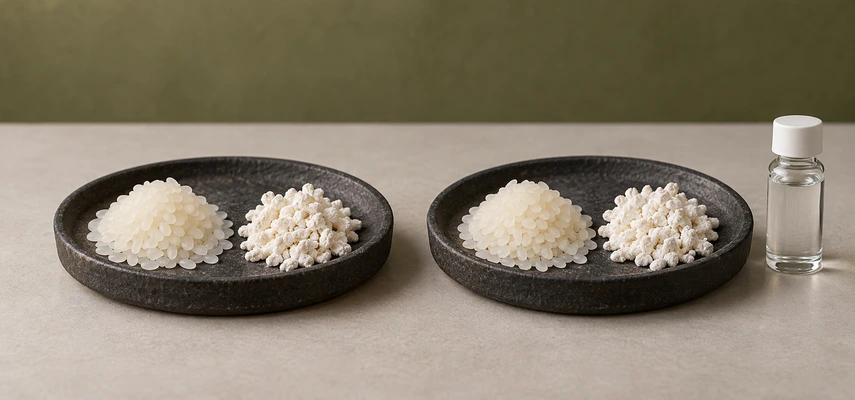

Junmai and honjozo are often introduced as pure rice versus added alcohol. That is a useful first signpost, but a poor place to stop. The ingredient distinction doesn’t tell you exactly how either sake tastes, whether it is dry or sweet, how it was stored or which one you will prefer with dinner.
To explain these categories at Level 3, separate three tasks. Establish the production requirements, explain what particular decisions can influence, then assess the actual sample. Tokubetsu junmai and tokubetsu honjozo add another question: what objective basis supports the special designation? The answer should come from production information rather than admiration for the word special.
Junmai and honjozo answer an ingredient question
Junmai is made without added brewing alcohol. Rice, rice koji and water form the core ingredient description. Koji provides enzymes and yeast carries out alcoholic fermentation, so pure rice isn’t a literal account of a sack of dry grain becoming sake without other inputs or biological activity.
Honjozo uses brewing alcohol within the special-designation restrictions. It also has a polishing requirement of 70% or less remaining. The National Tax Agency standard sets these conditions alongside other shared provisions. Simply finding alcohol in an ingredient list doesn’t establish honjozo eligibility without checking the rest.
This distinction concerns the origin and use of some alcohol, not whether the finished drink contains alcohol at all. Junmai still contains ethanol produced through fermentation. Describing it as alcohol-free because none was added would be a fundamental error, with obvious consequences for communicating accurately to a customer.
Plain junmai has no numerical polishing cutoff
The current framework doesn’t impose a numerical seimai-buai limit on plain junmai. Older simplified teaching that gives all junmai a 70% cutoff is therefore unreliable. Other requirements still apply, and the lack of that one numerical condition isn’t an exemption from the whole designation system.
Seimai-buai records remaining polished rice weight relative to brown rice weight. A junmai at 80% has undergone less extensive polishing than one at 60%, but that comparison alone doesn’t establish which tastes better. It describes one production difference whose consequences interact with fermentation and finishing.
The NRIB varieties chart shows the plain-junmai exception clearly. Distinguish it from junmai ginjo and junmai daiginjo, which have their own 60% and 50% thresholds and relevant production requirements. Adding a word to the designation can add conditions.
Honjozo requires more than adding alcohol
For honjozo, the 70%-or-less limit means at least the nominal outer 30% has been removed. A 65% rice figure meets that polishing condition; a 75% figure doesn’t. The number is a maximum percentage remaining, not an instruction that all honjozo must be polished to exactly 70%.
The alcohol restriction uses a particular accounting basis. The weight of brewing alcohol, calculated at the specified 95% alcohol reference, must be no more than 10% of polished rice weight. The NTA explanatory material makes both the reference concentration and denominator explicit.
That isn’t a 10% ABV cap on the drink. It isn’t a rule about 10% of the final bottle volume, either. Keep ingredient accounting and finished alcohol strength separate. A brewery can add alcohol under the relevant rule and later adjust the product with water; these are different operations at different points in the production story.
Why brewing alcohol may be used
Brewing alcohol can help extract aroma components from the mash before separation and change the concentration of rice-derived components. The JSS production account explains these effects. A lighter or cleaner expression can be an intentional result, rather than evidence that the maker failed to produce a sufficiently substantial sake.
The effect isn’t equivalent to adding banana flavoring because the sake later smells fruity. Relevant aroma compounds can originate through fermentation, while alcohol addition changes their extraction and the balance of the resulting liquid. Distinguish creating a compound, extracting it and retaining it through later handling.
Nor should you describe every alcohol-added product through the same motive. Honjozo is a restricted special designation; broader production outside that framework can involve different permissions and objectives. Use the stated category and process evidence rather than importing a story about cheaply increasing volume into every bottle with brewing alcohol listed.
Junmai does not guarantee a particular palate
Junmai examples often invite discussion of rice-derived flavor and palate substance, but the category contains a wide range. Polishing, koji, yeast, fermentation, dilution and maturation can move the expression toward delicacy or fullness. The ingredient distinction is reliable; a universal tasting note isn’t.
Imagine two original hypothetical junmai products. One uses carefully managed aromatic fermentation and is bottled for a youthful expression. The other undergoes longer development and shows more savory character. Their shared no-added-alcohol status doesn’t require them to converge on the same nose, texture or serving choice.
This also prevents an unsupported health claim. Junmai doesn’t mean harmless, alcohol-free or suitable for unrestricted consumption. In an educational explanation, stay with the production distinction instead of treating an appealing ingredient phrase as proof of a different health status. Quality and responsible service need their own evidence and context.
Tokubetsu junmai requires a qualifying special basis
Tokubetsu junmai retains the junmai ingredient condition while adding the qualifying special basis and relevant requirements. Polishing to 60% or less can provide that basis, or a special production method can do so with the required explanation. The word isn’t permission to invent an unstated technique.
The important habit is to read the explanation on the container or packaging. A producer’s objective account matters more than a reader’s guess that special must mean older rice, handmade everything or a longer fermentation. Those might be interesting facts if supplied, but none should be fabricated from the designation alone.
Tokubetsu junmai need not be renamed junmai ginjo because the polishing percentages overlap. Ginjo requirements involve the relevant production and characteristic expression. Categories can share one numerical feature while differing in other conditions, just as two recipes can share an ingredient without becoming the same dish.
Tokubetsu honjozo follows the same special logic
Tokubetsu honjozo combines the honjozo ingredient framework with its qualifying special basis. A 60%-or-less polishing basis or explained special production method is central to the familiar overview. Restricted alcohol use and shared requirements still matter; the extra word doesn’t discard them.
Don’t assume it must have greater aroma intensity than every ordinary honjozo. The designation supplies a production basis, while intensity is an observation. A particularly elegant, restrained expression may be exactly what its maker intended. The word special isn’t an instruction to maximize every sensory dimension.
For an examination comparison, state the common ground first, then the additional condition. Both honjozo and tokubetsu honjozo belong to the alcohol-added special-designation framework; the latter needs the special basis. This is clearer than presenting two unrelated lists with the same ingredients repeated and the key difference buried at the end.
Shared requirements keep comparisons honest
The minimum koji-rice proportion is 15% of total polished rice weight for specially designated sake. Eligible rice and the relevant quality conditions are also part of the framework. A two-column ingredient chart is therefore a helpful summary rather than a complete compliance decision.
Consider a simplified accounting exercise using 1,000 kilograms of polished rice. A 15% koji-rice proportion corresponds to 150 kilograms on that basis. The alcohol ceiling corresponds to 100 kilograms on the prescribed reference basis, not an instruction to pour 100 liters of an unspecified-strength liquid into the mash.
The exercise tests denominators, not operational brewing advice. Actual production requires accurate records and the appropriate calculation conventions. In a written answer, name the basis before doing arithmetic. That protects you from using a correct percentage with an incorrect material, unit or reference concentration.
Use the category, then taste the sake
When comparing bottles, record what the labels confirm before tasting. Keep serving temperature and glassware consistent if the purpose is a fair sensory comparison. Describe aroma, sweetness, acidity, umami, alcohol, body and finish from the samples, rather than writing the anticipated category stereotype in advance.
Then consider possible explanations with appropriate limits. If the honjozo seems lighter, alcohol addition may be relevant, but differing rice, fermentation and dilution could also contribute. Without a controlled comparison, you can’t attribute the whole difference to a single variable. That qualified reasoning is more useful than a confident but unsupported slogan.
Check the claim before making a recommendation
Suppose a guest asks for a rich sake and points to junmai as proof that a bottle will suit. Confirm the ingredient meaning, then describe the actual product using its tasting information. If a particular honjozo has the better combination of texture, balance and food compatibility, explain those observed features. The recommendation becomes useful because it connects the guest’s preference with the drink, while preserving the accuracy of the category description. The same approach works in an examination scenario: answer the preference stated, then support your choice with relevant sensory and production evidence.
Compare these categories with the overall classification framework and the role of added brewing alcohol. For overlapping ginjo designations, continue to ginjo and daiginjo explained.
One-page revision summary
Junmai excludes added brewing alcohol and has no plain-category numerical polishing cutoff. Honjozo permits restricted alcohol and requires 70% or less remaining. Both tokubetsu forms need a qualifying explained special basis, commonly 60% or less or special production. Remember shared requirements and correct weight denominators. Let label facts inform your understanding while the sample supplies the tasting evidence.
Written practice: original TFE exercises
These suggested marks and indicative points are independent teaching guidance, not official WSET marking schemes.
Exercise 1: 5 suggested marks
Explain why the statement “honjozo contains no more than 10% alcohol” is misleading. Mapping: Unit 1 LO1; LO2.
Indicative marking points:
- Honjozo permits restricted brewing alcohol addition.
- The restriction uses alcohol weight on a specified 95% reference basis.
- It compares that weight with polished rice weight.
- It is not the final beverage ABV or a percentage of bottle volume.
- Fermentation produces alcohol and later water adjustment can separately affect finished strength.
Model answer: The honjozo restriction concerns added brewing alcohol calculated by weight on the specified 95% basis relative to polished rice weight. It is not a 10% ABV limit or a fraction of final bottle volume. The sake also contains fermentation-derived alcohol, and later water adjustment can separately change its final strength.
Why it works: It corrects both the denominator and the distinction between ingredient accounting and the composition of the finished drink.
Common mistake: Repeating the number ten without identifying its weight basis or assuming junmai contains no alcohol at all.
Exercise 2: 5 suggested marks
Compare plain junmai with tokubetsu junmai and explain why 60% polishing alone does not prove ginjo status. Mapping: Unit 1 LO2.
Indicative marking points:
- Both exclude added brewing alcohol.
- Plain junmai has no numerical polishing cutoff.
- Tokubetsu junmai needs its qualifying special basis and relevant explanation.
- 60% or less can supply a polishing basis for tokubetsu.
- Ginjo requires further production and characteristic-expression conditions, so a shared percentage is insufficient.
Model answer: Both exclude brewing alcohol addition. Plain junmai has no numerical polishing cutoff, while tokubetsu junmai needs a qualifying special basis with the relevant explanation. Polishing to 60% or less can provide that basis, but ginjo also requires relevant production and characteristic expression. A shared number does not make the designations synonymous.
Why it works: The comparison separates common ingredients from additional eligibility conditions and identifies what the percentage cannot establish.
Common mistake: Giving all plain junmai a compulsory 70% cutoff or automatically relabeling every 60% tokubetsu junmai as ginjo.
Knowledge check: 10 original practice questions
Independent TFE questions, not official WSET examination items. Choose one answer per question; explanations follow separately.
1. How should a lighter-tasting honjozo be explained beside a different junmai?
2. Why is tokubetsu junmai not automatically junmai ginjo?
3. Which rice figure meets honjozo’s polishing threshold?
4. Which comparison uses the correct alcohol-restriction denominator?
5. What does tokubetsu require in these categories?
6. Which fact does junmai establish?
7. How much koji rice corresponds to 15% of 1,000 kg total polished rice?
8. Which is a recognized polishing basis for tokubetsu?
9. Which statement about plain junmai is accurate?
10. What is a possible purpose of brewing alcohol addition before pressing?
Answers and explanations
1. C — Alcohol addition may contribute, while other production differences also need consideration.. An uncontrolled bottle comparison cannot isolate one variable as the whole cause. Mapping: Unit 1 LO2 Range 1; LO1 Range 4.
2. C — A shared polishing percentage does not establish all ginjo requirements.. Category eligibility involves more than one numerical threshold. Mapping: Unit 1 LO2 Range 1; LO1 Range 4.
3. C — 65% remaining.. Honjozo requires 70% or less remaining, with other eligibility conditions still applying. Mapping: Unit 1 LO2 Range 1; LO1 Range 4.
4. D — Reference-basis alcohol weight against polished rice weight.. This is an ingredient-accounting restriction, separate from final ABV. Mapping: Unit 1 LO2 Range 1; LO1 Range 4.
5. D — A qualifying special basis and relevant objective explanation.. The designation needs an actual production basis rather than a general compliment. Mapping: Unit 1 LO2 Range 1; LO1 Range 4.
6. B — No brewing alcohol was added under the designation conditions.. Fermentation still produces alcohol; the distinction concerns addition of brewing alcohol. Mapping: Unit 1 LO2 Range 1; LO1 Range 4.
7. B — 150 kg.. The percentage is applied to the correct rice-weight denominator, producing a weight result. Mapping: Unit 1 LO2 Range 1; LO1 Range 4.
8. B — 60% or less remaining.. This can provide the polishing basis, while relevant other conditions and explanation still matter. Mapping: Unit 1 LO2 Range 1; LO1 Range 4.
9. A — There is no current numerical polishing cutoff.. Other conditions remain, but a fixed plain-junmai polishing limit is not part of the current framework. Mapping: Unit 1 LO2 Range 1; LO1 Range 4.
10. A — Assisting extraction of aroma components and adjusting the expression.. The mechanism helps explain a deliberate style without making a universal quality claim. Mapping: Unit 1 LO2 Range 1; LO1 Range 4.











