










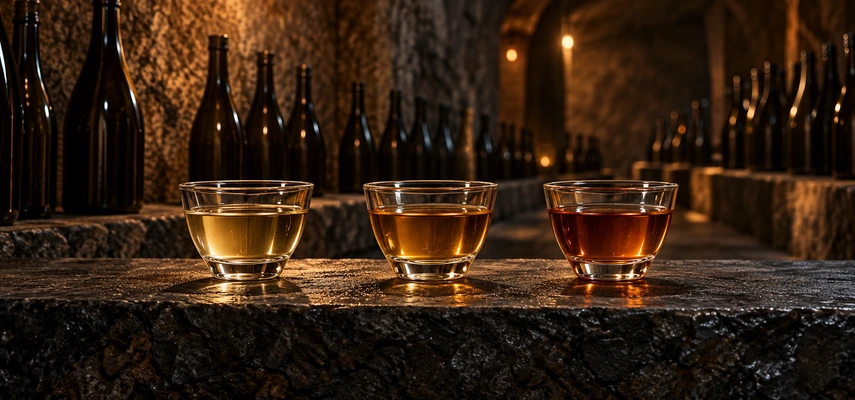

A bottle can get older without getting better. Koshu sake is interesting because it makes ageing an intentional production and style decision, with selection and conditions to match. The brewer is looking for worthwhile development rather than assuming that time will repair whatever went into storage.
Gold or amber colour, nutty or caramel-like aromas and a more evolved flavor can be part of the result. But koshu is not one fixed sensory endpoint. A cold-matured example can develop differently from one held at a warmer temperature, and the starting sake still matters. Age is an ingredient in the explanation, not the whole explanation.
Koshu sake means a deliberately aged expression
Within the Level 2 specialty-style framework, koshu is typically aged at the brewery for at least two years. The official specification identifies that typical period together with vessel size and storage temperature as relevant production choices. Treat it as the syllabus description, not an invented universal legal rule that every use of the broad word must satisfy.
Routine brewery storage and deliberate aged-style production are related but different ideas. Many sakes spend a period resting before release without being designed as mature koshu. The producer’s intention, chosen liquid, conditions and eventual character help explain the distinction.
The same caution applies to an old bottle found in a cupboard. Its age alone doesn’t prove that it has become an attractive koshu. Unknown storage and a sake not chosen for that development can lead to disappointment. Time cannot retroactively supply a sound ageing plan.
The starting composition gives ageing something to work on
Sake contains sugars, amino acids and many other components that can change during storage. Their initial amounts and relationships influence what development is possible. A fuller sake with a particular composition may respond differently from a delicate aromatic one, even when both are kept for the same number of years.
This is why a brewer selects the material as well as the duration. Rice preparation, kōji and fermentation have already shaped the liquid. Ageing works with that existing composition. It does not happen in a blank container where every sake follows the same path toward amber colour and caramel aroma.
Imagine two different pieces of fruit placed in the same kitchen. Their later condition depends on what they were at the start as well as the environment. Sake maturation is chemically different, but the comparison captures why starting material cannot be left out of a time-and-temperature explanation.
Slow reactions can create colour and aroma
Reactions involving sugars and amino compounds, often discussed under the Maillard or amino-carbonyl umbrella, can contribute to browning and evolved character over time. These are related to familiar browning chemistry, but sake storage is not the same process as searing food at high heat. Slow changes can occur under much cooler conditions.
The NRIB discussion of storage and maturation connects changing composition with both attractive mature aromas and unwanted stale ones. That contrast matters. The presence of chemical change doesn’t establish that the change will be pleasant.
Sotolon is associated with some caramel-like or mature aroma impressions. A taster may also describe nuts, dried fruit, spice or other evolved associations. These are possible sensory outcomes, not compulsory ingredients. A caramel note doesn’t mean caramel was added, just as a pear note in ginjō doesn’t prove pear juice.
Don’t reduce every aspect of ageing to one reaction or one molecule. Colour development and aroma development involve a system of components and conditions. A simplified mechanism is useful when it explains a connection; it becomes misleading when presented as the only thing happening in every bottle.
Temperature changes the rate and route
Warmer storage generally speeds many changes, while cooler storage slows them. That does not mean warmer is always better for making aged sake or that colder prevents all development. The desired style determines whether rapid colour and evolved aroma development is useful or whether preserving a more restrained character is the aim.
The NRIB preservation resource explains why temperature matters to both maturity and deterioration. A producer may intentionally choose cold maturation to manage aroma preservation and slower change. Another plan may allow more pronounced development under different conditions.
Equal age therefore doesn’t mean equal maturity. Two sakes kept for three years at different temperatures can follow different paths, particularly if their compositions also differ. Years are a necessary part of the production story, but they are not a complete measure of sensory development.
For study, complete the chain: temperature affects reaction rates, reaction rates affect the degree and pattern of change, and those changes influence appearance and flavor. That explanation is stronger than simply saying warm storage makes brown sake, which ignores selection and balance.
Vessel size and handling shape the conditions
The syllabus also names vessel size. Bulk tanks and smaller bottles organize the same volume of sake differently, with different practical possibilities for temperature management, sampling, transfer and exposure during handling. The material of the vessel and its closure can matter as well.
Avoid a universal claim that a larger vessel automatically ages faster or slower. The result depends on temperature, headspace, closure, transfers and other conditions. Size is a production variable to investigate, not a single directional rule that explains all examples.
Nor does koshu require oak barrels. Sake can mature in tanks or bottles, and the absence of wood does not prevent evolved aromas. Assuming every amber drink must have acquired its colour from a barrel would import a whisky expectation into a different production system.
A JETRO profile of aged sake illustrates how producers consider temperature and containers when developing koshu. It is a useful example of deliberate conditions. It should not be taken to mean that every brewery must use the same cellar or storage arrangement.
Sensory assessment needs room for variation
Appearance can range from relatively pale to deeper gold and amber. Clarity remains a separate question: an amber sake can be transparent. Don’t let colour depth substitute for a description of suspended material or automatically become a fault diagnosis.
Aromas may move away from youthful fruit toward nuts, caramel-like notes, spice or other mature associations. Texture and palate balance can also evolve. Some examples may feel rich and persistent, while others remain more restrained. There is no one required koshu tasting note that every successful bottle must copy.
Quality still depends on whether the result is convincing. Are the components integrated? Is the mature character appealing rather than dominated by unpleasant stale notes? Does the finish add something worthwhile? Complexity is useful only when the additional character contributes positively.
Maturation and deterioration are different judgments
Ageing and deterioration both involve change over time, and some chemical pathways can be relevant to both. The distinction lies in the intended style and the sensory result. An attractive evolved sake is not automatically faulty because it is amber. An unpleasantly stale sake is not automatically admirable because it is old.
The next faults lesson distinguishes oxidation, out-of-condition unpasteurised sake, light damage and microbial spoilage. Koshu should not be folded into those categories merely because it differs from a young ginjō. Equally, the word aged should not excuse every off-odor or poor storage history.
For a hypothetical comparison, one sake offers balanced nutty character and a clean persistent finish; another is dominated by an unwanted sulfurous stale impression. Both may have spent years in storage. Age alone does not tell you which outcome the producer intended or whether that intention succeeded.
Don’t make home storage a substitute for the producer’s work
Buying a deliberately matured sake provides information about a producer’s chosen result. Keeping an arbitrary bottle warm for several years is a different experiment. Most everyday advice to keep sake cool and enjoy it young remains sensible outside a specific ageing plan.
If exploring maturation, seek product-specific information about the original sake, conditions and recommended service. A label’s grade alone doesn’t establish ageing suitability. A delicate premium bottle is not necessarily improved by long storage simply because it was expensive.
Compare development with a question in mind
If suitable samples are available, compare a younger and deliberately matured expression with reliable production information. Keep the serving conditions similar, then note color, aroma families and palate balance. Ask which observations changed and which remain recognizable. The exercise can illustrate development without pretending the samples form a perfectly controlled chemical experiment.
For a non-tasting version, compare two producer technical descriptions. Record the original style, storage duration, temperature information and vessel. Leave unknown facts blank. This reveals why a simple age statement is less informative than a documented maturation history, and it prevents an invented explanation from filling every gap.
One-page revision summary
Koshu is an intentionally aged specialty expression, typically matured at the brewery for at least two years in the Level 2 framework. Starting composition, temperature and vessel conditions shape its development. Reactions can produce evolved colour and aroma, but time does not guarantee quality. Assess the result rather than equating amber with fault or age with excellence. Ordinary consumer storage and deliberate brewery maturation are different activities.
Knowledge check: 10 original practice questions
Independent TFE questions, not official WSET examination items. Choose one answer per question; explanations follow separately.
1. What is the Level 2 typical ageing reference for koshu?
- One day
- At least two years at the brewery
- Exactly four addition days
- No storage at all
2. Does every old bottle become desirable koshu?
- Yes, inevitably
- Only in clear glass
- No, starting sake and conditions matter
- Only if it was expensive
3. What can reactions between sugar and amino compounds contribute?
- Browning and evolved character
- New rice husks
- Distillation
- A new yeast strain number
4. Which is a possible mature aroma association?
- Mandatory fresh pear
- Only raw starch
- Only carbon dioxide
- Caramel or nuts
5. How does warmer storage generally affect many reactions?
- It freezes all change
- It speeds them, without guaranteeing a better result
- It removes all alcohol
- It establishes junmai status
6. Must koshu use oak barrels?
- Always
- Only if amber
- No, tanks and bottles can also be used
- Only if sweet
7. Why is vessel size not a universal speed rule?
- Temperature, headspace, closure and handling also matter
- Size never affects practical storage
- All vessels are chemically identical
- Every bottle is open
8. Does amber color alone establish a fault?
- Yes, always
- Only if transparent
- Only if stored upright
- No, it may fit deliberate maturation
9. Can two equally old sakes taste differently matured?
- Never
- Yes, composition and storage histories can differ
- Only if mislabeled
- Only after distillation
10. Which quality judgment is most defensible?
- Older is always better
- Darker is always better
- Evaluate balance, attractive development and the finish
- Every stale odor proves complexity
Answers and explanations
1. B — At least two years at the brewery. The specification gives this typical specialty-style reference while also naming vessel and temperature choices. Mapping: LO2.
2. C — No, starting sake and conditions matter. Ageing needs suitable material and handling; elapsed time alone does not guarantee improvement. Mapping: LO2.
3. A — Browning and evolved character. Slow maturation chemistry can change appearance and aroma without an added caramel ingredient. Mapping: LO2.
4. D — Caramel or nuts. Koshu can show evolved associations, although no single note is compulsory in every example. Mapping: LO2.
5. B — It speeds them, without guaranteeing a better result. Reaction rate and sensory desirability are different questions; faster change can also be unwanted. Mapping: LO2.
6. C — No, tanks and bottles can also be used. Mature colour and aroma do not require a wood source or whisky-style storage. Mapping: LO2.
7. A — Temperature, headspace, closure and handling also matter. Size operates within a broader storage system rather than fixing one outcome by itself. Mapping: LO2.
8. D — No, it may fit deliberate maturation. Appearance must be interpreted with intended style and the rest of the sensory evidence. Mapping: LO2.
9. B — Yes, composition and storage histories can differ. Age is one variable, while temperature and starting components affect the development path. Mapping: LO2.
10. C — Evaluate balance, attractive development and the finish. Maturity should be judged through its actual contribution rather than rewarded automatically. Mapping: LO2.
Continue studying sake
Article #10: Sake Pasteurisation and Finishing Explained: Charcoal Fining, Storage, and Dilution · Article #11: Sake Categories Explained: Futsū-shu, Premium Sake, and Classification Rules · Article #21: How to Store Sake Properly: Freshness, Light, Temperature, and Ageing · Article #22: Sake Faults Explained: Oxidation, Light Damage, and Microbial Spoilage












