










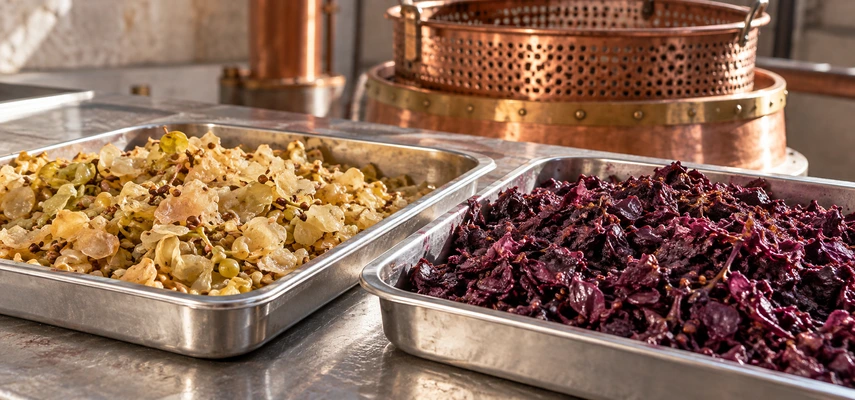

The most useful question about Grappa is not “which grapes?” but “which part of the winemaking process?” A wine spirit begins with the alcoholic liquid. Grappa begins with pomace, the grape material left after the wine’s pressing and separation stages. Grappa explained starts by giving those skins their own production story.
That material isn’t just a cheaper name for wine. It is physically different, and its fermentation history can differ too. Pomace removed before fermentation needs another step before it can supply ethanol to a still. Pomace that has already spent fermentation in contact with the wine arrives with a different starting condition.
The distinction makes Grappa a useful final lesson in this fruit-spirit section. Cognac, Armagnac and Pisco have shown how grapes become spirits through an alcoholic liquid. Calvados changed the fruit. Grappa changes the part of the grape process being distilled, creating another relationship between raw material, handling, equipment and final style.
Grappa explained through Italian grape pomace
The course’s essential origin is Italy, with Italian grape pomace as the raw material. Pomace consists chiefly of skins and seeds remaining from winemaking. These solids carry relevant aromatic material and, depending on their history, sugar or retained alcohol. They should not be imagined as a tank of ordinary finished wine under another label.
The Poli Grappa Museum’s production account distinguishes this solid starting material from other grape-derived distillates. It also stresses the importance of raw-material quality. Using a winemaking by-product can recover valuable material, but the word “by-product” is an economic description, not a sensory verdict on the finished drink.
Grape variety and winemaking choices can influence what the pomace contains. Aromatic material associated with the skins offers possibilities for a distinctive spirit. Yet a single variety doesn’t guarantee one tasting note, and a blend of pomaces isn’t automatically less expressive. Condition, handling and distillation intervene before the liquid reaches a glass.
For revision, keep wine and pomace in different boxes. A grape wine supplies an alcoholic liquid made by fermentation. Pomace is the retained solid material, with its own fermentation state. The two can come from the same harvest while requiring different handling and giving rise to different spirit categories.
White-grape pomace commonly needs fermentation
In conventional white winemaking, juice is usually separated from the skins before alcoholic fermentation. The resulting white-grape pomace therefore has not necessarily fermented with the wine. It can contain sugars but little alcohol, and needs suitable fermentation before distillation. This is the course’s central white-pomace handling distinction.
Water can be mixed with the pomace as part of preparation for that fermentation route. The purpose is to make a suitable medium for microbial activity and processing, not to create alcohol directly. Yeast still needs fermentable sugar and the appropriate conditions. Adding water is not a substitute for the biological conversion that supplies ethanol.
Once fermentation has taken place, the material can enter distillation. Read the sequence carefully: separation from juice, appropriate preparation, fermentation, then distillation. If you skip the fermentation step because the material came from a winery, you assume that the pomace experienced a process that in this route happened to the separated juice instead.
The rule is about production history rather than skin colour possessing magical properties. Some white-wine methods involve skin contact, and real cellar practice can vary. For the standard examination comparison, understand the typical unfermented white pomace versus fermented red pomace model, then use authenticated information when discussing a particular producer’s exception.
Red or black-grape pomace has a different history
In conventional red winemaking, black grapes, often described as red-wine grapes, ferment with their skins. When the pomace is separated from the resulting wine, it has already taken part in alcoholic fermentation and retains alcohol. It can therefore move towards distillation without needing the same fresh fermentation step as typical virgin white pomace.
That doesn’t make storage irrelevant. The material should be handled promptly and distilled immediately where practical, because deterioration and spoilage can damage the desired character. The producer is managing a perishable raw material, not a dry bag of inert colouring. Timely movement from winery to distillery helps preserve the possibilities present at separation.
Hello Grappa’s industry production guide explains the contrast between fermented and virgin pomace. Its useful lesson is to ask what happened before arrival at the distillery. A dark colour alone is less informative than knowing whether the skins spent time in fermenting must and what condition they are in now.
Try a hypothetical receiving-yard question. One delivery contains pale skins pressed before juice fermentation; another contains skins removed after red-wine fermentation. The first requires the appropriate fermentation preparation. The second already contains alcohol and needs prompt distillation handling. Neither delivery should be described simply as “grape waste, so the process is identical.”
Distilling solids requires suitable handling
Pomace changes the engineering problem because the charge is not merely a free-flowing alcoholic wine. Producers use suitable equipment and heating arrangements, including steam or water-based systems. The goal remains vaporisation, selection and condensation, but the physical nature of the material affects how it is loaded, heated and discharged.
Steam can pass through fermented pomace and carry alcohol and aromatic components into the distillation system. Other arrangements use different methods for heating the charge. The course doesn’t require the learner to design that plant; it does require recognition that solid material brings handling considerations absent from a simple tank-of-wine description.
Both batch and continuous distillation systems exist in Grappa production. Equipment and operation influence the composition collected. A distiller selects a suitable heart rather than treating every drop from the beginning and end as an identical product. The terms heads, heart and tails retain their general selection meaning without imposing one universal set of cut points.
Do not infer that continuous Grappa must be neutral or that batch Grappa is automatically superior. Those shortcuts confuse equipment with outcome. Evaluate the raw material, the intended style and the documented operation. A carefully managed system should be understood through the job it performs, rather than assigned a quality score because of its silhouette.
Young Grappa preserves a different balance from wood-aged Grappa
Unaged or young Grappa does not receive a wood-ageing period before bottling. It may rest in inert vessels after distillation and strength adjustment. This allows the producer to prepare the spirit while avoiding the same wood-derived colour and flavour that an active cask can contribute.
The museum’s young-Grappa explanation describes a steel-vessel route without wood ageing. The important distinction is unwooded presentation versus immediate bottling. A clear appearance does not prove the spirit spent no time being rested, blended or otherwise prepared after leaving the condenser.
Wood-aged Grappa follows another path. A cask can add colour, aroma and texture-related influences while the spirit develops. Vessel type, activity, history and duration matter. Wood isn’t a requirement that every example must acquire the same vanilla character, and a darker colour alone doesn’t authenticate a particular number of years.
There is no need to force the two presentations into a simple winner-and-loser contest. One can foreground pomace-derived character without a wood overlay; another can integrate that character with maturation. The relevant question is how the chosen process serves the intended result, not whether brown automatically means more sophisticated than clear.
Compare Grappa with wine spirits on equal terms
Imagine the same grape harvest contributing juice for wine and skins for Grappa. A spirit distilled from the wine and a spirit distilled from the pomace share a vineyard connection, but their immediate raw materials differ. Their handling, chemical starting points and possible equipment arrangements may differ as well. The common grape name does not erase those distinctions.
Now compare two Grappas, one young and one wood-aged. Separate the variables you know from those you don’t. If the grape source, distillation and maturation all differ, the exercise is not a controlled test of wood alone. You can still learn from it by identifying plausible contributions and stating the limits of your inference.
Floral, fruity, herb-like or developed woody associations can all be useful sensory observations in suitable examples. None is a guarantee that a named ingredient was added. Sweet-associated aromas also shouldn’t be treated as a measured sugar level. Describe aroma character, intensity, sweetness, texture and finish as distinct dimensions before proposing a production explanation.
Avoid three common pomace shortcuts
First, “all grape spirits are distilled wine” overlooks Grappa’s solid raw material. Second, “the winery already fermented it” ignores white pomace separated before the juice fermented. Third, “clear means unfinished” dismisses an intentional young presentation. Each shortcut starts with a familiar fact and stretches it beyond what the production record supports.
A stronger answer names the material, its fermentation state and its next operation. For example: this white pomace was separated before fermentation, so it needs the appropriate fermentation preparation before distillation. That sentence explains a mechanism and a sequence. It is more resilient than memorising that one colour of skins always belongs to one fixed flavour profile.
What to remember
For Grappa, follow the skins. Where were they separated from the juice or wine, had they already fermented, and how were they handled afterwards? Those questions explain why white and red pomace can take different routes to the still. Then separate inert-rested young Grappa from wood-aged presentation. Raw material, fermentation history, distillation and vessel choice each contribute a different part of the answer.
Continue your study
To revisit why fermentation history matters, read How Spirits Begin: Raw Materials, Sugar Conversion, and Fermentation. To contrast pomace with grape-wine Pisco, read Pisco Explained: How Chile and Peru Produce Grape Spirits. To compare inert rest and wood maturation, read How Spirits Develop Flavor: Oak Maturation, Blending, Filtration, and Finishing.
Knowledge check: 10 original practice questions
Independent TFE questions, not official WSET examination items. Choose one answer per question; explanations follow separately.
1. What engineering issue distinguishes pomace from wine?
- It already contains finished oak-aged spirit
- It eliminates vapour-liquid separation
- It removes the need for a condenser
- It is a solid raw material requiring suitable loading and heating
2. What chiefly makes up grape pomace?
- Oak shavings
- Solid grape material such as skins and seeds
- Only distilled ethanol
- Purchased botanical extract
3. Why is prompt pomace handling important?
- It is chemically identical to dry steel
- The material can deteriorate and spoil
- All aroma disappears exactly one hour after pressing
- It must turn into oak
4. Why can typical red pomace move directly towards distillation?
- It contains no volatile compounds
- Its colour itself creates ethanol
- It has already fermented with the wine and retains alcohol
- Red grapes require no processing
5. What is Grappa’s defining raw material in this lesson?
- Blue agave
- Italian grape pomace
- Only finished grape wine
- Unfermented cane juice
6. Why does typical white pomace need fermentation before distillation?
- White skins cannot contain sugar
- It was separated from juice before alcoholic fermentation
- Oak maturation must happen first
- The still cannot heat pale material
7. Which claim is most reliable when comparing young and wood-aged Grappa?
- Darker is always superior
- Young means no post-distillation preparation
- Colour alone proves exact age
- They pursue different vessel influences rather than a universal quality ranking
8. Which distillation systems can be used in Grappa production?
- Batch and continuous systems
- Only mandatory triple pot systems
- No thermal systems
- Only freezing systems
9. What can an inert resting vessel offer young Grappa?
- Automatic amber colour
- Alcoholic fermentation from wood
- A guaranteed minimum oak age
- Preparation without the same oak-derived contribution
10. What is the role of mixing water with suitable white pomace in this route?
- Preparing a medium for fermentation and processing
- Increasing the amount of grape seed oil by definition
- Adding oak flavour
- Creating ethanol without yeast
Answers and explanations
1. D — It is a solid raw material requiring suitable loading and heating. Pomace’s physical form requires appropriate handling rather than simply copying every part of a liquid-wine process. Mapping: LO2.
2. B — Solid grape material such as skins and seeds. Pomace is the solid material associated with winemaking, not simply another name for the finished wine. Mapping: LO2.
3. B — The material can deteriorate and spoil. Pomace is perishable; prompt handling helps preserve the condition and aromatic possibilities of the raw material. Mapping: LO2.
4. C — It has already fermented with the wine and retains alcohol. Red pomace has usually participated in wine fermentation and retains alcohol, unlike typical virgin white pomace. Mapping: LO2.
5. B — Italian grape pomace. Grappa uses Italian grape pomace, distinguishing it from spirits distilled from grape wine. Mapping: LO2.
6. B — It was separated from juice before alcoholic fermentation. In the usual white-wine route, the juice ferments separately, leaving virgin pomace that needs its own fermentation preparation. Mapping: LO2.
7. D — They pursue different vessel influences rather than a universal quality ranking. Vessel choice changes possible influences, but appearance and age alone do not establish overall quality. Mapping: LO2.
8. A — Batch and continuous systems. Both batch and continuous arrangements occur; the equipment and operation must be considered together. Mapping: LO2.
9. D — Preparation without the same oak-derived contribution. Inert resting avoids the same wood extraction while allowing preparation of the unwooded presentation. Mapping: LO2.
10. A — Preparing a medium for fermentation and processing. Water supports the preparation route, while yeast fermentation remains the process that creates ethanol. Mapping: LO2.












