










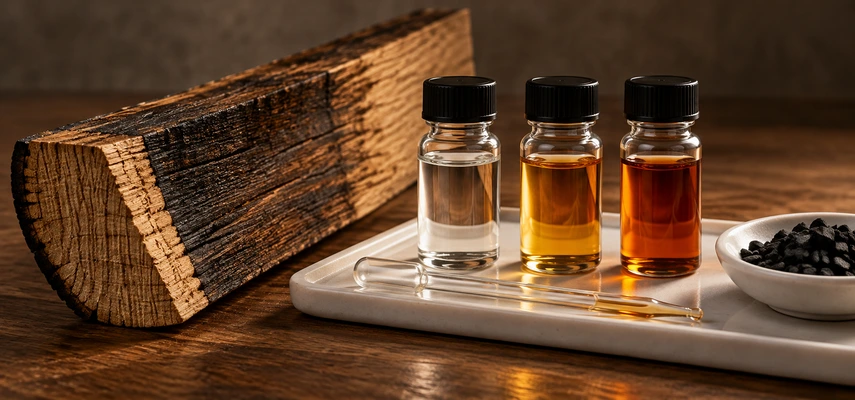

Two batches can leave the same still and head towards very different bottles. One might rest in wood, another retain a clear appearance, and a third become the base for botanicals. Spirits maturation and finishing begin where distillation ends, but they don’t follow a single compulsory recipe.
That is what makes the final production stage so interesting. The producer can add, remove, combine or preserve characteristics, within the rules of the intended category. A barrel is one tool in that kit. Water, filtration and a carefully judged blend can be just as deliberate, even if they are less likely to appear on a romantic label.
This lesson explains the mechanisms before later articles apply them to individual spirits. Keep two questions side by side: what does the operation do, and is it permitted here? Understanding a technique is not the same as establishing permission to use it in every drink.
Spirits maturation changes more than the calendar
During oak maturation, a spirit can extract compounds from the wood, undergo chemical changes and lose some material through evaporation. These processes interact. Time allows them to proceed, but time alone doesn’t specify the resulting colour, flavour or texture. The starting spirit, cask and storage conditions help determine the direction of development.
Wood can contribute aromas associated with vanilla, toast, coconut or spice, depending on its characteristics and treatment. These are sensory associations rather than an ingredient list. A whisky that smells like vanilla has not necessarily been flavoured with vanilla. Distinguish wood-derived character from a botanical addition when explaining how a particular style develops.
Maturation can also reduce some impressions of harshness. That broad description includes several possible changes rather than one substance being removed by the calendar. A spirit may become better integrated while retaining distinctive raw-material or fermentation character. More obvious wood is not automatically a better outcome, especially when it obscures the balance a producer wanted.
The Glenlivet’s maturation account describes wood extraction, interaction with the environment and evaporation as connected parts of development. The useful takeaway is that maturation is a changing system. Avoid treating a barrel as a passive container that merely lends the liquid its brown paint.
Barrel age and previous contents change the starting conditions
Barrel age means the condition and use history of the vessel, not simply the spirit’s age statement. New wood generally has more readily available extractable material than repeatedly used wood. A refill cask may contribute more gently while allowing other changes to continue. Different wood activity can therefore produce different results over the same period.
The previous contents can matter too. A cask that previously held another permitted drink can contribute a different influence from a new cask. An additional maturation period in a different cask is often called a cask finish. Here “finish” describes a production stage, rather than the length of flavour after a sip.
Imagine two otherwise similar spirits maturing for the same duration, one in active new oak and another in a well-used vessel. Predicting equal wood character from equal time would ignore the casks’ different starting resources. The comparison explains why age isn’t a complete recipe or a guarantee that two bottles will taste alike.
Legal permission remains separate. The Scotch Whisky Association’s cask guidance sets conditions on what may be used for Scotch. It illustrates a general discipline: an interesting cask experiment does not automatically retain every protected category name. Check the actual category rules before making a claim about an allowed finish.
Oxygen, temperature and evaporation influence development
Oxygen and time allow reactions that can change the spirit’s aroma profile. The barrel’s interaction with its surroundings is part of the process, alongside extraction from wood. It is more useful to describe these as linked mechanisms than to assign every mature aroma to a single source with absolute confidence.
Warehouse temperature influences the rate and pattern of development. Conditions also vary within a storage building, so casks from different locations can develop differently. A warmer environment does not simply turn one year into a fixed number of cooler-climate years. Extraction, evaporation and reactions need not accelerate in identical proportions.
Evaporation reduces the amount of liquid remaining. The concentration of some non-volatile components can increase as the system changes. Alcoholic strength can move in different directions depending on relative water and ethanol losses and storage conditions. “Older always means stronger” is therefore no better than “older always means darker.” Identify the mechanism rather than assuming a universal direction.
Inert vessels can preserve and allow change without oak extraction
An inert vessel does not supply the same wood-derived compounds as an oak cask. It can hold spirit for storage, support preservation of a desired style and allow certain changes over time without adding oak character. Depending on the drink and its process, producers may describe a period of resting or maturation in such vessels.
Inert doesn’t mean nothing anywhere in the liquid can change. Nor does time in an inert tank automatically satisfy a legal oak-ageing requirement. The physical effect of the vessel and the category’s definition of qualifying maturation are different matters. A producer cannot substitute a stainless tank for mandatory oak simply because both contain a calendar’s worth of spirit.
This distinction helps with clear spirits. A colourless presentation need not mean a bottle was filled the instant distillation ended. There may have been resting, blending, dilution or filtration. Conversely, colour cannot independently prove a precise period in wood. Use authenticated production information and relevant label rules for those conclusions.
Blending solves consistency and complexity problems
Blending combines components to reach a desired result. It can build complexity by bringing different characteristics together. It can also maintain consistency when individual casks or production batches vary. Those aims can coexist: a recognisable style may be produced by adjusting the component balance as the available stock changes.
Consider a hypothetical blend in which one component supplies fruit character and another a firmer oak contribution. Their combination can create a balance neither offers alone. That does not imply every blend must use different distilleries, different ages or a particular number of components. The category and intended product determine the relevant constraints.
Nor is blending automatically a way to disguise poor material. The meaningful question is whether the selected components achieve the intended profile. Single-cask and blended presentations offer different approaches to variation. Neither label can replace an evaluation of the actual drink, just as an ingredient count doesn’t tell you whether a meal is well cooked.
Flavouring uses several routes
Maceration extracts material by contact between flavouring ingredients and liquid. An alcoholic extract is a tincture. Time, temperature, ingredient preparation and recipe influence what is extracted. This route can retain components that would not travel through distillation in the same way, including relevant colour and bitter substances.
Redistillation carries selected volatile aromatic components from botanicals into a collected distillate. The botanical material may be handled in different ways, including contact with liquid or vapour, depending on the process. The result need not have the same profile as a direct maceration of the same ingredients. Extraction and volatility select different parts of a plant’s chemical mixture.
Producers may also add purchased natural flavourings or use other flavour materials where permitted. These are alternative production routes, not automatic indicators of price or quality. Later gin, aniseed-spirit, bitter-spirit and liqueur lessons examine their specific uses. Here, learn why adding an extract and redistilling botanicals are mechanically different operations.
Dilution, sweetness and colour need separate explanations
Adding suitable water lowers alcoholic strength. It can also change how aromas and texture are perceived. Dilution does not remove ethanol by evaporation; it changes the proportion of ethanol in the enlarged mixture. Bottling strength is therefore one decision within production rather than proof of the strength at which the spirit left the still.
Adding sugar can change sweetness and the sensory balance, but it is not permitted in every category. Likewise, caramel colouring, other natural colours and artificial colours have different legal contexts. General knowledge that these operations exist must not become a claim that every whisky, brandy, gin or rum permits all of them.
Colour and sweetness are separate observations. A permitted colour adjustment need not establish a sweet palate, and an amber spirit may derive its appearance from wood rather than added colour. Read a label and describe a sample carefully before deciding which process accounts for what you observe. One visible clue should not be asked to solve the entire production history.
Filtration can target different things
Chill filtration cools a spirit so certain haze-forming material can be removed through filtration. It primarily addresses a presentation and stability concern. A producer may choose a non-chill-filtered presentation, but that phrase alone doesn’t guarantee greater quality. Evaluate the intended style and actual sensory result rather than converting a process choice into a universal score.
Activated charcoal filtration uses an adsorptive material that can remove selected components. Its effect depends on the medium and treatment, so it is not identical to straining out visible particles. Some production systems use it to reduce colour or alter aroma. Don’t confuse it with simply naming any process involving charcoal; category-specific charcoal treatments may serve different purposes.
What to remember
After distillation, ask whether an operation adds, removes, combines or preserves characteristics. Then identify the mechanism and check the category rule. Oak, inert storage, blending, flavouring, dilution, sweetening, colouring and filtration give the producer different controls. Together they explain why the liquid leaving a still is an important beginning, while the bottled spirit remains the result of further decisions.
Continue your study
To see used-cask choices applied to malt Scotch, read Single Malt Scotch Whisky Explained: Distilleries, Peat, Pot Stills, and Oak. To explore flavouring methods in more detail, read Flavored Vodka and Spiced Rum Explained: How Spirits Gain Added Flavor. To test maturation claims through comparison, read How to Taste and Compare Spirits: A WSET Level 2 Revision Guide.
Knowledge check: 10 original practice questions
Independent TFE questions, not official WSET examination items. Choose one answer per question; explanations follow separately.
1. Which claim about inert storage is correct?
- It always meets a legal oak-maturation requirement
- It does not supply oak-derived compounds in the same way as a cask
- It makes every spirit amber
- It necessarily means absolutely no chemical change
2. Why can two equally old spirits have different wood influence?
- Colour is fixed entirely by fermentation
- Every barrel has the same extractable material
- Age determines an identical chemical profile
- Their casks and storage conditions may differ
3. What is a cask finish?
- A mandatory addition of sugar
- An additional maturation period in another cask
- The length of flavour after a sip
- Another name for yeast fermentation
4. What does chill filtration target in the description here?
- Pressing fruit to release juice
- Material that can contribute to haze after cooling
- Creating yeast esters
- Conversion of fructans into sugars
5. What is the main strength effect of adding water?
- Removal of all congeners
- A lower ethanol proportion in the resulting mixture
- A guaranteed increase in sugar concentration
- More ethanol created by fermentation
6. What must be checked before adding sugar or colour to a named spirit category?
- Only whether the liquid looks pale
- Whether the bottle has a cork
- The applicable category rules
- Only the colour of the barrel
7. Why can redistillation and maceration give different results from the same botanical?
- Every botanical compound has identical volatility
- Maceration always removes every bitter component
- Redistillation is alcoholic fermentation
- They select components through different mechanisms
8. What can blending achieve?
- Consistency and complexity
- Automatic exemption from category rules
- Only a higher minimum age than every component
- Only removal of all colour
9. What does barrel age describe in this context?
- Only the spirit’s bottled age statement
- The number of years since bottling
- The age of the distillery founder
- The vessel’s condition and use history
10. What is a tincture in this lesson?
- A unit of alcohol strength
- An alcoholic extract obtained through maceration
- A compulsory oak age statement
- A column’s waste outlet
Answers and explanations
1. B — It does not supply oak-derived compounds in the same way as a cask. Inert storage lacks the same wood contribution, but some changes can still occur over time. Mapping: LO1.
2. D — Their casks and storage conditions may differ. Cask history, activity and storage conditions affect development alongside elapsed time. Mapping: LO1.
3. B — An additional maturation period in another cask. A cask finish is a production stage, distinct from the sensory finish in a tasting description. Mapping: LO1.
4. B — Material that can contribute to haze after cooling. Cooling allows relevant haze-forming material to be filtered, addressing appearance and stability. Mapping: LO1.
5. B — A lower ethanol proportion in the resulting mixture. Dilution changes ethanol concentration by adding water; it does not create additional alcohol. Mapping: LO1.
6. C — The applicable category rules. General availability of a technique does not establish that a particular protected or regulated category permits it. Mapping: LO1.
7. D — They select components through different mechanisms. Direct extraction and collection of volatile distillate components need not retain the same chemical balance. Mapping: LO1.
8. A — Consistency and complexity. Combining components can maintain a profile and bring complementary characteristics together. Mapping: LO1.
9. D — The vessel’s condition and use history. Barrel age concerns the vessel and its history, which can affect its wood contribution. Mapping: LO1.
10. B — An alcoholic extract obtained through maceration. Maceration extracts flavouring material through contact; the resulting alcoholic extract is a tincture. Mapping: LO1.












