











“Champagne” on a Cognac label can confuse an otherwise sensible reader. It does not mean the spirit began as the sparkling wine from northeastern France. Cognac explained properly starts by separating three things labels often place close together: the drink’s protected identity, the origin of its grapes and the age of its youngest component.
Those distinctions make the production story easier to follow. Cognac is a French grape spirit with a defined geographical origin and production requirements. Within that framework, grape growing, wine production, distillation, oak management and blending still leave room for a range of styles. The name establishes a regulated family, not a promise that every bottle has an identical aroma.
This lesson applies the general production principles from the opening section to one particular category. Rather than repeat the whole chemistry of a pot still, we will ask why this raw material, this distillation tradition and these maturation decisions matter together. The label then becomes a useful production clue instead of a string of expensive-looking letters.
Cognac explained from the vineyard onwards
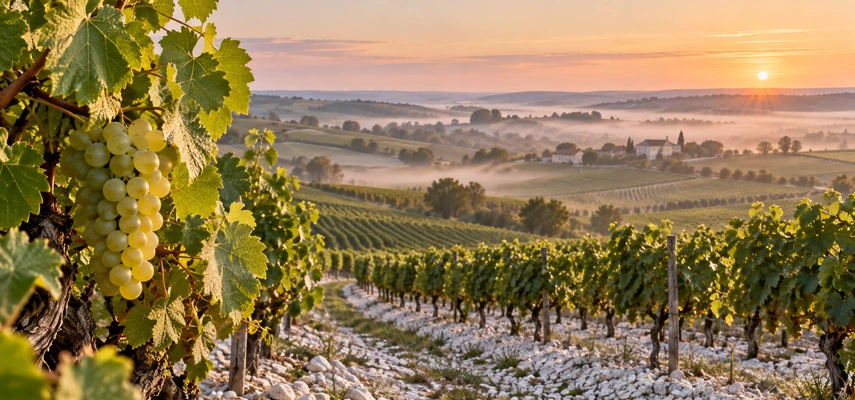
The grapes must come from the defined Cognac area of France. Ugni Blanc is the central variety to recognise for this course, although the category’s detailed specification includes other permitted grapes. The grape name identifies a raw material; it is not an age grade, a subregion or the name of a distillation technique.
The aim is to make a wine suitable for distillation. Grapes supply fermentable sugars, so the sequence begins with harvesting, crushing, pressing and fermentation rather than grain-style starch conversion. The producer first needs an alcoholic wine, not sweet grape juice travelling directly from the press into a still.
Fruit and juice are vulnerable to spoilage, so handling and timing matter. Fermentation also establishes compounds that can contribute to the eventual spirit. Distillation will reshape their balance rather than preserve the wine unchanged. A finished Cognac is therefore neither ordinary wine with stronger alcohol nor grape juice whose sweetness has simply been concentrated.
The BNIC’s official FAQ places the production in a defined French area and describes its double-distillation and oak-ageing route. Treat that geographical requirement as part of the category’s identity. Another country’s excellent grape brandy does not become Cognac merely because it uses similar equipment or presents a comparable flavour.
Grande Champagne and Petite Champagne are grape origins
Grande Champagne and Petite Champagne are Cognac crus: delimited vineyard origins within the wider region. Their names belong to this geographical system. They are not permission to substitute sparkling Champagne as the required base, nor do they identify a method for making bubbles in the finished spirit.
Borderies is another named cru required for this lesson. A cru designation identifies a source of grapes under the relevant conditions. It doesn’t itself specify whether the bottle is VS, VSOP or XO. Keep the geography and age axes separate, because a reader can otherwise mistake a place name for a rung on a quality or maturity ladder.
Regional soil and growing conditions can influence the wine and the spirit available for maturation. However, a broad regional tendency is not an authenticated tasting note for every cask. Fermentation, distillation, oak and blending still intervene. Learn the names and what they denote before trying to attach a rigid aroma slogan to each one.
Fine Champagne is a precise blend, not a compliment
Fine Champagne has a specific meaning: the Cognac comes exclusively from Grande Champagne and Petite Champagne, with at least 50% from Grande Champagne. The BNIC protected-origin guidance states that composition. The word “Fine” here is doing a regulatory job rather than offering a reviewer’s vague approval.
For a hypothetical origin exercise, a blend of 60% Grande Champagne and 40% Petite Champagne meets that origin composition. A blend with 40% Grande Champagne and 60% Petite Champagne doesn’t. Nor does adding Borderies to the first example preserve the exclusively-two-crus condition. Other Cognac requirements would still need to be met in every case.
None of those proportions tells you the components’ ages. A Fine Champagne can carry a separate age classification, and a Cognac from another permitted origin can be mature and complex without using the Fine Champagne designation. Once again, origin and time are separate pieces of information. Neither should be made to answer a question it wasn’t designed to answer.
Double pot distillation concentrates and selects
Cognac uses the Charentais tradition of double pot distillation. The course associates it with direct heating and a worm-tub condenser. The first distillation makes an intermediate alcoholic liquid; the next makes a more selective collection. The fermented wine remains the source of the ethanol and much of the starting chemical material.
This method links Cognac with the pot-still principles already introduced: a batch changes over time, and the distiller chooses portions appropriate to the desired spirit. The retained mixture includes ethanol and congeners. It is not pure alcohol waiting for wood to manufacture every trace of character afterwards.
Producer choices within the regulated method can influence the aromatic balance that enters maturation. That is why a general claim such as “twice distilled means light” is too crude. The wine, equipment, operating approach and selected collection all matter. Double distillation tells you something useful about the route without giving a complete sensory prediction.
Oak creates another layer of character
Cognac must undergo at least two years of qualifying maturation in oak before sale to the consumer. The specific age categories may require longer. Wood can contribute colour and aromas while reactions and evaporation change the spirit. Cask history and management influence the balance between the distillate’s character and the contribution from maturation.
Newer and previously used oak need not act identically. A producer can manage the amount and duration of contact to avoid overwhelming the spirit while developing a chosen profile. The result may suggest fruit, flowers, spice, toast or developed notes, depending on the example. Those possibilities are not a compulsory set of aromas that every Cognac must display.
Colour alone cannot certify an age category. Wood activity and permitted finishing choices complicate a simple darker-equals-older rule. If a question asks whether the youngest component qualifies for XO, use the verified maturation information. A deep amber photograph cannot do the work of a production record.
VS, VSOP, XO and Hors d’âge follow the youngest component
The principal minimums are VS: two years; VSOP: four years; XO: ten years. Hors d’âge sits with the ten-year minimum category in the BNIC’s published classification. It may be used for products older than that minimum, but it does not legally mean the liquid has no measurable age or must be a specific much older number.
The relevant age is that of the youngest component in the blend. Suppose a hypothetical Cognac combines spirits aged four, eight and twelve years. The twelve-year-old component cannot pull the youngest up to an average age. On this information, the blend meets the VSOP minimum, while it does not meet the XO minimum.
Now consider a blend whose components are all at least ten years old. It meets the XO age minimum even if the components have different ages. A label’s minimum doesn’t promise that every component is exactly that old. Read minimum-age language as a floor, not a complete inventory of the casks used.
Storage in a bottle does not add qualifying oak maturation. A VSOP kept on a shelf for six more years does not become XO through household arithmetic. Bottled storage and cask ageing are different conditions. This distinction is useful beyond Cognac, but here it protects the meaning of the specific designations a learner needs to know.
Blending and finishing shape the final presentation
Blending can combine spirits of different ages, origins and oak histories for consistency or complexity. It is a central tradition rather than a compulsory claim that every bottle includes every cru. The blender works with actual components whose differences can complement one another, while the finished Cognac must satisfy its origin and age statements.
Permitted finishing adjustments can include sweetness management and caramel colour within the category’s controls. That does not turn Cognac into an unrestricted flavoured spirit. The existence of an authorised adjustment should not be expanded into permission to add any ingredient in any quantity while retaining the name.
For evaluation, describe sweetness separately from sweet-associated aromas. A vanilla impression may come from wood; it does not establish the precise amount of added sugar. Likewise, a consistent house colour does not independently reveal how it was achieved. Useful tasting observations and verified production facts complement one another without becoming interchangeable.
Compare bottles using the same questions
A practical study comparison can use a VS, VSOP and XO, ideally chosen to make the producer variable manageable. Compare appearance, aroma character, intensity, sweetness, texture and finish without assuming the most expensive or oldest example must win every category. The exercise is about recognising possible development, not proving a hierarchy from a label before looking at the glass.
If you don’t taste alcohol, do the same work with documented production descriptions and hypothetical examples. Identify the grape origin, distillation route, youngest-component age and relevant finish. You can solve Fine Champagne proportions and minimum-age questions without drinking. The reasoning is the same: establish which fact answers which part of the problem.
What to remember
Cognac’s label has several coordinates. Ugni Blanc belongs to the grape story; Grande Champagne, Petite Champagne and Borderies belong to geography; Fine Champagne specifies a particular two-cru composition; VS, VSOP, XO and Hors d’âge concern qualifying age. Connect those coordinates with wine, double pot distillation and oak, and the category becomes a production system you can explain rather than a code you merely recite.
Continue your study
To compare Armagnac’s grape and still traditions, read Armagnac Explained: Grapes, Column Distillation, and Regional Styles. To change the fruit foundation to Calvados, read Calvados Explained: How Apples and Pears Become French Brandy. To revisit the double-distillation mechanism, read Pot Still Distillation Explained: Heads, Hearts, Tails, and Double Distillation.
Knowledge check: 10 original practice questions
Independent TFE questions, not official WSET examination items. Choose one answer per question; explanations follow separately.
1. What determines the age classification of a Cognac blend?
- Years since the bottle was bought
- The youngest component
- The oldest component
- The arithmetic average age
2. What happens to a Cognac’s qualifying oak age after bottling?
- It becomes the average of all grapes used
- It does not increase through bottle storage
- It doubles every decade
- It increases exactly one year each calendar year
3. Which distillation route is associated with Cognac?
- Double pot distillation
- Only high-strength neutral column distillation
- Fermentation without distillation
- Distillation of unfermented grape juice
4. What is the published minimum associated with XO Cognac?
- Twenty years
- Four years
- Ten years
- Six years
5. What do Grande Champagne and Petite Champagne identify here?
- Age classifications
- Cognac vineyard origins
- Oak species
- Sparkling-wine additions
6. Which minimum applies to Cognac VSOP?
- Six years
- Two years
- One year
- Four years
7. What does Hors d’âge guarantee in the classification discussed?
- An unknowable age outside all controls
- At least the ten-year minimum
- No wood contact
- Exactly fifty years
8. Which hypothetical composition meets the Fine Champagne origin condition?
- 60% Grande Champagne and 40% Petite Champagne
- 100% Borderies
- 40% Grande Champagne and 60% Petite Champagne
- 60% Grande Champagne and 40% Borderies
9. What does Borderies identify?
- A condenser design
- A Cognac cru
- The minimum age for XO
- An artificial colouring
10. Which grape is central to Cognac study at this level?
- Blue agave
- Ugni Blanc
- Rye
- Sugar cane
Answers and explanations
1. B — The youngest component. The youngest component controls the minimum-age claim; older material does not raise that youngest age. Mapping: LO2.
2. B — It does not increase through bottle storage. Bottle storage does not add years of oak maturation or convert a younger age category into an older one. Mapping: LO2.
3. A — Double pot distillation. Cognac is made by double pot distillation of wine in the Charentais tradition. Mapping: LO2.
4. C — Ten years. XO Cognac requires at least ten years for the youngest component under the current classification. Mapping: LO2.
5. B — Cognac vineyard origins. These names identify Cognac crus and must not be confused with the sparkling-wine region. Mapping: LO2.
6. D — Four years. VSOP requires the youngest component to have at least four years of qualifying maturation. Mapping: LO2.
7. B — At least the ten-year minimum. BNIC places Hors d’âge in the ten-year minimum category, although individual examples may be older. Mapping: LO2.
8. A — 60% Grande Champagne and 40% Petite Champagne. Fine Champagne uses only Grande and Petite Champagne, with at least half from Grande Champagne. Mapping: LO2.
9. B — A Cognac cru. Borderies is a delimited grape origin within Cognac, rather than an age grade or production apparatus. Mapping: LO2.
10. B — Ugni Blanc. Ugni Blanc is the principal Cognac grape to recognise; the alternatives belong to other raw-material groups. Mapping: LO2.












