











Armagnac is an excellent antidote to the idea that a column still must make a neutral spirit. Its traditional short continuous still can deliver a characterful grape distillate, ready for a production path quite different from neutral vodka. Armagnac explained as “Cognac with another name” misses precisely what makes it worth studying.
The two French grape spirits share broad ingredients and some age vocabulary. They also have different origins, important grape traditions and typical distillation routes. Armagnac adds another useful distinction: a clear Blanche presentation preserves a different relationship with the distillate from a long-oak-aged example. Brown is not the only colour in this family.
This lesson follows the decisions that matter for Level 2: where the grapes grow, which varieties are important, how the wine is distilled, and what the labels promise about origin and time. The aim is to compare Armagnac fairly rather than define it entirely by what its better-known neighbour does.
Armagnac explained from its Gascon origins
Armagnac comes from a defined part of southwestern France, within Gascony. The course requires recognition of Bas-Armagnac and Ténarèze. These identify subregional origins, not two different age categories or two still designs. A label can therefore communicate a geographical name and a maturity designation at the same time.
The BNIA’s terroir account places the vineyards across parts of Gers, Landes and Lot-et-Garonne and describes the principal subregions. Bas-Armagnac is associated especially with sandy and sandy-loam soils; Ténarèze includes clay-limestone and other soils. These are geographical and growing-condition distinctions, not a demand that every bottle have a predetermined aroma.
You may encounter broad descriptions of more delicate or more powerful regional styles. Use them as tendencies in a larger production story. Variety, wine handling, still operation, oak and blending also shape the result. A cru or regional name does not cancel the work of every person and vessel between the vineyard and the bottle.
Three grape names deserve separate attention
Ugni Blanc, Baco Blanc and Folle Blanche are the essential varieties for this lesson. Other grapes are permitted, but these three provide a manageable starting point. Ugni Blanc also appears in Cognac, which offers a useful overlap without establishing that the categories are interchangeable.
Baco, often encountered as Baco 22A, is a distinctive part of the Armagnac story. Folle Blanche has its own historical and stylistic associations. The purpose of learning the names is to recognise production options, not to guarantee a fixed fruit or flower aroma whenever one variety appears in a description.
Grape choice influences the wine available for distillation. The grapes are processed and fermented into an alcoholic wine before entering the still. As in other fruit spirits, timely handling helps preserve suitable material. Distillation reshapes what is present; it doesn’t turn unfermented grapes into ethanol by applying heat.
When comparing with Cognac, make the difference explicit: Ugni Blanc is shared territory, while Baco and Folle Blanche deserve particular attention here. That is more informative than saying both drinks use grapes and stopping. Categories can overlap in one variable while differing in several others.
The traditional column is built for this spirit
The usual Armagnac route uses a short continuous column still, often called an alambic armagnacais. Wine and vapour interact through its working sections while spirit is collected. The resulting distillate can retain pronounced grape- and fermentation-derived character. It is a practical example of why continuous operation does not require a neutral sensory result.
The BNIA’s distillation account describes this traditional equipment and its production role. Connect it with the general column lesson: repeated vapour-liquid contact changes composition, and the configuration and operating choices determine the degree of separation. A short column used for characterful Armagnac is not simply a smaller version of a neutral-spirit plant with an identical goal.
Double pot distillation is also permitted but uncommon. That exception matters because “Armagnac is always single-pass column distilled” would be too absolute. The correct comparison is between typical production traditions, with the recognised alternative stated clearly. Avoid making an exception so prominent that readers lose sight of the principal method.
The distillate then enters a controlled maturation or resting path. Its final character depends on what follows as well as what came before. A meaningful production explanation therefore connects grapes, wine, still and vessel instead of asking the still alone to account for every aroma in a mature bottle.
Oak and inert vessels lead towards different presentations
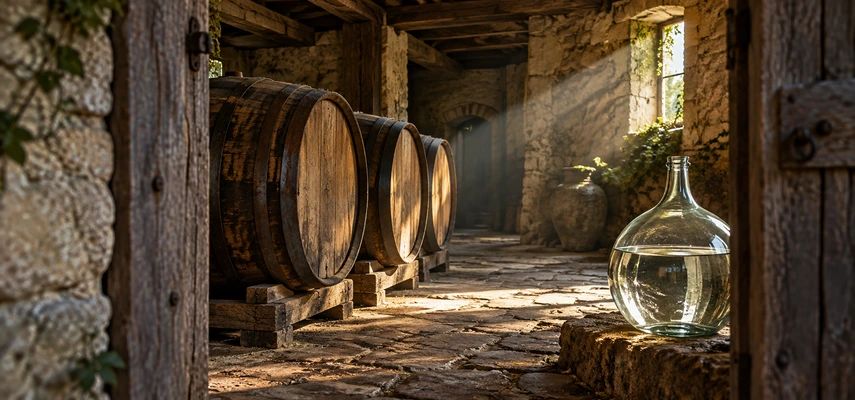
For wood-aged Armagnac, the introductory minimum is one year of qualifying oak maturation. Wood can contribute colour and aroma while the spirit develops over time. Producers manage the activity and history of their casks, sometimes moving spirits between vessels to shape the balance rather than simply leaving every batch untouched until a birthday arrives.
Blanche Armagnac follows a different route. It remains in inert vessels from the end of distillation, with at least three months of maturation before the relevant approval for sale. This preserves a colourless presentation and a different emphasis on the fruit-derived distillate. It is not an ordinary aged Armagnac that has merely forgotten to turn brown.
The BNIA’s Blanche guidance describes that inert-vessel period and product controls. Time still allows handling and development, but it doesn’t provide the same wood extraction as oak. “Unwooded” and “unconsidered” are very different descriptions; a clear spirit can involve deliberate selection and preparation.
For study, compare the two vessel choices through their functions. Oak can add a wood-derived layer while changing the liquid. An inert vessel avoids that same contribution and supports another style objective. Neither route automatically establishes superior quality. The relevant question is whether the producer achieves the intended presentation under its rules.
Read VS and VSOP by their own minimums
VS, also called three stars, requires the youngest component to have at least one year of qualifying wood ageing. VSOP requires at least four years. Those thresholds concern the youngest spirit in a blend, not an average raised by including a small quantity of much older material.
Notice the difference from Cognac VS, whose minimum is two years. Shared lettering does not guarantee identical requirements across categories. A compact comparison is useful: Armagnac VS one, Cognac VS two, both VSOP four. Attach the category name to every number so that a familiar abbreviation doesn’t quietly import the wrong rule.
A hypothetical blend of Armagnacs aged four, seven and twelve years meets the VSOP age minimum. It doesn’t become twelve years old because the oldest component is twelve. This youngest-component principle helps prevent one of the most common mistakes in interpreting blended-spirit ages.
XO, Hors d’âge and vintage answer different questions
Current XO Armagnac requires at least ten years of maturation for the components used. Hors d’âge likewise belongs with the ten-year minimum framework. The dedicated BNIA age-category page is the relevant current reference. Older articles can retain superseded numbers, so checking the source’s date and purpose matters.
A vintage, or millésime, identifies the harvest year from which the Armagnac was made. It is not itself a statement of years spent in wood. To interpret the maturation period, consult bottling information and the authenticated production record. A vintage date on a bottle bought today doesn’t mean it remained in its cask until today.
The BNIA vintage guidance treats these spirits as expressions of an identified harvest. A vintage can still include blending of suitable components from that harvest; it need not mean one barrel or one grape variety. Vintage, single-cask and single-variety claims answer different production questions.
Vintage presentation also doesn’t abolish the rules governing maturation and sale. For study, hold the two ideas together: the year identifies origin in time, while qualifying ageing describes what happened afterwards. The date gives an important coordinate without documenting every subsequent movement of the liquid.
Blending and finishing complete the style
Armagnac may be blended across appropriate subregions, ages and oak histories to reach a desired profile. Blending can support consistency or build complexity. A producer offering a vintage presentation and another offering an age-category blend are organising their material differently, rather than demonstrating two levels of seriousness.
Permitted finishing options can include adjustments involving sweetness and caramel colour within the category’s controls. Don’t turn that into unrestricted flavouring permission. Nor should you assume every producer makes every permitted adjustment. Distinguish what the rules allow, what a named producer documents and what a glass appears to suggest.
When evaluating an aged example, fruit-like, spicy, woody or developed aromas may offer useful descriptors. They remain observations rather than a certificate of grape variety, harvest year or exact cask age. Compare the same dimensions across Blanche, younger and older examples, allowing each presentation to express a different production aim.
What to remember
Build the Armagnac map around Gascon grapes, typically short continuous distillation, and a choice of maturation presentation. Bas-Armagnac and Ténarèze locate origin; Blanche identifies the inert-vessel route; VS, VSOP, XO and Hors d’âge organise age assurances; vintage identifies a harvest. Keeping those jobs separate gives the category its own clear identity and makes comparison with Cognac much more rewarding.
Continue your study
To compare the Cognac framework, read Cognac Explained: Ugni Blanc, Crus, Distillation, and Age Classifications. To revisit how a short column retains character, read Column Still Distillation Explained: Reflux, Rectification, and Continuous Production. To organise a controlled fruit-spirit comparison, read How to Taste and Compare Spirits: A WSET Level 2 Revision Guide.
Knowledge check: 10 original practice questions
Independent TFE questions, not official WSET examination items. Choose one answer per question; explanations follow separately.
1. Which distillation method is typical of Armagnac?
- Distillation of dry grain before fermentation
- Short continuous column distillation
- Mandatory neutral distillation to 96% ABV
- Mandatory triple pot distillation
2. Which alternative distillation route is permitted but uncommon?
- Distilling unfermented grape juice into ethanol
- Double pot distillation
- Only freezing wine
- No distillation at all
3. What is the Armagnac VS minimum discussed?
- One year
- Four years
- Ten years
- Two years
4. Which current minimum applies to XO Armagnac?
- Four years
- Six years
- Two years
- Ten years
5. What minimum inert maturation period is specified for Blanche before approval for sale?
- Ten years
- Three months
- Three days
- One week
6. Which grape is especially associated with Armagnac alongside Ugni Blanc and Folle Blanche?
- Pinotage as the required sole grape
- Corn
- Blue agave
- Baco Blanc
7. What does a vintage Armagnac date identify?
- Automatically the year of bottling
- The harvest year
- The date the producer began trading
- A guaranteed single barrel
8. What do Bas-Armagnac and Ténarèze identify?
- Geographical subregions
- Yeast strains
- Two mandatory barrel sizes
- Minimum age bands
9. Which minimum applies to VSOP Armagnac?
- One year
- Two years
- Eight years
- Four years
10. What vessel route distinguishes Blanche Armagnac?
- Maturation only in bottle after sale
- Compulsory long new-oak ageing
- Inert storage from the end of distillation
- No controlled handling after distillation
Answers and explanations
1. B — Short continuous column distillation. The traditional alambic armagnacais is a short continuous still capable of characterful spirit. Mapping: LO2.
2. B — Double pot distillation. Double pot distillation is a recognised but relatively rare alternative to the typical continuous method. Mapping: LO2.
3. A — One year. Armagnac VS has a one-year minimum, which differs from the two-year Cognac VS minimum. Mapping: LO2.
4. D — Ten years. Current dedicated BNIA guidance states ten years; old articles may still retain the earlier six-year figure. Mapping: LO2.
5. B — Three months. BNIA specifies at least three months of inert-vessel maturation before the relevant approval process. Mapping: LO2.
6. D — Baco Blanc. Baco Blanc is one of the key prescribed Armagnac grapes, alongside Ugni Blanc and Folle Blanche. Mapping: LO2.
7. B — The harvest year. The vintage identifies the harvest; bottling and maturation information are separate considerations. Mapping: LO2.
8. A — Geographical subregions. These are subregional origin names within the Armagnac production area, separate from age classifications. Mapping: LO2.
9. D — Four years. VSOP requires the youngest component to have at least four years of qualifying maturation. Mapping: LO2.
10. C — Inert storage from the end of distillation. Blanche remains in inert vessels, preserving a colourless style rather than acquiring the same oak contribution. Mapping: LO2.












