










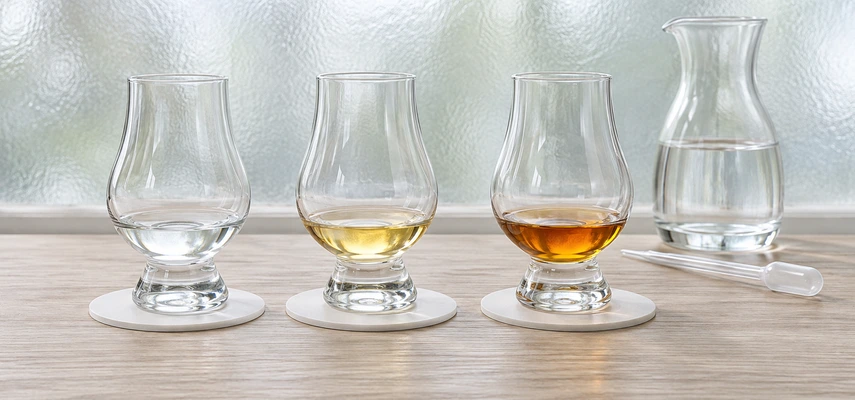

The most useful tasting note often begins with a question. Why does this clear spirit smell of fruit while that one seems restrained? Why does an older sample feel more woody without necessarily feeling more harmonious? A comparison turns a glass into evidence, although it never turns your nose into a laboratory certificate.
To compare spirits for Level 2 revision, connect observations to the production choices you have studied. Keep a distinction between what you perceive, what the producer confirms and what you are inferring. That small discipline makes notes more useful than a spectacular list of aromas with no explanation.
The official qualification specification recommends tasting examples to support learning. The examination itself is multiple choice: there is no assessed practical tasting or written tasting paper. You do not need to purchase or consume every example below to understand the course. Guided teaching, shared comparisons and production records can all support revision.
Compare spirits with one clear question at a time
A huge flight mixes too many variables. Start with two examples and a focused question: different raw materials, different distillation choices, different maturation or different botanical recipes. When possible, hold other factors reasonably steady. Two ages from one producer can isolate maturation more effectively than two unrelated blends with different strengths and cask histories.
Use matching clean glasses and modest samples. Strong perfume, food aromas and a recently washed glass can obscure what you are trying to notice. Record bottling strength and any disclosed production information before drawing comparisons. If one sample is much stronger, distinguish alcohol impact from flavour concentration.
Tasting is optional, and swallowing is unnecessary. Spitting and taking breaks help keep a session about observation. Never treat a study list as a drinking target. A comparison can be discussed from labels and producer information when tasting is unsuitable or unavailable.
Look first, then ask what appearance can establish
Describe clarity and colour before supplying a cause. A clear appearance does not prove youth or the absence of oak: filtration may remove colour. Amber does not prove a particular age, since cask extraction and permitted colouring can influence the result. Appearance supplies a clue rather than a complete production history.
An aniseed spirit becoming cloudy after water is added is a useful exception to the idea that every haze signals a fault. Anethole-rich oils can form light-scattering droplets when their solubility falls. Note the change, then explain the mechanism instead of calling the sample defective simply because it is no longer transparent.
Likewise, legs on a glass are not a quality score. Alcohol, surface tension and dissolved components affect liquid movement. They cannot reliably identify an age statement, region or price. Your revision notes become stronger when they include the limits of an observation as well as the observation itself.
Move from aroma to a reasoned production explanation
Approach the glass gently rather than taking one forceful inhalation. Alcohol can dominate at close range. Describe a few clear aroma impressions and their intensity, then ask which broad production stage could explain them. Grain, fruit, cane, agave, fermentation, smoke, botanicals and wood provide useful causal starting points.
A ripe-fruit impression in rum does not prove fruit was added. Fermentation and maturation can generate compounds that remind us of fruit. A vanilla impression in whisky can come from oak rather than a vanilla pod. Separate the sensory resemblance from the ingredient claim: they answer different questions.
If you add water, note that you did so and use a measured, small addition. Changes in alcohol concentration alter volatility and perception; an aroma may become easier or harder to notice. Water is an investigative tool, not a rule that every sample improves with dilution or that the new impression reveals its entire recipe.
Taste sweetness, texture and finish separately
Sweet-smelling vanilla and actual sweetness are different observations. Sugar tastes sweet; aromas can suggest sweet foods even when little sugar is present. Alcohol, acidity and bitter ingredients also influence balance. State what seems sweet on the palate rather than automatically converting every dessert-like smell into an added-sugar claim.
Texture concerns how the liquid feels: weight, smoothness, viscosity or drying sensations may all matter. These impressions interact with alcohol strength and other components. A soft texture does not establish low strength, and a forceful sample is not automatically more complex. Compare like with like wherever the available examples allow.
The finish is what remains after the liquid leaves the mouth. Consider persistence and the character of the remaining sensations separately. A lasting, integrated sequence of flavours differs from a long, harsh alcohol sensation. Length alone cannot settle quality, just as intensity alone cannot settle balance.
Fruit spirits: compare maturation without losing the fruit
For Cognac, the recommended teaching range includes VS, VSOP and XO, ideally from the same producer. Compare the fruit-and-floral emphasis with wood, spice and developed notes, then use the youngest component’s category minimum to interpret the label. The classification does not disclose the exact age of every component.
Alongside those samples, compare at least two from Armagnac, Grappa and Pisco when available. Cognac and Armagnac invite questions about distillation and maturation, while aromatic grape Pisco and pomace-based Grappa bring different starting material and processing questions. A Calvados comparison adds apple or pear character to this grape-based discussion.
Do not conclude that every Armagnac is rustic, every Pisco is intensely floral or every Grappa is fiery. Specific raw materials, stills, cuts, strength and maturation can change the result. Useful comparisons explain a sampled contrast while leaving room for the range inside each category.
Whiskies: change the production question between flights
Tennessee whiskey, Bourbon and rye provide a useful comparison of mash composition and production choices. Tennessee charcoal mellowing is a process question; the word does not mean that the whiskey must taste smoky. Corn and rye proportions can influence style, but the barrel and distillation choices still matter.
Compare two single malt Scotches and a blended Scotch. A peated and an unpeated malt can focus attention on smoke from drying malt with peat, without turning peat into a universal Scotch ingredient. The blend introduces the contribution of grain whisky and the blender’s choices rather than a lower-quality category by definition.
Broaden the comparison with examples of Bourbon, single malt, Irish, Canadian and Japanese whisky as teaching access permits. Ask what is confirmed about raw materials, still type and wood. Nationality alone does not prove peat use, triple distillation, a particular mash bill or a specific flavour intensity.
Cane spirits and agave: keep colour separate from character
The recommended rum range is deliberately varied: a light, colourless molasses rum; a more characterful colourless rum; two aged rums, one showing developed rancio character; and an inexpensive, heavily coloured example. Together they challenge the shortcut that darker always means older, richer or better.
Rancio describes a family of developed, often nutty, savoury or dried-fruit-like impressions associated with extended ageing and oxidation. It is not a guarantee attached to every old spirit, nor a single flavour ingredient. Compare the actual aged examples, explaining wood and oxidation separately from any disclosed colouring or sweetening.
For agave, compare a 100% agave blanco Tequila with a 100% agave reposado or añejo, and a blanco Artesanal Mezcal. Consider cooked-agave character, any smoke, and wood influence where applicable. Mezcal need not be uniformly smoky; maturation is not required for agave character to be complex.
Neutrality, botanicals and wine need different comparisons
Place a relatively neutral vodka alongside two more characterful vodkas. Ask what remains from the raw material and processing rather than expecting the potato, wheat or rye label to predict an exact flavour. Restrained aroma is a deliberate style possibility, not evidence of an unfinished product.
Compare London Dry gin with a contemporary style or Old Tom. Identify the role of juniper, the botanical balance and any evident sweetness. Old Tom is not one universal sugar formula, and London Dry is a production designation rather than a requirement to manufacture the gin in London.
The teaching range also includes two liqueurs sharing a principal flavouring, plus two examples drawn from a further gin, an aniseed spirit or a bitter spirit, and one aromatised wine such as vermouth, quinquina, chinato or Americano. Shared orange flavour, for example, does not imply an identical base, extraction method or sugar level.
Compare a liqueur with an aromatised wine by identifying the foundation first. A wine base contributes a different framework from a spirit base, even when both products contain sugar and botanicals. The comparison is about ingredients and structure rather than declaring one family more sophisticated.
Turn observations into a useful quality judgement
Write a short conclusion supported by what you observed: whether alcohol and other components feel integrated, whether flavours remain clear and varied, and what persists on the finish. A sample can be intentionally neutral or simple and still serve its style well. Preference and quality are related questions, not interchangeable scores.
The official Level 2 tasting resource provides WSET’s current terminology and framework. Consult that source directly; this guide does not reproduce its chart. For your own revision, a short original note connecting observation, plausible cause and uncertainty is more useful than copying a scale without understanding it.
What to remember
Compare spirits to test a production question. Describe the evidence before proposing its cause, distinguish aroma from ingredients, and keep colour separate from age. Review strength, sweetness, texture and finish as connected but distinct observations.
Use the recommended comparisons as learning opportunities, not compulsory purchases or drinking targets. The examination assesses knowledge through multiple-choice questions. Tasting helps that knowledge become memorable when you can explain why the samples differ.
Continue your study
To revisit the causes of maturation differences, read How Spirits Develop Flavor: Oak Maturation, Blending, Filtration, and Finishing. To separate neat-spirit comparisons from cocktail structures, read The Four Cocktail Families Explained: Spirit-Forward, Short Sour, Highball, and Long Sour. To test the production knowledge with full practice papers, read WSET Level 2 Spirits Exam: Complete Revision Guide and Practice Examinations.
Knowledge check: 10 original practice questions
Independent TFE questions, not official WSET examination items. Choose one answer per question; explanations follow separately.
1. Why compare two colourless rums with different aroma intensity?
- Colour establishes whether the rum is molasses-based
- Clear rum cannot contain aroma compounds
- Colourless appearance can coexist with different congener profiles
- The stronger aroma proves longer oak ageing
2. A vanilla aroma is noticed in an unsweetened whisky. What is a sound conclusion?
- Every vanilla-smelling spirit is a liqueur
- Oak-derived aroma can suggest sweetness without proving sugar addition
- The aroma establishes the exact sugar concentration
- Vanilla aroma always proves vanilla extract was added
3. What distinguishes an aromatised wine comparison from a typical spirit-based liqueur comparison?
- Liqueurs always contain no sugar
- Both must have identical acidity
- Wine-based drinks never contain botanicals
- The wine foundation needs to be considered
4. A water addition makes an aniseed spirit cloudy. What is the relevant mechanism?
- All ethanol suddenly freezes
- The spirit necessarily contains a microbial fault
- The water creates oak pigments
- Anise-derived oils become less soluble and form droplets
5. Which evidence best supports a claim about a sampled vodka’s raw material?
- The length of the bottle neck
- The absence of colour alone
- The producer’s verified production information
- An assumption that smooth means wheat
6. How is tasting assessed in the Level 2 Spirits examination described here?
- Candidates must buy all recommended samples
- Every tasting note earns five official marks
- Each candidate must identify ten blind samples
- There is no assessed practical tasting component
7. Which comparison targets peat-derived smoke most directly?
- A gin and a sugar syrup
- Two sweet vermouths differing in colour
- Peated and unpeated single malt Scotch examples
- Two neutral vodkas with matching strength
8. What makes a useful comparison note?
- Observed differences linked to plausible causes with uncertainty stated
- A long aroma list without any production connection
- A price estimate used as the quality explanation
- An exact recipe inferred solely from smell
9. Which comparison most directly explores maturation within a producer’s Cognac range?
- VS, VSOP and XO from that producer
- Three bottles selected only for identical colour
- One Cognac and two grapefruit mixers
- Three unrelated gins at different strengths
10. What should accompany a conclusion that a spirit has a long finish?
- A description of the character and balance of what persists
- A claim that all lingering sensations are desirable
- An automatic maximum quality grade
- An exact age derived from persistence
Answers and explanations
1. C — Colourless appearance can coexist with different congener profiles. Distillation and other choices can create restrained or characterful clear styles; colour alone does not establish aromatic intensity. Mapping: LO2.
2. B — Oak-derived aroma can suggest sweetness without proving sugar addition. An aroma resembling sweet food and actual sugar sweetness are different observations; oak can supply vanilla-like compounds. Mapping: LO2.
3. D — The wine foundation needs to be considered. Wine contributes a different foundation, including its own flavour and acidity, even where both products contain botanicals and sugar. Mapping: LO3.
4. D — Anise-derived oils become less soluble and form droplets. Reduced oil solubility can form light-scattering droplets, so louching is an expected physical effect in suitable aniseed spirits. Mapping: LO3.
5. C — The producer’s verified production information. Sensory impressions can support discussion, but verified production information is stronger evidence for a specific raw-material claim. Mapping: LO2.
6. D — There is no assessed practical tasting component. The qualification uses a multiple-choice examination; recommended tasting supports learning rather than constituting a practical examination. Mapping: LO1.
7. C — Peated and unpeated single malt Scotch examples. A controlled malt comparison can connect peat smoke during drying with sensory differences, without assuming all Scotch is peated. Mapping: LO2.
8. A — Observed differences linked to plausible causes with uncertainty stated. A useful note separates perception, confirmed production facts and inference, making the comparison explanatory rather than speculative. Mapping: LO2.
9. A — VS, VSOP and XO from that producer. Using the same producer reduces some recipe variation while different age categories invite a focused maturation comparison. Mapping: LO2.
10. A — A description of the character and balance of what persists. Persistence must be interpreted alongside the nature of the remaining flavours and sensations, rather than treated as quality by itself. Mapping: LO2.












