










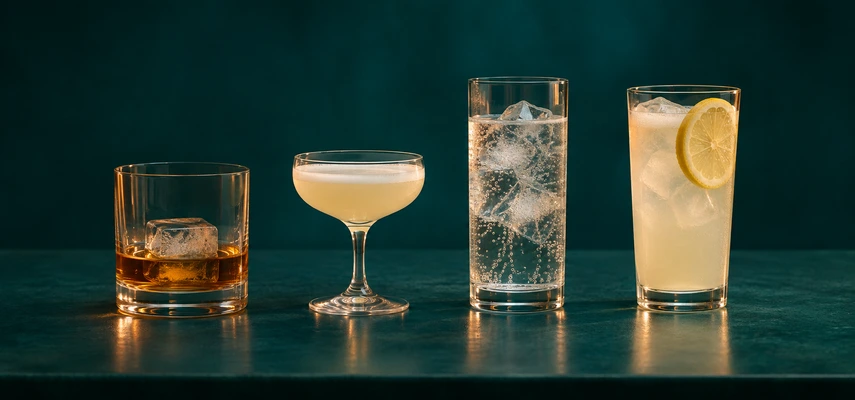

A list of nineteen cocktails looks like a memory test until the relationships become visible. Change the base in a spirit-citrus-sweet structure and several familiar names appear. Add a lengthening ingredient and the same balancing ideas begin to explain another group of drinks.
The four cocktail families in this Level 2 study framework are spirit-forward, short sour, highball and long sour. They are teaching categories for recognising structure. Cocktail writers and bartenders sometimes organise individual drinks differently, so use the syllabus groupings for this revision task.
The tables below cover all nineteen required examples. They describe key ingredients and functions, not compulsory measured recipes. Exact formulations can vary; the production lesson is to understand what each ingredient is doing and why the drink belongs in its study family.
Cocktail families organise balance, not just glassware
A coupe does not make every drink a short sour, and a tall glass does not turn every recipe into the same highball. Look at the composition: alcoholic foundation, sweet or bitter counterpart, citrus where relevant, dilution and any lengthening component.
Some ingredients perform several roles. Orange liqueur contributes sweetness and alcohol, sweet vermouth contributes wine character and botanical balance, and grapefruit soda provides dilution alongside sweetness and acidity. Those overlaps make structural understanding more reliable than memorising one role per bottle.
The International Bartenders Association’s recipes offer concrete reference formulations. Their ingredient records support the examples here; the four-family arrangement follows the WSET syllabus rather than a claim that every bartender uses one universal classification.
Spirit-forward: the alcoholic ingredients remain central
The spirit-forward family generally uses relatively little non-alcoholic lengthening. Dilution commonly comes through mixing with ice rather than a large measure of soda or juice. Sweetness, bitterness and aromatic ingredients balance the alcoholic foundation without making a citrus sour structure compulsory.
Spirit-forward does not mean undiluted, unsweetened or always made from one spirit. A Negroni combines several alcoholic ingredients, and a Manhattan includes a wine-based component. The phrase identifies the overall emphasis rather than banning modifiers.
| Example | Key structure | What to understand |
|---|---|---|
| Old Fashioned | Bourbon or rye, sugar, aromatic bitters and water | Sweetening and bitter seasoning support the whiskey; ice contributes dilution. |
| Sazerac | Cognac or rye tradition, sugar, aromatic bitters and an absinthe rinse | The rinse adds anise aroma without becoming a long mixer. |
| Rusty Nail | Scotch with Drambuie, a whisky-based honey-and-herb liqueur | The liqueur adds sweetness, character and alcohol rather than citrus acidity. |
| Manhattan | Whiskey, sweet red vermouth and aromatic bitters | Vermouth contributes wine-based sweetness and botanicals alongside the base. |
| Martini | Gin and dry vermouth in the classic gin version | The vermouth and dilution shape a restrained spirit-and-wine structure. |
| Negroni | Gin, bitter aperitif and sweet red vermouth | Bitter and sweet components also contribute alcohol; no citrus juice is needed. |
The IBA Sazerac uses Cognac and acknowledges rye in its discussion. Other established recipes use rye. For revision, recognise both rather than declaring that only one version can exist.
Likewise, Martini commonly means the gin-and-dry-vermouth reference here, while vodka variants exist. The existence of a variant does not make the family structure meaningless. State which version you are explaining before analysing its ingredients.
Short sour: spirit, sourness and sweetness
Short sours organise the relationship between a spirit base, citrus acidity and a sweet counterpart without a large lengthening component. The sweet contribution can come from plain sugar or syrup, a fruit syrup or a liqueur. It need not be a separate bottle labelled sweetener.
Ice in preparation chills and dilutes the mixture. Egg white can add foam and texture in some recipes, but is not the defining feature of every sour. A Daiquiri remains a sour without requiring an egg component.
| Example | Key structure | What to understand |
|---|---|---|
| Pisco Sour | Pisco, citrus, sugar or syrup; egg white in a familiar version | Pisco supplies the base; citrus and sweetness form the main taste relationship. |
| Whiskey Sour | Whiskey, lemon and sugar or syrup; egg white optional | The foam choice changes texture without replacing the sour foundation. |
| Daiquiri | Rum, lime and sugar | A simple example of base, sour and sweet, with dilution from preparation. |
| Sidecar | Cognac, orange liqueur and lemon | The liqueur provides sweetness and orange aroma as well as alcohol. |
| Margarita | Tequila, orange liqueur and lime | Agave character, citrus acidity and liqueur sweetness form a related structure. |
| Clover Club | Gin, raspberry syrup, lemon and egg white in the reference version | Fruit syrup supplies sweet flavour; egg white supplies a separate texture contribution. |
Compare the Sidecar and Margarita first through their similarities. Both use a spirit, orange liqueur and citrus. Then identify the changes: Cognac and lemon versus tequila and lime in these reference versions. A family relationship explains the resemblance without making the drinks identical.
The IBA Pisco Sour uses lemon, while other regional recipes use locally named citrus or lime expressions. The useful exam connection is pisco, citrus and sweetening, with the relevant variant identified when discussing finer details.
Highball: a base lengthened by a mixer
Highballs combine a spirit with a substantial lengthening mixer. That mixer contributes water and flavour, and may also add sweetness, bitterness, acidity or carbonation. The family is not limited to plain soda and does not require every example to have bubbles.
The simple appearance can conceal important ingredient roles. A sweet carbonated mixer changes both sides of the balance model. Juice can supply sourness as well as dilution. Use the actual composition rather than calling the mixer only weak.
| Example | Key structure | What to understand |
|---|---|---|
| Cuba Libre | Rum, cola and lime | Cola lengthens and sweetens; lime adds acidity, yet the syllabus groups it as a highball. |
| Greyhound | Vodka or gin with grapefruit juice | Juice supplies the length and flavour; carbonation is not essential. |
| Horse’s Neck | Brandy/Cognac and ginger ale, often bitters, with lemon peel | Ginger ale lengthens; the long peel is an aromatic garnish rather than a measure of lemon juice. |
LCBO’s Greyhound supplies a vodka-and-grapefruit example. Gin versions are also established. The spirit variation does not remove the basic spirit-plus-juice structure.
The IBA Horse’s Neck uses Cognac and ginger ale. Recognising the mixer is more useful than assuming every long brown drink contains whiskey and cola. Ingredient identity still matters within a broad family.
Long sour: extend the sour relationship
Long sours keep a sour-sweet relationship while adding a substantial lengthening element. Soda is familiar, but the lengthener can contribute more than water. Sparkling wine, for example, brings alcohol and acidity as well as volume and bubbles.
This is why the family cannot be understood simply as a short sour in a taller glass. The recipe’s proportions and lengthening ingredient need to support the intended result. Adding a large arbitrary quantity of any mixer would not necessarily preserve the balance.
| Example | Key structure | What to understand |
|---|---|---|
| Tom Collins | Gin, lemon, sugar or syrup and soda | A gin sour structure lengthened with soda; Old Tom appears in the IBA note. |
| Paloma | Tequila, grapefruit soda and lime in a familiar version | The soda supplies several roles; the syllabus places it among long sours. |
| French 75 | Gin, lemon, sugar or syrup and Champagne | Sparkling wine lengthens while also contributing alcohol and acidity. |
| Mojito | Rum, lime, sugar, mint and soda | Mint adds aroma to a lengthened rum sour structure. |
The IBA John Collins page includes the note to use Old Tom gin for a Tom Collins. Many contemporary Tom Collins recipes use other gins. Learn the gin-lemon-sugar-soda structure while keeping that historical-style variation visible.
Paloma is often described as a highball in other cocktail writing because it is built with a long mixer. Here its placement follows the prescribed Level 2 long-sour grouping. The classification is a study framework, not a reason to pretend other descriptions do not exist.
Compare across families to make the names stick
Compare a Daiquiri and Mojito. Both use rum, lime and sugar; the Mojito adds mint and soda and follows a long-sour structure. The comparison explains the new ingredient roles rather than merely memorising a different name.
Compare a Martini and Tom Collins. Gin can be central to both, but dry vermouth and restrained dilution support one structure, while lemon, sugar and soda support another. Base spirit alone does not determine cocktail family.
Compare a Negroni and Margarita. Each combines alcoholic ingredients with a balancing counterpart, but the Negroni’s bitter-sweet structure differs from the Margarita’s citrus-sour relationship. Shared alcohol does not make bitterness and acidity interchangeable.
Then compare Cuba Libre and Paloma within the syllabus map. Both use a spirit and a long flavoured mixer, but they are assigned to different study families. Learn the named examples alongside the general patterns, rather than replacing the prescribed list with a personal classification system.
Revision without mixing nineteen drinks
Use a four-column card: name, base, balancing ingredients and lengthener. Cover one column and reconstruct it from the others. This tests ingredient roles more effectively than repeatedly reading a drinks menu.
You do not need to prepare or drink cocktails to demonstrate this knowledge, and practical bartending is not the examination format. A written ingredient map can show why a liqueur is not the sour component, why Champagne is not alcohol-free dilution and why a garnish is not necessarily a main balancing ingredient.
What to remember
The six spirit-forward examples, six short sours, three highballs and four long sours make nineteen required references. Learn both their syllabus groupings and their main ingredient relationships. Formal recipes and common variants should be identified rather than silently mixed together.
Use base, bitter or sour counterpart, sweet contribution and dilution to explain each drink. Once those roles are clear, the family names become a useful map instead of another list to memorise.
Continue your study
To revisit the two balance scales, read Cocktail Balance Explained: Strong vs. Weak, Sweet vs. Sour and Bitter. To understand the botanical base in gin cocktails, read Gin Explained: Juniper, Botanicals, London Dry, Distilled Gin, and Old Tom. To compare vermouth with other modifiers, read Aromatised Wines Explained: Vermouth, Quinquina, Chinato, and Americano.
Knowledge check: 10 original practice questions
Independent TFE questions, not official WSET examination items. Choose one answer per question; explanations follow separately.
1. Which is a short sour in the prescribed list?
- Negroni
- Rusty Nail
- Clover Club
- Horse’s Neck
2. How does a Mojito relate to a Daiquiri structurally?
- It contains no lime
- It extends a rum/lime/sweet relationship with mint and soda
- Both must be spirit-forward
- It removes rum and uses whisky
3. Which group contains only spirit-forward syllabus examples?
- Greyhound, Margarita and Clover Club
- Tom Collins, French 75 and Cuba Libre
- Daiquiri, Mojito and Paloma
- Old Fashioned, Manhattan and Negroni
4. Which claim about highballs is correct?
- They contain no dilution
- Every example is a short sour
- They need not all be carbonated
- Every example is only spirit and soda
5. What distinguishes a Sidecar from the Margarita reference here?
- Only the Margarita contains any alcohol
- The Sidecar is a highball
- Cognac/lemon versus tequila/lime
- Both must have identical bases
6. What lengthens the Horse’s Neck reference?
- Ginger ale
- Absinthe rinse
- Cream
- Orange liqueur
7. Where is Paloma placed for this syllabus revision?
- Short sour
- Long sour
- Spirit-forward
- Unclassified because other writers differ
8. What sweet modifier is central to a Rusty Nail?
- Grapefruit soda
- Lime juice
- Drambuie
- Dry vermouth only
9. Which ingredient makes the French 75 lengthener unusual?
- It is a concentrated cocktail bitter
- Champagne also contributes alcohol
- Champagne is pure water
- It contains no acidity
10. Which revision method best tests understanding?
- Assume every garnish supplies the main acidity
- Ignore all named examples
- Reconstruct base, balancing ingredients and lengthener from the name
- Learn only glass shapes
Answers and explanations
1. C — Clover Club. Gin, raspberry sweetness and lemon support the Clover Club’s short-sour structure; egg white changes texture. Mapping: LO4.
2. B — It extends a rum/lime/sweet relationship with mint and soda. The comparison links familiar base and balance roles while identifying the long-sour additions. Mapping: LO4.
3. D — Old Fashioned, Manhattan and Negroni. The three named answers centre on spirit-forward structures rather than short sour or long-mixer examples. Mapping: LO4.
4. C — They need not all be carbonated. The Greyhound is a spirit-and-juice example, showing carbonation is not essential to the study family. Mapping: LO4.
5. C — Cognac/lemon versus tequila/lime. Both share an orange-liqueur sour relationship while their base spirit and citrus differ. Mapping: LO4.
6. A — Ginger ale. Ginger ale provides the substantial mixer; lemon peel is an aromatic garnish rather than the main lengthener. Mapping: LO4.
7. B — Long sour. The prescribed grouping is long sour even though other cocktail taxonomies may call it a highball. Mapping: LO4.
8. C — Drambuie. The Scotch-and-Drambuie structure uses a whisky-based liqueur rather than a citrus sour component. Mapping: LO4.
9. B — Champagne also contributes alcohol. Sparkling wine lengthens while adding alcohol and acidity, so it performs several roles. Mapping: LO4.
10. C — Reconstruct base, balancing ingredients and lengthener from the name. Ingredient-role mapping explains the drink while avoiding assumptions based solely on appearance. Mapping: LO4.












