











Bourbon has enough numbers on its label and in its production rules to look like a maths test in a bottle. The trick is to ask what each number measures. A grain percentage, distillation strength, barrel-entry strength and age statement describe different stages. Bourbon explained becomes much simpler once those coordinates stop competing for the same job.
The category also leaves room for variation. Two compliant Bourbons can use different grain proportions, yeast, warehouse locations and blending decisions. Meeting a legal definition gives them a shared framework; it doesn’t assign every producer an identical recipe or promise an identical flavour.
This lesson follows the corn-led mash into new charred oak, then decodes the main labels. Tennessee and rye whiskey receive their own lesson next. Keeping those categories separate lets us compare them without treating every American whiskey as a slightly different spelling of Bourbon.
Bourbon explained through its United States identity
Bourbon must be distilled and aged in the USA. Kentucky is its major centre of production, but the category is not restricted to Kentucky. A qualifying Bourbon made elsewhere in the United States does not need to cross a state border to become legitimate. Country and state claims should be read separately.
The fermented grain mash bill must contain at least 51% corn. The remaining grain portion may include rye, wheat and barley, with malted barley often supplying useful enzymes. This percentage concerns the grain recipe, not the bottled alcohol level or a requirement that 51% of the final liquid physically consist of corn juice.
The current federal whisky standard supplies the category framework. A compliant spirit must satisfy the requirements together. Corn alone is not enough: an all-corn distillate produced or stored outside the relevant conditions cannot simply borrow the Bourbon name because one ingredient looks familiar.
The mash bill changes the starting material
A producer can choose a corn proportion above the minimum and decide how to organise the other grains. A rye-containing recipe and a wheat-containing recipe offer different processing and flavour possibilities. Common descriptions of more spice or softness can be helpful tendencies, but the finished result still depends on yeast, still operation and wood.
Imagine two hypothetical mash bills: both exceed the corn minimum, while one uses rye as a secondary grain and the other uses wheat. They share the legal corn-led structure without becoming identical recipes. To explain a difference between their bottled spirits, compare the other production variables before assigning every sensory observation to that one grain substitution.
Mashing and cooking prepare suitable sugars for fermentation. The producer isn’t distilling dry grain into alcohol. Enzymatic conversion supplies fermentable material, and yeast creates ethanol in the alcoholic mash. The general mechanism was covered in the previous lesson; Bourbon gives it a particular grain recipe and regulated destination.
Yeast selection and sour mash are process choices
Selected yeast strains can influence fermentation performance and the congener mixture available for distillation. The grain bill is therefore not the only recipe decision. Two producers using the same grain proportions could still make different choices about fermentation, and the later spirit need not have the same aromatic balance.
Sour mash refers to using a portion of suitable spent stillage from an earlier distillation in preparing a subsequent mash. It helps establish fermentation conditions and process consistency. The term does not promise a sour-tasting bottle, nor does it mean the distillery intentionally allows every batch to spoil.
Sour mash is a common production practice rather than the definition of Bourbon itself. A distiller’s explanation of backset also clarifies that spent material from distillation is not a source of live yeast. Keep its function separate from the legal grain and wood requirements. If a label uses it, ask what the practice does during production; don’t interpret it as an instruction to describe the finished whiskey as acidic.
Distillation and barrel entry have separate limits
Bourbon is distilled at no more than 80% ABV, or 160 US proof. This limits the degree of concentration and helps retain characteristics associated with the fermented grain base. It is not the required bottling strength. A distillation limit tells you something about production before the spirit enters its maturation stage.
The spirit enters the required wood at no more than 62.5% ABV, or 125 proof. That is another stage-specific maximum. The TTB’s Bourbon classification example sets out both limits alongside the corn and wood requirements. Memorise them as labelled pairs, rather than four disconnected numbers.
For a hypothetical check, a spirit distilled at 75% ABV could meet the distillation ceiling, while an entry strength above 62.5% would still fail the separate barrel-entry condition. Satisfying the first maximum does not cancel the next one. Compliance is a sequence of requirements, not a choice of whichever number looks easiest.
US proof is twice the ABV percentage. A 90-proof Bourbon is 45% ABV; a 100-proof one is 50%. The minimum bottled whisky strength under the federal framework is 40% ABV, or 80 proof. Always identify whether a proof number concerns distillation, entry or bottling before converting it into a style explanation.
New charred oak is a central production rule
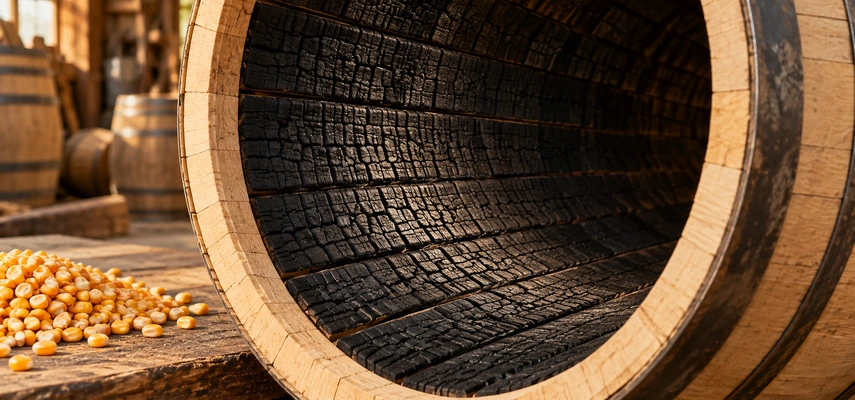
Bourbon is stored in new charred oak barrels or the specified containers. “New” means this is not simply a previously used Bourbon cask being refilled for another Bourbon batch. “Charred” describes treatment of the inner wood surface. These conditions distinguish its starting wood resources from the often-used casks familiar in Scotch maturation.
The wood can supply colour and aromas while reactions and evaporation develop the spirit. Char treatment changes the inner surface and the conditions through which spirit interacts with wood. Vanilla, toast, caramel-like and spice associations can help describe examples, but they are not proof that those foods were added as flavourings.
Warehouse conditions matter too. Casks on different floors or in different locations can develop differently, so a producer may consider warehouse position during selection and blending. Mash bill and age also help organise the components available for a blend. This is not a promise that a higher floor always makes a better barrel; storage is an active variable rather than one uniform room.
Straight adds a minimum that Bourbon alone does not
Straight Bourbon must meet the Bourbon requirements and have at least two years of qualifying maturation. Bourbon without the straight designation does not carry that same general two-year minimum merely by using the Bourbon name. It still has to meet its required storage conditions; “no specified minimum duration” is not permission to ignore the wood requirement.
Straight does not mean single barrel. A producer can combine qualifying material while meeting the relevant blending and labelling controls. Nor does straight automatically mean bottled at cask strength, made from only one grain or more than four years old. Each of those would be a different claim requiring its own support.
An age statement concerns the youngest whisky in the relevant product, rather than its average or oldest component. Under the federal age-statement rules, whiskies under four years generally require the appropriate age information. A longer-aged component cannot quietly raise a younger component’s age through averaging.
Bottled in bond is a package of assurances
For Bourbon labelled bottled in bond, the spirit comes from the same distiller at the same distillery in the same distilling season, is stored at least four years, and is bottled at 100 proof, or 50% ABV, under the applicable bonded framework. Those conditions work together; the term isn’t simply a decorative synonym for strong whiskey.
The bottled-in-bond regulation also controls permitted treatment and proof reduction. In this context, only pure water is used for reducing proof to the prescribed bottling level. A bottle at 100 proof does not automatically qualify if it fails the origin-in-production or minimum-storage conditions.
For study, imagine a three-year-old single-season Bourbon at 100 proof. Its strength alone cannot make it bottled in bond because the four-year condition is missing. Now imagine a qualifying four-year spirit bottled at 90 proof: it misses the prescribed strength. These examples explain why one recognisable number cannot stand in for the whole designation.
Single barrel and small batch describe different selections
Single barrel communicates a selection from one barrel. Different barrels can vary, so such releases may display individual character rather than an exact batch-wide average. The phrase does not, by itself, promise a particular age or cask strength. A single-barrel Bourbon can still be adjusted to an appropriate bottling strength.
Small batch suggests a selected, limited blending run, but the phrase alone does not tell the reader a universal barrel count. Consult the producer’s actual explanation instead of inventing one. It should not be confused with the formal age and strength conditions attached to straight or bottled in bond.
Blending can aim at a consistent house profile or a particular combination of barrel characteristics. A single-barrel approach values a different presentation of variation. Neither automatically establishes higher quality. The meaningful comparison considers the intended profile, the actual liquid and what the claim verifiably promises.
What to remember
Attach every Bourbon rule to its stage: USA origin, at least 51% corn, no more than 80% ABV distillation, no more than 62.5% entry into new charred oak, and the relevant bottling conditions. Straight adds two years; bottled in bond adds its combined four-year, production-identity and 100-proof conditions. Bourbon does not permit added sugar or caramel colour as ordinary finishing ingredients. Read labels as several specific promises, then connect those promises with the choices that create style.
Continue your study
To compare Tennessee and rye requirements, read Tennessee and Rye Whiskey Explained: Production Rules and Style Differences. To revisit mash preparation, read How Whisky Is Made: Grains, Mashing, Fermentation, and Maturation. To connect new oak with maturation mechanisms, read How Spirits Develop Flavor: Oak Maturation, Blending, Filtration, and Finishing.
Knowledge check: 10 original practice questions
Independent TFE questions, not official WSET examination items. Choose one answer per question; explanations follow separately.
1. Which conditions include the required bottled-in-bond strength and minimum age?
- 100 proof and at least four years
- 125 proof and one year
- 90 proof and two years
- 80 proof and six months
2. Where can qualifying Bourbon be produced?
- Anywhere if it contains corn
- Only in Tennessee
- In the United States, including states outside Kentucky
- Only in Kentucky
3. What is the minimum corn proportion in the grain mash bill?
- 30%
- 40%
- 100%
- 51%
4. What is the maximum strength on entry into the required oak?
- 62.5% ABV or 125 proof
- 80% ABV or 160 proof
- 35% ABV or 70 proof
- 100% ABV or 200 proof
5. What minimum does straight Bourbon add?
- At least 100 proof bottling
- Two years of qualifying maturation
- No oak contact
- Exactly four years
6. Which addition is incompatible with ordinary Bourbon finishing as described?
- Qualifying Bourbon components in an allowed blend
- Suitable water for proof adjustment
- Caramel colour
- Time in required oak
7. Which wood presentation is required for Bourbon?
- New charred oak
- Only used sherry oak
- Only stainless steel
- Any previously flavoured vessel
8. Which claim does single barrel make by itself?
- The selection comes from one barrel
- The whiskey is necessarily ten years old
- The whiskey is necessarily cask strength
- The corn proportion is exactly 51%
9. What is Bourbon’s maximum distillation strength?
- 62.5% ABV or 125 proof
- 96% ABV or 192 proof
- 80% ABV or 160 proof
- 50% ABV or 100 proof
10. What does sour mash mean in this production context?
- The final bottle must taste sour
- Every batch has spoiled
- Water is prohibited at every stage
- Use of suitable spent stillage in a later mash
Answers and explanations
1. A — 100 proof and at least four years. Bottled in bond combines 100-proof bottling with four years and the other production-identity conditions. Mapping: LO2.
2. C — In the United States, including states outside Kentucky. Bourbon is a United States category; Kentucky is central but not its only permitted state. Mapping: LO2.
3. D — 51%. The grain mash bill must contain at least 51% corn, a raw-material percentage rather than bottled ABV. Mapping: LO2.
4. A — 62.5% ABV or 125 proof. The entry limit is distinct from distillation strength and must also be met. Mapping: LO2.
5. B — Two years of qualifying maturation. Straight Bourbon adds the two-year minimum while preserving the underlying Bourbon requirements. Mapping: LO2.
6. C — Caramel colour. Bourbon does not permit caramel colour or added sugar as ordinary finishing ingredients while retaining the category. Mapping: LO2.
7. A — New charred oak. New charred oak is central to Bourbon’s storage standard rather than merely an optional tasting preference. Mapping: LO2.
8. A — The selection comes from one barrel. Single barrel concerns selection source, while strength, age and grain proportions are separate claims. Mapping: LO2.
9. C — 80% ABV or 160 proof. The distillation maximum is 80% ABV; barrel entry and bottling have separate conditions. Mapping: LO2.
10. D — Use of suitable spent stillage in a later mash. Sour mash describes a production practice affecting fermentation conditions, not a required sour flavour. Mapping: LO2.












