










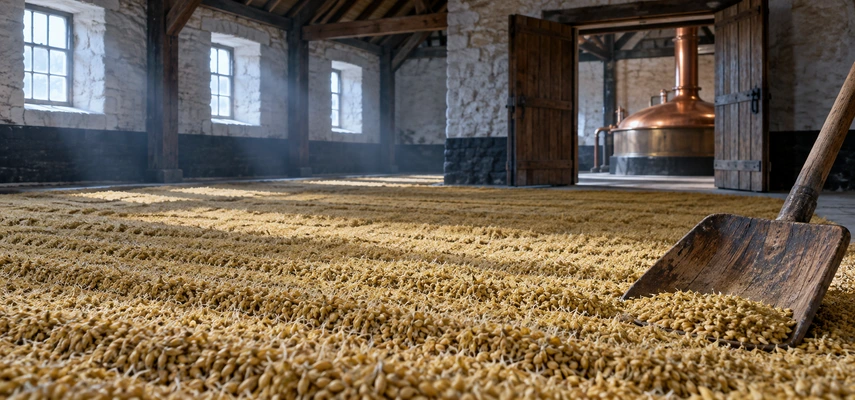

A grain of barley is a store cupboard, not a miniature bottle of whisky. Much of its useful carbohydrate is packed as starch, and yeast needs access to suitable sugars before it can make alcohol. Understanding how whisky is made begins with the surprisingly practical business of opening that cupboard.
The rest of the journey follows from it. Grain preparation makes carbohydrate available, fermentation creates an alcoholic base, distillation selects a spirit, and maturation develops it further. Change the grain or the route through those stages and you change the material available for the next decision. Whisky’s variety comes from linked choices, not a single secret ingredient.
This lesson explains the common grain-to-spirit framework. The following articles apply it to Bourbon, Tennessee and rye whiskey, Scotch and other national traditions. They will supply the specific legal thresholds. Here the priority is to understand the mechanisms well enough that those later rules have a sensible place to fit.
How whisky is made starts with a grain choice
The principal grains in this course are barley, corn, rye and wheat. Barley may be malted or unmalted, depending on the production tradition. These terms describe different preparations of a raw material, not two unrelated plants. A mash recipe can combine grains, subject to the requirements of the intended whisky category.
Different grains can contribute different processing behaviour and sensory possibilities. However, “corn means sweet” or “rye means pepper” is too crude as a complete explanation. Fermentation, distillation and wood also influence the finished spirit. A grain-associated aroma is a useful observation in an appropriate example, not proof that every compliant mash recipe must taste identical.
The proportion of each grain can matter legally as well as stylistically. Later American whiskey lessons examine minimum grain percentages; the Scotch lessons distinguish malt and grain categories. Don’t import a rule from one country into all whisky simply because the starting materials overlap. A shared ingredient doesn’t establish a shared legal definition.
Starch granules contain the potential, not ready-made ethanol
Starch granules are organised stores of larger carbohydrate molecules. Their sugar units are linked together, so the producer needs to make the starch accessible and break it down into smaller sugars. This is preparation for fermentation. It is not alcoholic fermentation itself, and it does not create a mature spirit through heat alone.
Heat and water help disrupt and dissolve accessible starch structures during processing. Enzymes then break larger carbohydrates into smaller units that can support fermentation. Glucose is a key simple sugar in the course’s conversion model; actual grain processing can yield a mixture of sugars, rather than only one chemically pure product.
Use a practical distinction in your notes: accessibility is the physical processing problem, while breakdown is the enzymatic conversion problem. The operations are linked, but naming the two jobs helps explain why merely crushing dry grain doesn’t finish the preparation. Yeast still needs a suitable liquid with usable carbohydrate.
Malting recruits the grain’s own machinery
Malting begins by encouraging barley to germinate under controlled conditions. The developing grain modifies its internal structures and makes enzyme activity available. The process is stopped by drying before the growing plant consumes too much of the stored resource. The distiller wants the useful preparation, not a field of seedlings inside the maltings.
Milling then crushes the malt into grist. Mashing brings that grist together with appropriately warm water so sugars can be produced and extracted. In malt-whisky production, the collected sugary liquid is called wort. The producer now has material that can feed yeast, rather than expecting yeast to digest a dry whole kernel directly.
Diageo’s Malts production introduction follows these operations in a Scotch malt context. That is a useful example of the mechanism, but it should not be expanded into a requirement that every whisky worldwide uses only malted barley. The legal single-malt detail belongs with its category, not with the entire grain-spirit family.
Cooking offers another route to accessible starch
Other grain processes can begin by crushing grain, mixing it with water and cooking it to make its starch more accessible. Malted barley, purchased enzymes or suitable combinations can then provide the conversion activity. The exact handling depends on the material and production system, so there isn’t one cooking schedule to memorise for every whisky.
Corn, wheat and rye can therefore enter whisky production without each grain first being malted in the same way as barley. The general requirement remains usable fermentable material. If a question asks why malt or enzymes are introduced, answer in terms of starch conversion rather than saying they are simply added “for flavour.”
Some traditions separate a wort before fermentation; others ferment a grain-containing mash. That physical difference should not obscure the shared chemical task: yeast uses available sugars to produce ethanol. Conversely, the shared fermentation mechanism should not make you assume every distillery drains and handles the material exactly like a Scotch malt mash tun.
Peat can influence malt before fermentation begins
If peat smoke is used during drying, smoke-derived compounds can become part of the malt’s character and influence the later spirit. Peat is therefore connected with a raw-material processing decision. It is not a compulsory ingredient in all whisky, nor is every smoky flavour explained by peat colouring the water supply.
The Scotch Whisky Association’s FAQ locates the familiar smoky character in peat used during barley drying. A later cask treatment can also contribute its own influences, so record the actual production account rather than treating every smoky impression as proof of one cause. The single-malt lesson develops the peat comparison more fully.
For the general framework, remember the timing. A production choice made before mashing can remain relevant after fermentation, distillation and maturation. The stages don’t live in sealed educational boxes. Each passes a changed mixture to the next, which is why a complete explanation needs the sequence rather than only the final barrel.
Fermentation builds an alcoholic base with character
Once suitable sugary liquid or mash is ready, yeast performs alcoholic fermentation. It produces ethanol, carbon dioxide and heat, together with a mixture of congeners. Strain, substrate and conditions influence that mixture. The producer’s objective is not simply to reach a number on an alcohol meter while ignoring everything that travels with the ethanol.
Glasgow Distillery’s production account shows wort moving into fermentation and the resulting wash entering distillation. Its details describe that producer’s approach, not compulsory timings for every whisky. Use examples to make the mechanism concrete while resisting the temptation to turn one distillery’s schedule into a universal law.
Compare two hypothetical fermentations made from the same grain recipe. Different yeast and conditions can give different congener balances, even before the still is involved. That doesn’t guarantee that every difference survives to the same degree in the mature bottle. It explains why the fermented base is a meaningful production variable rather than interchangeable fuel.
Distillation shapes the grain-derived starting material
Whisky can involve pot or column systems, depending on the category and tradition. Pot operation selects changing fractions through a batch; continuous columns can select streams through an operating arrangement of vapour and liquid flows. Their separation choices affect alcoholic concentration and the congener mixture retained in the spirit.
Do not equate a column with absence of character or a pot with automatic quality. The equipment and its operation need to be considered together. Nor does the bottled strength reveal the distillation strength, because water adjustment can occur later. Ask which stage a number describes before using it to explain a style difference.
The resulting new spirit is a foundation for maturation, not already a complete account of the final whisky. Fermentation and distillation can supply fruit-like, cereal-associated or other characteristics; wood can add and transform further material. A mature whisky is the outcome of those interacting layers, rather than either raw grain or barrel alone.
Cask choices make the general story category-specific
New oak and used oak can have different activity. New charred oak is central to particular American whiskey categories, while previously used casks are common in Scotch production. Those are valuable comparisons because they connect a regulatory or traditional choice with the amount and kind of wood influence available.
Maturation can involve extraction, reactions and evaporation. Cask history, warehouse conditions and time influence the result. Longer ageing is not a complete quality ranking, and equal years do not make two casks equivalent. An active vessel can supply a strong wood contribution while another permits a more restrained interaction over the same period.
National minimums and permitted additions vary. Bourbon should not be assigned Scotch’s universal three-year rule, and a general description of colouring or sweetening must not be treated as permission in every whisky. Later category lessons attach each number and prohibition to its actual definition. The production framework explains why those rules matter without replacing them.
What to remember
Follow five handovers: grain provides starch; preparation makes suitable sugars available; yeast creates an alcoholic base; distillation selects a spirit; maturation develops it within the category’s rules. At every handover, ask what material is now available and which choice changes it next. That turns whisky production into a sequence of understandable jobs and gives later national distinctions a much stronger foundation.
Continue your study
To revisit the sugar-to-ethanol handover, read How Spirits Begin: Raw Materials, Sugar Conversion, and Fermentation. To apply grain choices to Bourbon, read Bourbon Explained: Mash Bills, Yeast, New Oak, and American Whiskey Labels. To follow malted barley into Scotch, read Single Malt Scotch Whisky Explained: Distilleries, Peat, Pot Stills, and Oak.
Knowledge check: 10 original practice questions
Independent TFE questions, not official WSET examination items. Choose one answer per question; explanations follow separately.
1. What do enzymes contribute to starch conversion?
- Creation of barrel staves
- Breakdown into smaller usable sugars
- Removal of all fermentation character
- Direct condensation of spirit vapour
2. What does the grain principally supply for conversion before whisky fermentation?
- Starch
- Finished ethanol
- Oak colour
- Juniper oil
3. What is wort in the malt-whisky example?
- The final mature bottled whisky
- The waste left after spirit distillation
- The sugary liquid collected from mashing
- A legal age designation
4. What is an important purpose of malting?
- Adding bottled alcohol strength
- Removing the need for mashing
- Making useful enzyme activity and modified grain structures available
- Creating all the whisky’s ethanol directly
5. Which statement about fermentation handling is accurate?
- No grain-containing mash can ferment
- Some traditions use separated wort and others grain-containing mash
- Every process must malt every grain
- Every whisky must use an identical clear wort
6. What is the function of cooking in relevant other-grain processes?
- Helping make starch accessible
- Measuring the age of the grain
- Creating sugar through distillation
- Oak maturation
7. Which pair distinguishes two forms of barley preparation?
- Malted and unmalted
- VS and XO
- Heads and tails
- Reposado and añejo
8. Where can peat smoke first influence the malt in the described route?
- Only after bottling
- During barley drying
- By replacing yeast during fermentation
- Only through glass manufacture
9. What can used casks offer compared with highly active new oak?
- An identical profile regardless of prior contents
- Automatic permission to call any spirit Scotch
- Guaranteed absence of every chemical change
- A different, often gentler wood contribution
10. Why should minimum maturation rules be learned by category?
- All whiskies require exactly three years
- Spelling alone determines every legal requirement
- Different whisky definitions impose different requirements
- Bottled colour always determines legal age
Answers and explanations
1. B — Breakdown into smaller usable sugars. Enzymes break larger carbohydrate molecules into smaller sugars that can support fermentation. Mapping: LO1.
2. A — Starch. Grain supplies starch that must become accessible and be converted into suitable fermentable sugars. Mapping: LO1.
3. C — The sugary liquid collected from mashing. Wort is the sugary liquid prepared through mashing before yeast creates the alcoholic wash. Mapping: LO1.
4. C — Making useful enzyme activity and modified grain structures available. Malting prepares the grain and supplies enzyme activity for later conversion; fermentation remains the ethanol-producing stage. Mapping: LO1.
5. B — Some traditions use separated wort and others grain-containing mash. Different physical handling routes can serve the shared chemical requirement of providing usable sugars to yeast. Mapping: LO1.
6. A — Helping make starch accessible. Cooking with water helps make starch accessible before the appropriate enzymatic conversion. Mapping: LO1.
7. A — Malted and unmalted. Malted and unmalted describe preparation of barley, while the other pairs belong to different production or labelling contexts. Mapping: LO1.
8. B — During barley drying. Peat smoke used in drying can contribute compounds to malt that remain relevant later in production. Mapping: LO1.
9. D — A different, often gentler wood contribution. Cask activity and history affect available wood influence, so new and used vessels need not act identically. Mapping: LO1.
10. C — Different whisky definitions impose different requirements. Country and category rules differ, so a familiar minimum must not be imported into every whisky. Mapping: LO1.












