










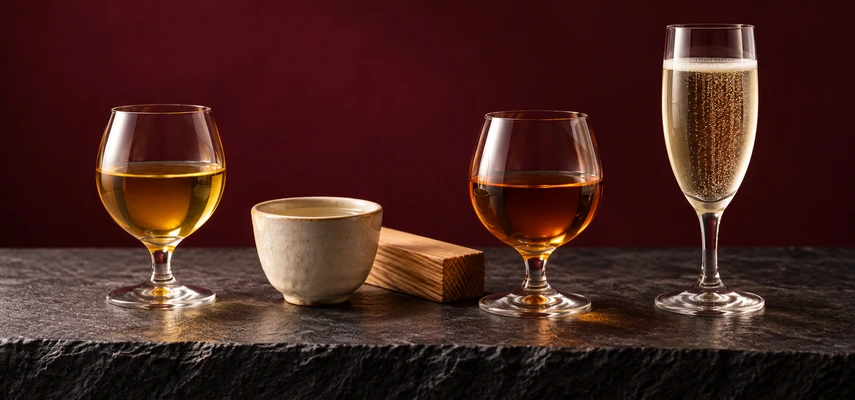

Sparkling sake makes the breadth of sake immediately visible, but bubbles are only one route away from a familiar clear, still expression. Kijoshu changes part of the brewing liquid. Taru-zake gains wood-derived character. Koshu develops through maturation. Each asks a different production question, and each can produce more than one sensory result.
These terms aren’t four extra rungs above daiginjo. They describe methods or styles that can interact with other production information. A kijoshu may also be matured; a sparkling product may be cloudy or clear. Understanding the mechanism prevents an attractive style name from becoming a promise about sweetness, alcohol strength or quality that it cannot keep.
Kijoshu uses sake in place of some brewing water
In kijoshu production, part of the brewing water is replaced with sake. The alcohol and other components in that sake change the mash environment compared with adding the same quantity of plain water. This is a production choice during brewing, rather than simply mixing two finished bottles immediately before service.
Daishichi’s production account and Hakkaisan’s kijoshu description both confirm the central substitution. They also illustrate why a producer account is valuable: the shared principle doesn’t force every brewery to use an identical starter, fermentation course or maturation strategy.
The resulting style is commonly rich and sweet. Introducing sake changes alcohol conditions during fermentation and can affect the relationship between sugar production and consumption. Explain the mechanism with suitable qualification rather than insisting that every yeast population stops instantly at one universal moment.
Sweetness needs balance, not merely quantity
A rich, sweet sake can still feel lively when acidity and other components provide a convincing balance. Conversely, a high sugar impression without enough supporting structure may feel heavy or cloying. The quality question concerns the relationship among components, not whether the product succeeds in being as sweet as possible.
Kijoshu can be sold with a youthful expression or undergo maturation. Developed examples may show deeper color and additional aromas, but the production term alone doesn’t establish a dark amber appearance or a specific age. Don’t confuse a frequent presentation with a requirement.
When recommending it with dessert, consider relative sweetness and intensity in the actual pairing. A strongly sweet dish can make a less sweet drink seem sharper or thinner. The useful comparison is between the selected food and sake, rather than a universal declaration that every kijoshu suits every dessert.
Taru-zake gets character from wood contact
Taru-zake is associated with sake rested in wooden casks, particularly Japanese cedar in the familiar style. Contact can contribute a distinctive woody aroma. Kikumasamune’s taru account provides a direct example centered on Yoshino cedar character.
Don’t import an oak-wine explanation automatically. Cedar isn’t simply another name for toasted oak, and taru-zake doesn’t require the vanilla-and-toast profile a reader might expect from some other barrel-aged drinks. Describe the actual woody character instead of borrowing a tasting note from an unrelated beverage.
The wood contribution can be obtained without years of storage. Contact time, wood condition and the intended expression matter. A cask-rested product and a long-matured product therefore answer different questions, even when a particular sake combines the two histories.
A bottle can retain cedar character after leaving the cask
Taru-zake doesn’t have to be served directly from its maturation vessel. It can be transferred and sold in a bottle while retaining wood-derived aroma. The package visible to the customer isn’t necessarily the container that supplied the character.
This is useful in blind tasting. A cedar-like note may support wood-contact reasoning, but the taster shouldn’t invent the cask size, exact contact period or producer. A plausible category inference is different from reconstructing a detailed production record without evidence.
Quality still requires assessment of the whole. Strong cedar can be appropriate, but it should interact convincingly with the palate and finish. A prominent recognizable aroma isn’t enough to establish balance, length or complexity, and a subtler expression isn’t automatically less successful.
Koshu develops through maturation
Koshu refers to aged sake, with substantial variation in the way producers pursue development. Time, temperature, composition and other storage conditions affect the result. Warmer maturation and cooler maturation need not create the same color or aromatic expression over an equal period.
WSET’s current overview explicitly notes that koshu has no legal minimum maturation period. This matters because older general guides sometimes present a fixed age as if it governed every use. Distinguish a producer or organization’s convention from a universal legal definition.
Development can bring aromas reminiscent of nuts, dried fruit, caramel or savory foods, with deeper color in some examples. A pale, cool-matured expression need not imitate a dark amber one. The category gives a reason to investigate development, not permission to fill in the same descriptors for every sample.
Maturity and damage are different judgments
An aged style can be balanced and complex; unwanted deterioration can also produce developed notes. Decide through the intended expression, condition and full sensory evidence. The mere presence of color or a nutty aroma doesn’t settle whether a sake is successful or faulty.
Look at the relationship between sweetness, acidity, bitterness, umami and alcohol. Consider whether developed flavors remain attractive through the finish or become harsh and disjointed. This turns an age discussion into quality reasoning instead of awarding points for the oldest date.
Maturation also doesn’t prove wood contact. A sake can develop in an appropriate non-wood container, while a young taru-zake can show cedar. Keep time-related development and extracted wood aroma separate before explaining a sample that may contain both.
Sparkling sake contains dissolved carbon dioxide
Sparkling sake produces bubbles when dissolved carbon dioxide leaves the liquid after opening and pouring. Carbonation changes texture and can contribute a lively impression on the palate. Its presence doesn’t by itself establish how the gas entered the drink.
The Gekkeikan style guide distinguishes natural carbonation in tanks or bottles from gas injection at bottling. Fermentation-generated carbon dioxide can be retained, or carbonation can be introduced through another controlled route. The word sparkling alone doesn’t confirm a specific method.
A primary fermentation study demonstrates yeast-generated carbon dioxide in a sparkling sake containing yeast cells. It is evidence of one production route, not proof that all commercial sparkling sake must contain live yeast or remain cloudy.
Carbonation is not a complete style specification
Sparkling products can differ in sweetness, acidity, alcohol strength, clarity and aroma. Some are relatively light and approachable; others are drier or more substantial. Don’t use the bubbles as a shortcut to low alcohol, just as you wouldn’t assume every sparkling wine has the same composition.
Cloudy sparkling sake combines two pieces of information: retained material and carbonation. A clear sparkling sake lacks the first visible feature while sharing the second. Pasteurization history is another separate question, requiring its own production information and handling guidance.
In tasting, record mousse or the character of the bubbles where relevant, but don’t let texture distract from balance. Attractive carbonation should be considered alongside sweetness, acidity, alcohol and flavor persistence. A dramatic initial fizz can coexist with a simple or short palate.
Handle pressure with product-specific instructions
Keep sparkling sake at the temperature recommended by its producer and read opening guidance before disturbing the bottle. Avoid shaking, particularly where fermentation or retained solids may complicate opening. Packaging and pressure levels vary, so one improvised ritual shouldn’t be prescribed for every product.
Service temperature also affects perception. A well-chilled product may open and present differently from a warm bottle, while excessive chilling can mute aromatic detail. Follow the product guidance and evaluate the actual result, keeping practical opening control separate from a claim that all styles taste best at one exact temperature.
Compare mechanisms before assigning names
For revision, give each style a one-sentence cause-and-effect chain. Sake replacing some water changes the brewing environment and supports a rich sweet kijoshu expression. Cedar contact supplies wood-derived character. Maturation permits development under chosen conditions. Dissolved carbon dioxide supplies sparkling texture.
Then add one limitation to each chain. Kijoshu isn’t necessarily old; taru-zake isn’t necessarily long-matured; koshu isn’t necessarily dark; sparkling isn’t necessarily sweet or cloudy. These qualifications aren’t evasions. They identify the boundary between a sound explanation and an unsupported guarantee.
Finally, imagine selecting a tasting flight to show these differences. Keep sample size modest, provide the relevant serving conditions and compare what each method changes. A particularly sweet aged kijoshu could illustrate two production dimensions at once, but it wouldn’t isolate either variable. Include clear notes about that overlap so the exercise teaches interpretation rather than pretending to be a controlled experiment.
When recording the flight, keep the serving order in your notes. A rich sweet sample can affect how a delicate dry sample tastes immediately afterward. Rinse, allow time and revisit comparisons where needed. This improves the evidence without pretending that the palate is an unchanging measuring instrument.
Include a nigori-zake in the specialty flight as a contrast in retained material, alongside the sparkling, taru-zake, koshu and kijoshu examples. Its cloudiness does not require sweetness or bubbles. Follow the producer’s handling guidance, record the actual texture and palate, and distinguish this visible production dimension from the other specialty mechanisms.
Connect the specialty expression to maturation and vessel choices, then assess it through systematic tasting. Its place at the table depends on the actual profile, as the pairing exercises demonstrate.
One-page revision summary
Kijoshu substitutes sake for part of the brewing water; taru-zake gains wood-derived character; koshu develops through maturation without a universal legal minimum age; sparkling sake contains dissolved carbon dioxide from a production route that needs confirmation. Explain sensory possibilities, recognize overlapping terms and assess the actual balance and quality instead of treating the name as the conclusion.
Written practice: original TFE exercises
These suggested marks and indicative points are independent teaching guidance, not official WSET marking schemes.
Exercise 1: 5 suggested marks
Compare kijoshu and koshu, explaining how the two descriptions can overlap without meaning the same thing. Mapping: Unit 1 LO2.
Indicative marking points:
- Kijoshu replaces part of brewing water with sake.
- This changes the fermentation environment and commonly supports rich sweetness.
- Koshu describes aged sake.
- Maturation conditions influence development and no universal legal minimum age applies.
- A kijoshu can be matured and therefore combine both descriptions.
Model answer: Kijoshu is made by replacing some brewing water with sake, changing the mash environment and commonly producing a rich sweet expression. Koshu concerns maturation, with development depending on storage conditions and no universal legal minimum age. A matured kijoshu can carry both descriptions, but kijoshu itself does not prove age.
Why it works: It separates a brewing-liquid decision from a storage history, then explains a valid overlap.
Common mistake: Calling kijoshu simply any old sweet sake or giving all koshu a universal legally required age.
Exercise 2: 5 suggested marks
Explain why a cloudy sparkling sake cannot be assigned a complete production method from appearance and bubbles alone. Mapping: Unit 1 LO2.
Indicative marking points:
- Cloudiness supports retained material but does not identify the entire separation process.
- Bubbles indicate dissolved carbon dioxide.
- Carbon dioxide can be fermentation-derived or introduced through another controlled route.
- Pasteurization and residual sweetness need separate evidence.
- Producer instructions should guide opening and handling, without shaking a potentially pressurized bottle.
Model answer: Cloudiness and bubbles establish two observations, not a complete production record. Retained material can explain turbidity, while dissolved carbon dioxide can come through different carbonation routes. Neither observation proves heat history or sweetness. Check the actual product information and follow its opening instructions rather than shaking it.
Why it works: The response distinguishes observations, possible mechanisms and handling advice without inventing an exact method.
Common mistake: Assuming every cloudy sparkling sake is live, sweet, low-alcohol and bottle-fermented.
Knowledge check: 10 original practice questions
Independent TFE questions, not official WSET examination items. Choose one answer per question; explanations follow separately.
1. Which quality conclusion is defensible?
2. Which factor helps explain differing koshu expressions at equal age?
3. What is the universal legal minimum age for the koshu term in this overview?
4. Which statement about kijoshu is most careful?
5. What is the central kijoshu production choice?
6. What directly produces sparkling texture after opening?
7. Which carbonation routes are possible?
8. Why does cedar aroma not establish long maturation?
9. Which is associated with familiar taru-zake character?
10. What should be checked before opening potentially pressurized sake?
Answers and explanations
1. C — Assess balance and other sensory evidence within the intended style.. Style information guides interpretation while quality still requires evidence from the actual sample. Mapping: Unit 1 LO2 Range 2; LO1 Range 4.
2. C — Maturation temperature and starting composition.. Time interacts with conditions rather than functioning as a direct sensory measurement. Mapping: Unit 1 LO2 Range 2; LO1 Range 4.
3. B — There is no universal legal minimum age.. Distinguish individual conventions from a legally universal requirement. Mapping: Unit 1 LO2 Range 2; LO1 Range 4.
4. C — It commonly shows richness and sweetness, but its age and full profile require more information.. A brewing principle does not establish every later finishing and maturation decision. Mapping: Unit 1 LO2 Range 2; LO1 Range 4.
5. B — Replacing part of brewing water with sake.. The substitution changes the brewing environment and is distinct from finished-product blending. Mapping: Unit 1 LO2 Range 2; LO1 Range 4.
6. A — Dissolved carbon dioxide coming out of solution.. The observation does not by itself identify the route through which carbonation was achieved. Mapping: Unit 1 LO2 Range 2; LO1 Range 4.
7. D — Fermentation-derived carbonation or controlled gas addition, according to the product.. The broad style term does not confirm a single required production method. Mapping: Unit 1 LO2 Range 2; LO1 Range 4.
8. D — Wood contact and time-related development are separate variables.. A relatively young cask-rested product can show wood aroma without a developed koshu profile. Mapping: Unit 1 LO2 Range 2; LO1 Range 4.
9. A — Japanese cedar contact.. Wood-derived aroma can remain after transfer from a cedar cask into another package. Mapping: Unit 1 LO2 Range 2; LO1 Range 4.
10. B — Producer storage and opening instructions.. Product-specific guidance matters because carbonation and retained solids can vary. Mapping: Unit 1 LO2 Range 2; LO1 Range 4.












